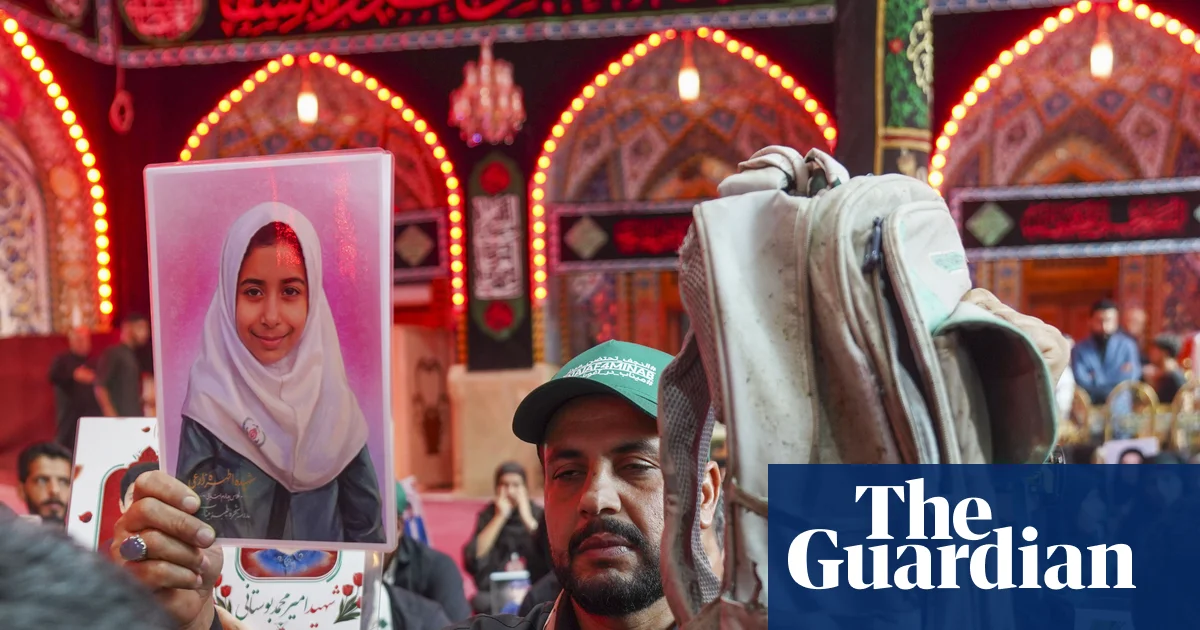
The attack on a girl's elementary school in the Iranian town of Minab was one of the US military's deadliest civilian bombings in decades. But nearly four months on, the Pentagon has produced no answers about why the military fired a Tomahawk cruise missile into a school on the first day of the war, killing at least 175 people, mostly children. This was reported by Qazaqyia.kz citing The Guardian.
Some critics doubt that the Pentagon ever will, or will bury the results under classifications to keep the worst mistakes secret from the public.
As the US signs a shaky memorandum of understanding on a ceasefire with Iran, the secretive investigation into the attack has also become a test case for the self-styled secretary of war Pete Hegseth's new approach to what he calls "warfighting". As he said in early March, nearly two weeks after the attack, "our rules of engagement are bold, precise and designed to unleash American power, not shackle it".
Shortly after the attack, Donald Trump suggested that it was carried out by Iran. When it became clear that the strike used a US-made Tomahawk missile, he suggested that Iran also had access to the cruise missiles. It does not.
As he celebrated a ceasefire deal to open the Strait of Hormuz last week, Trump signalled he was ready to write off the attack as a mistake. "It's such a strange question to be asked at this date, because you're talking about a long time ago," Trump said when he was asked about the investigation during a press conference at the G7 in Évian-les-Bains, France. "But nobody did that on purpose."
It was at the beginning of what Trump has taken to calling a "little excursion" into Iran – that the back-to-back or "double tap" strikes on the school building took place, killing mainly children under the age of 12. Officials have told media anonymously that the site was believed to be an Islamic Revolutionary Guard Corps (IRGC) base.
Mohammadreza Ahmadi Tifakani lost two children in the school bombing. His seven-year-old daughter, Hanieh, was killed, along with all of her classmates in the girl's section of the school when the first missile hit. According to witnesses, her 10-year-old brother, Sobhan, had survived the initial explosion, but ran back to look for his sister. He was killed in the second blast. "I personally went to the morgue and identified both of them," Tifakani told the Guardian in an interview shortly after the attack. "Sobhan was missing an eye, and half of his face was gone. His legs were broken. Hanieh's skull was fractured, but her face was intact. I recognised Sobhan at first glance, even though he was severely injured."
"Mistakes are made," Trump said last week. "The war is nasty."
Several former Pentagon and national security officials expressed doubt to the Guardian that the US government would take responsibility for the deaths of the schoolchildren in Minab – or even release the full report into the attack. "It's very rare that you would have a military operation and not have some incidents where there was a mistaken target and civilians are harmed or killed, but then there is a system for investigating, assessing accountability, and taking responsibility" in those cases, said one former senior Pentagon official. "Even without the civilian harm mitigation office, there's a very clear process for this, and I'm very doubtful that the Hegseth Pentagon will follow through," the former official added.
As part of Hegseth's "anti-woke" crusade at the Pentagon, the military has shuttered or reduced units meant to review civilian casualty incidents and more broadly indicated that decisions made in combat by "warfighters" would not be subject to such close scrutiny. The incident is comparable to some of the worst mass-casualty incidents of past US wars, including the 2017 Mosul airstrike that killed at least 105 and perhaps more than 200 civilians, the 2015 Kunduz hospital airstrike that killed 42 people, and the 1991 Amiriyah air-raid shelter bombing that killed more than 400 Iraqi civilians who were sheltering during Desert Storm.
Trump said last week that the investigation was continuing. US Central Command, when asked about the investigation, gave no new information. "We have no updates at this time," a defence official wrote.
But media reports indicate that the investigation has concluded. Preliminary results said the attack came because of the US using seven-year-old targeting data that failed to indicate that the building next to an IRGC base was in fact a girls' school. The New York Times reported last week that at least one analyst had alerted a colleague several years ago that the US appeared to be targeting what was now a school in Minab. But the targeting data was not updated, and military officials continued to revalidate the site as a legitimate target for bombing.
Tifakani said at the time he had little hope of accountability from US investigations or the world. Asked what message he had for legal institutions or investigators into the bombing, he said: "They are witnessing everything themselves. We saw what happened in Gaza..."