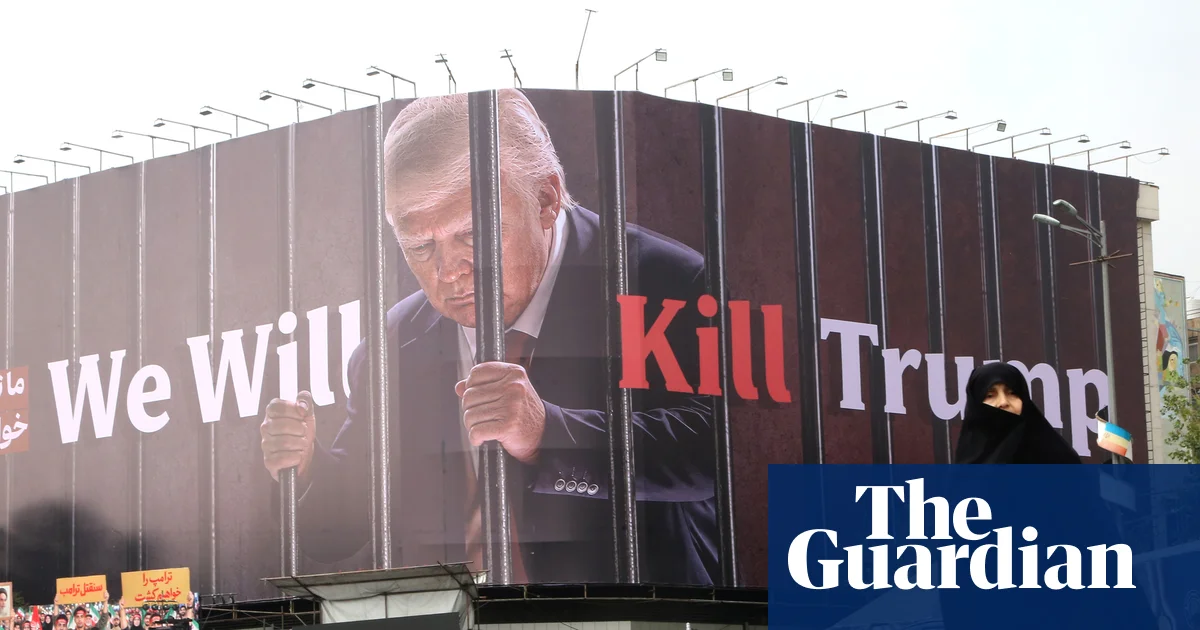
Iran this week unveiled a massive new billboard and banners over Enqelab Square in central Tehran. The billboard pledged in English: “We will kill Trump” – elevating the degree of personal animus with which Donald Trump is viewed in official Iranian circles. This was reported by Qazaqyia.kz citing The Guardian.
The poster depicts the US president behind bars with his head bowed. And in a sense, given the US midterm election results on Tuesday, Iran has indeed killed Trump, or at least the second term of his presidency. Trump’s reverse is all the more piquant because it comes on the day Iran’s leadership celebrates the anniversary of the seizure of the US embassy in Tehran in 1979, an event that ensnared Jimmy Carter, and a reminder of how Iran has ruined the prospects of more than one US president.
Not surprisingly, the keenly followed election results have led to a good degree of triumphalism inside Iran.
Ehsan Movaheidian, an international relations scholar, claimed: “The Islamic Republic of Iran has succeeded in regime change in America. The same will soon happen in Europe as well. Bow down before the power of Iran.”
Meisam Zohurian, a conservative member of parliament, said: “The joy over the outcome of the US elections has nothing to do with the arrival of this party or the departure of that party. The issue is the aggressor was smeared in the dirt and Iran had an impact on the result.”
Ali Nikzad, the first deputy speaker of the parliament, said: “These electoral defeats are the aftershocks of Trump’s defeat by the Iranian people.”
Iran’s supreme leader said anyone expecting a shift in US policy was “seriously mistaken”, however. “Those who still harbour even the slightest hope that the behaviour of the hegemonic system might change through partisan or factional shifts, or who imagine that making concessions to the United States can dissuade it from hostility towards the Iranian nation, are seriously mistaken,” Mojtaba Khamenei wrote.
Others predicted further electoral defeats for what they considered to be the warmongers in Europe, and the expulsion of US bases from the entire Middle East.
The resistance – or bloody-mindedness – shown by Iran for the past eight gruelling months did allow the strait of Hormuz to become an Iranian-controlled channel through which inflation and high diesel prices were transmitted to the American system. Even Trump himself on Wednesday accepted, and lamented, that the American people had decided the “short-term” pain of inflation was not a price worth paying to prevent Iran becoming a nuclear power.
But the big question now is whether either side will regard these seismic results as a moment to review their diplomatic strategy. Iran’s chief negotiator, Mohammad Bagher Ghalibaf, was quick to call on Trump to accept the wisdom of the American people. On social media he urged Trump to bow to the verdict of America: “Whether driven by conscience or the cost of living, America said no to war and we endorse this message.”
Ghalibaf added: “If the US government betrays the public will in order to serve international paymasters and blackmailers it will learn our ‘no’ comes with a nightmare.”
Yet Iran will also be asked to reflect on the wisdom of war by the Gulf monarchies, and possibly by Russia and China – the latter a country that seems finally to be stirring itself to find a solution to the blockade in the strait of Hormuz that is preventing badly-needed Middle East oil exports from reaching its industries.
China tends to knock only on doors that it knows are going to open, so it is probably testing the feasibility of a deal in which Iran “downblends” – or dilutes – its stockpile of highly enriched uranium inside Iran under international supervision. A Chinese special envoy is travelling to Oman, Iran and Saudi Arabia almost immediately.
These countries, some sympathetic to Iran’s predicament, can point out that if Tehran ever thought in the run-up to the elections Trump would capitulate and turn his carrier fleet around, it was mistaken. Some Iranian diplomats had indeed hoped that the prospect of defeat in the midterms, and pressure from within the Republican party, would have led Trump to make concessions to Tehran.
In fact, both sides and the chief mediator, Qatar, clearly did try to use polling day as a lever, but in the end neither side retreated. Trump, for once, was true to his word and refused to allow the darkening opinion polls to reduce his determination to keep Iran in his vice. Confined to a holding bay of “neither war nor peace”, Trump’s priority was to keep the oil price as low as possible.