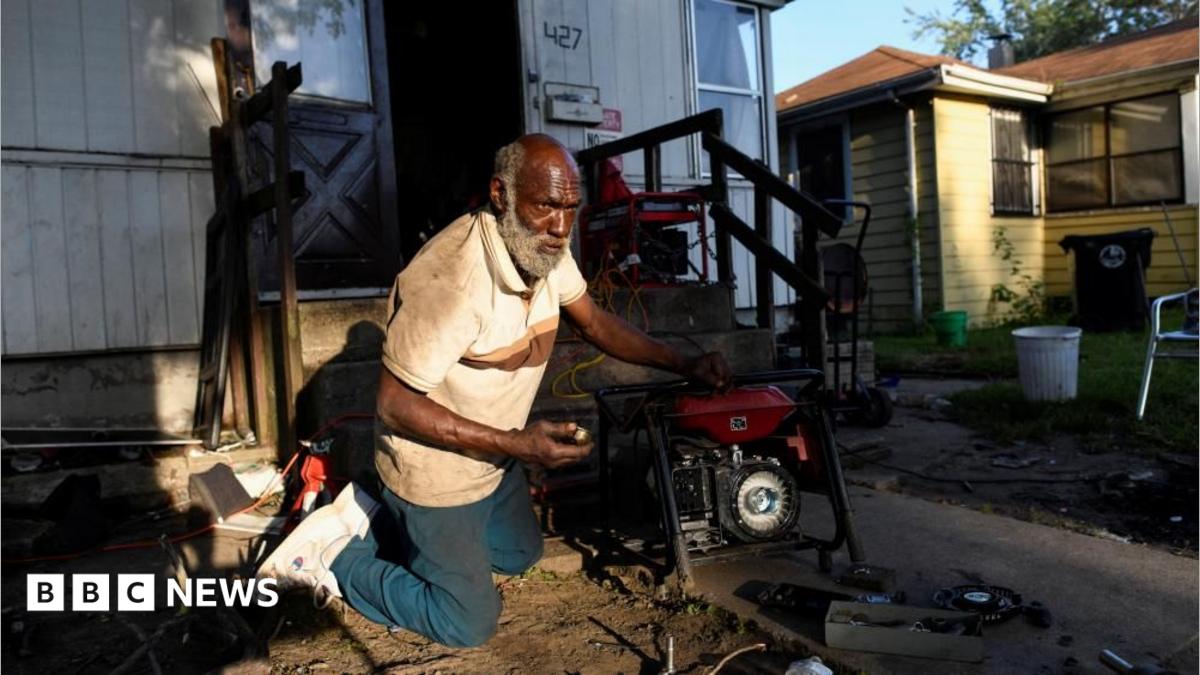
Nearly 30,000 residents in Indiana remain without electricity 12 days after a devastating storm. This was reported by Qazaqyia.kz citing BBC News.
Terry Dubois, 77, is one of tens of thousands of people still without power nearly two weeks after a damaging storm struck her town. She has been relying on friends to bring her non-perishable food to eat. Her son brought her a power bank so she can charge her phone and keep in touch with the outside world. Thankfully, the summer heat hasn't been too punishing, Dubois said, meaning she has not missed her air conditioning too much.
"I've never seen a storm like that in my entire life. Never, never," she tells the BBC. "It was like a sheer wall of wind," she recalls.
A wave of sudden, severe storms brought flooding and tornadoes to the US Midwest on 11 August, including to Chicago and Indiana, where seven people were killed. The former industrial town of Gary, which runs along the southern shore of Lake Michigan, was hit particularly hard. Wind gusts peaked at 99mph (159kmh), according to the National Weather Service.
The worst of the storm only lasted five to 10 minutes, but the impacts are lingering 12 days later. Power has been restored to more than 345,000 customers since the storm struck, but almost 30,000 were still without power as of Sunday morning, according to the area's electrical company Northern Indiana Public Service Company (Nipsco).
In the first few days after the storm, petrol stations, supermarkets and pharmacies were without power, leaving people to survive on what they had. As the outage stretched into a second week, global food charity World Central Kitchen arrived to help people without access to food.
Power outages are not out of the ordinary for this part of the US. But outages that last more than a week are uncommon. Once home to the world's largest steel mill, the former industrial heartland of Gary has felt the outage on many fronts. One third of its roughly 70,000 residents live in poverty, according to US Census data.
As well as dealing with storm-damaged properties, residents of the former industrial town have struggled to source food and maintain good hygiene. There have also been reports of people unable to refrigerate medication and a wheelchair user crawling down their stairs in the absence of working lifts. At night, some roads have been "pitch black" without working street lights, Gary resident Kyle Allen tells the BBC.
Allen has faced shorter power outages before, but this experience has been different as he has started caring for his 95-year-old father. As a result, he bought a generator which has been sustaining him and his father since the power failed.
Shatiya Hardin, meanwhile, said the situation has been "absolutely horrible". "At night we're sweating, we're irritable, we have children to look out for, elderly people who need electricity for oxygen tanks," she told the BBC's US partner CBS. "It's not OK for us to continually be in survival mode."
Amid mounting frustration, local residents have launched a class-action lawsuit, accusing the utility company Nipsco of failing to manage the trees which brought down the power lines in the storm. In the lawsuit, resident Jack Tipold said he was in the middle of dental surgery when the power failed. He said he was forced to abandon the procedure and was discharged without adequate pain medication. "I had all my teeth removed, and no medication for 48 hours. Let me tell you something, it was a struggle," he told CBS.
Nipsco has denied wrongdoing and said it would "vigorously" defend itself in court. Faith leaders alarmed by the ongoing outage held a press conference on Saturday outside a local church.