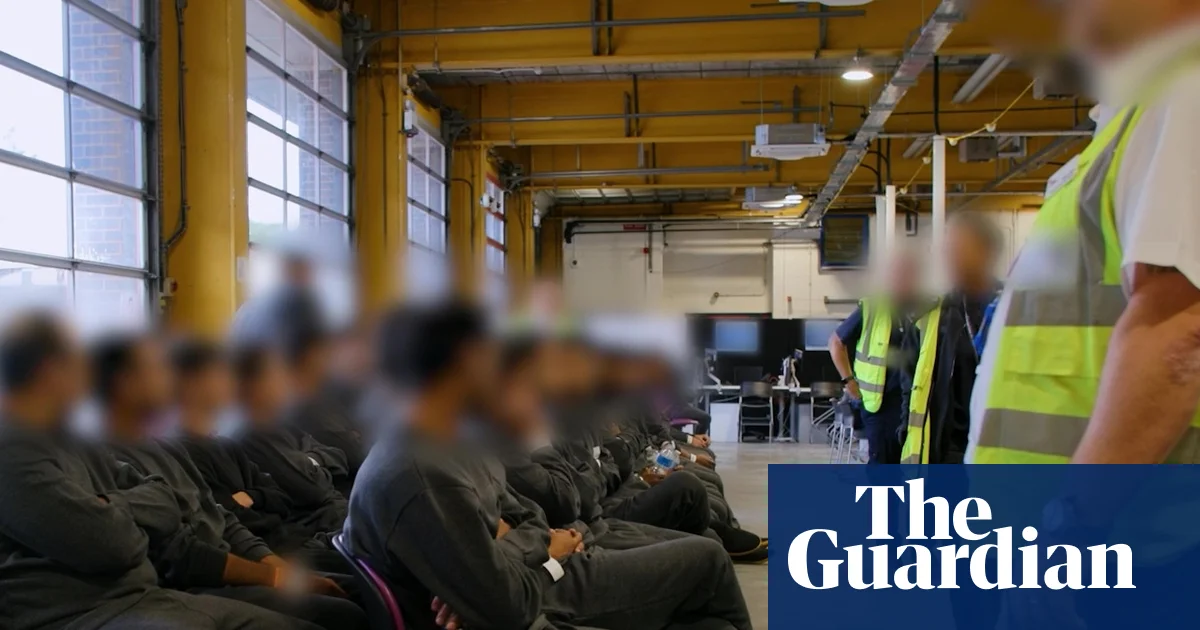
Staff at an immigration detention centre wore England flags pinned to their uniforms while guarding migrants, a report from the prisons and detention watchdog has revealed. This was reported by Qazaqyia.kz citing The Guardian.
The Independent Monitoring Boards' national annual report, published on Wednesday, is based on 127 annual reports about different prisons, young offender institutions and immigration detention centres. It raises concerns about the wearing of St George's Cross flags by staff at one of the Home Office's short-term holding facilities.
The report from the interim IMB chair, Jane Leech, notes that the flag has become closely associated with far right and anti-migrant activists and groups including Raise the Colours. "The board felt this risked perceptions of bias or even intimidation among detained people, especially in the light of recent immigration protests in which flag displays were prominent. At a minimum the board concluded it raised concerns about professional standards and workplace culture," it said.
The report is damning about the state of prisons, immigration detention centres and young offender institutions, finding a "consistent and deeply troubling picture" where "longstanding failures are not being resolved but are instead being compounded".
On immigration detention centres, the report finds "a troubling picture of systemic failings across immigration detention that continue year after year, exposing detained people to avoidable harm while falling short of the minimum standards that are meant to be upheld in detention."
The report provides the first overview from a watchdog about the Home Office's controversial one-in-one-out scheme to forcibly return some small boat arrivals back to France, in exchange for a similar number being brought legally from France to the UK. Of particular concern is the unlawful detention of children for this scheme. According to the terms of the one-in-one-out agreement, lone children must not be part of it. At Gatwick immigration removal centre, 12% of those detained for one-in-one-out were age disputed, with 20% of that group later found to be children, "indicating serious safeguarding gaps". IMB found the figure to be "a strikingly high rate".
The criteria for who the Home Office selects from small boats to return to France is kept secret and is currently part of a high court challenge. Board members said they were told selection was "random by design in order to undermine smuggler operations."
Access to healthcare was also criticised, with an example cited of a detainee having to wait one month to get treatment for a broken finger, while another waited three hours for a medical response after a suspected stroke. At Gatwick immigration removal centre, detainees were told they could not receive hospital treatment unless they agreed to be handcuffed, a practice the board considered to be "coercive".
In the prison estate, illicit drug use continued to be the biggest destabilising force. At HMP High Down, 13 medical emergencies were recorded in one day, largely due to drugs. Spider infestations were so serious at HMP Bullingdon that three prisoners were hospitalised with spider bites, with one so seriously affected he was told by medics that he might lose his leg.
At Feltham Young Offenders Institution, 50 weapons were found among 100 boys in August 2025. Some boys in the centre self-isolated due to fear of others, and at times it was so cold some boys slept in coats.
Leech said: "The evidence available to us strongly suggests that many of these longstanding issues are not only unresolved but are becoming more acute. This is not a moment for complacency. It is a moment that requires honesty about the deterioration of conditions, and confidence in the evidence. The Home Office must exercise stronger oversight and clearer accountability in how detention is used in practice."
A Home Office spokesperson said: "We do not accept this report's findings. We accept nothing but the highest standards of safety, welfare provision and staff behaviour for those in our care. This government inherited an under-resourced detention estate from the previous government. Since taking office, we have made significant improvements, including increased staffing levels and refurbishment of our facilities to improve conditions and safeguards."
The minister for prisons, probation and reducing reoffending, James Timpson, said: "We have seen positive improvements across the estate thanks to strong leadership but we know more needs to be done. Whether it's keeping the public safe by creating 3,000 more prison places, investing over half a billion in vital maintenance and security."