The latest Guardian Essential poll shows opposition leader Angus Taylor's approval rating has crashed and One Nation's primary vote has plateaued. This was reported by Qazaqyia.kz citing The Guardian.
But it is not all smooth sailing for Labor, with Australians rubbishing the government's handling of the inflation and cost of living crisis.
Australians have also shown their reluctance to embrace new AI datacentres, with less than a third saying they would be happy to have a facility in their local area and sharing concerns about energy demands, water supply, environmental impacts and noise.
The Guardian Essential poll, of 1,060 voters last week, found One Nation's popularity was continuing to level off, attracting a 25% primary vote, down one point from June's poll. Meanwhile, Labor's indicative primary vote ticked up one point to 31% and the Coalition's vote dropped further, down another point to 22%.
All those movements are within the poll's margin of error, but it is the second consecutive Essential poll where One Nation's primary vote has dropped since reaching a high of 28% in May. The populist right-wing party has dipped back to where it was in April. It comes after weeks of scrutiny over Pauline Hanson's European trip, her interview with Tommy Robinson, and comments about domestic violence and immigration policy.
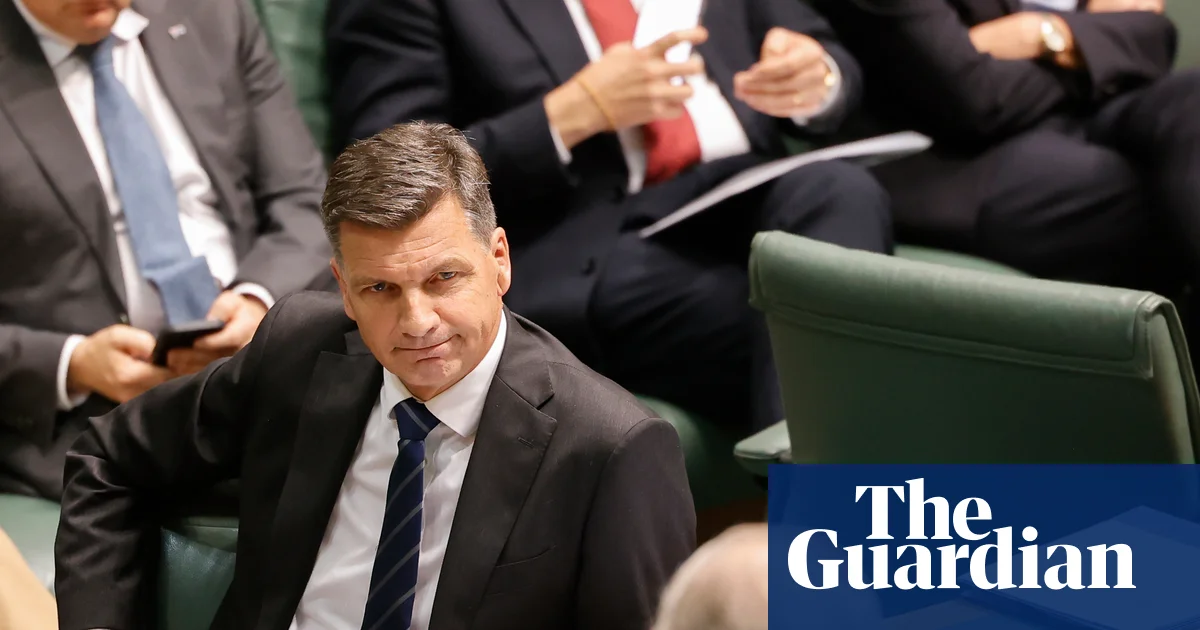
Struggling for political oxygen and attention amidst One Nation's rise, the opposition leader has seen his own approval ratings plummet in the last month. In June, 36% of people approved of Taylor's job performance and 37% disapproved, for a net approval of minus-1; but this month's poll has seen his approvals drop three points and his disapprovals increase by seven points, for a new net approval of minus-12.
Taylor's approval rating has crashed 16 points among men and four points among women, as well as by 20 points among people aged 35-54 and 13 points among those aged 18-34.
Anthony Albanese's approval rating ticked up one point to minus-14, with 38% approving and 52% disapproving of his performance as prime minister. It is the fourth straight month in which more than half of voters have disapproved of his performance.
Respondents to the poll also rejected Labor's handling of the inflation and cost of living crisis, with a decisive 64% rating the government's performance as poor; while just 16% of Australians rated it as good.
Nearly 80% of voters said cost of living and inflation was one of the most important issues to them, far and away the most-cited issue among respondents. Next most-cited was Medicare and health (50%), crime (42%) and immigration (35%).
But only 39% of voters rated the Labor government's performance on Medicare and health as good, with 30% saying poor; on crime, 22% rated Labor as good and 50% as poor, while 24% rated Labor as good on immigration and another 50% as poor.
"Cost of living remains the stand-out issue for voters and the government's handling of inflation is being rated down," the executive director of Essential Media, Peter Lewis, said.
On managing technology and AI, the subject of a major speech by Albanese earlier this month, 29% rated Labor's performance as good and 30% as poor.
The Essential report found only 28% of voters would support a new datacentre being built in their area, with 37% against. Men (34% support and 34% oppose) were far more supportive of new datacentres than women (22% support and 39% oppose).
Asked about their reservations about datacentre development, 61% raised concerns about impact on energy demand and power prices, and another 44% were worried about water supply. Environmental impacts and noise were raised by 41% of voters, while 39% had general concerns about the growth of AI generally.
Albanese this month announced plans to more strongly regulate datacentres and AI, particularly setting rules for power and water use, and building social license for the construction of facilities.