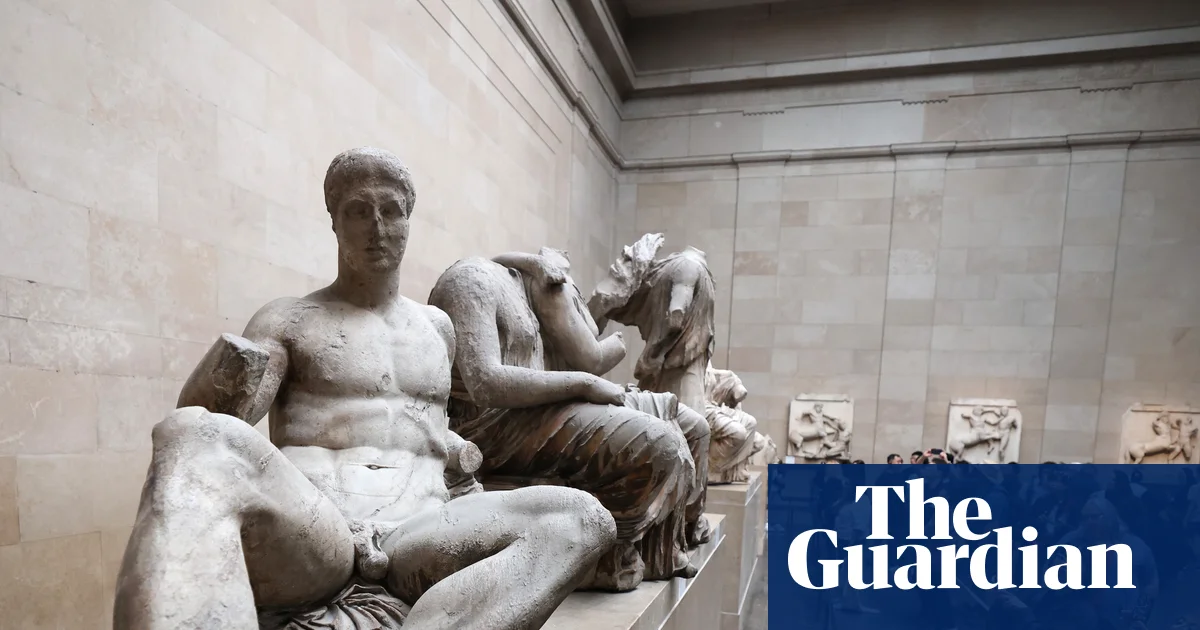
The Greek prime minister has vowed to “ramp up” his country’s claims to win back the Parthenon marbles from the British Museum, emphasising that his UK counterpart, Andy Burnham, was hugely supportive of restitution efforts before he moved into Downing Street. This was reported by Qazaqyia.kz citing The Guardian.
Kyriakos Mitsotakis said he would raise the issue in the strongest of terms when he met Burnham, who was culture secretary in a previous Labour government.
“Unfortunately they have not progressed,” he told a conference in Athens when asked about talks with London over a muted “hybrid” deal to repatriate the fifth-century BC marbles in return for a treasure trove of other antiquities.
“We will very clearly ramp up the intensity of our claims, not just with the British Museum, but also with the British government. I would also like to remind the audience that the new prime minister of the UK, unequivocally, was supportive of the return of the Parthenon sculptures before he became prime minister.”
Mitsotakis also conceded, for the first time, that negotiations with the British Museum, under the aegis of its chair, George Osborne, had failed to make headway.
Upping the ante, he suggested the fate of the artworks was also connected to Burnham’s stated desire for the UK to have closer ties with the EU. Sculpted to adorn a monumental frieze that embellished the Parthenon, the carvings have been split between Athens and London since their controversial removal at the behest of Lord Elgin, Britain’s ambassador to the Ottoman empire, more than 200 years ago.
“For those of us who were saddened to see the United Kingdom leave the European family, we took great interest in the comments made by the UK PM,” said the Greek leader, citing the possibility of “a stronger relationship between the UK and Europe”.
“The Parthenon sculptures will be part of this debate, this is not just an issue for Greece. It’s an issue for Europe.”
The combative remarks come amid thinly disguised disdain in Athens for Burnham’s seeming about-turn on the sculptures. In private, Greek officials have voiced dismay that within days of assuming office, he should so publicly reverse his position, stating in one of his first interviews that the dispute was “an issue for the British Museum” to resolve.
Long seen as an advocate of repatriation, Burnham’s support for the antiquities to be returned to Athens dates back 25 years with officials in Athens seeing his elevation as the best hope yet of finally ending the row.
In 2023, as mayor of Greater Manchester, he appeared to go further than ever before, posting on social media: “Send them back, no strings. And let’s use culture to change how Britain is seen around the world.”
“His change in stance caused great disappointment,” said one well-placed Greek heritage expert who has legally advised successive governments on the issue. “There was more than an element of perfidious Albion about it.”
The British Museum has been home to about 160 metres of the frieze since 1816, when a bankrupt Elgin was forced to sell the marbles in what, even then, was viewed as a controversial acquisition by the British government.
Mitsotakis, whose centre-right administration has sought to refocus the campaign on the idea of reunifying the masterpieces within view of the Acropolis, said on Tuesday that changing attitudes in Britain could not be dismissed.
There was, he said, still room for a “win-win” solution with the imminent closure and renovation of the National Archaeological Museum in Athens allowing gems that had never been seen outside Greece to be sent to the UK in exchange for the sculptures.
“[The marbles] reunification in Athens would also set a precedent for a unique cultural partnership between Greece and the UK, and in particular between Greece and the British Museum,” he said. “I will certainly make the case very forcibly to the British PM when I meet him. I think the time has come. British public opinion supports reunification of the sculptures and I do believe that now is the time to push in this direction.”