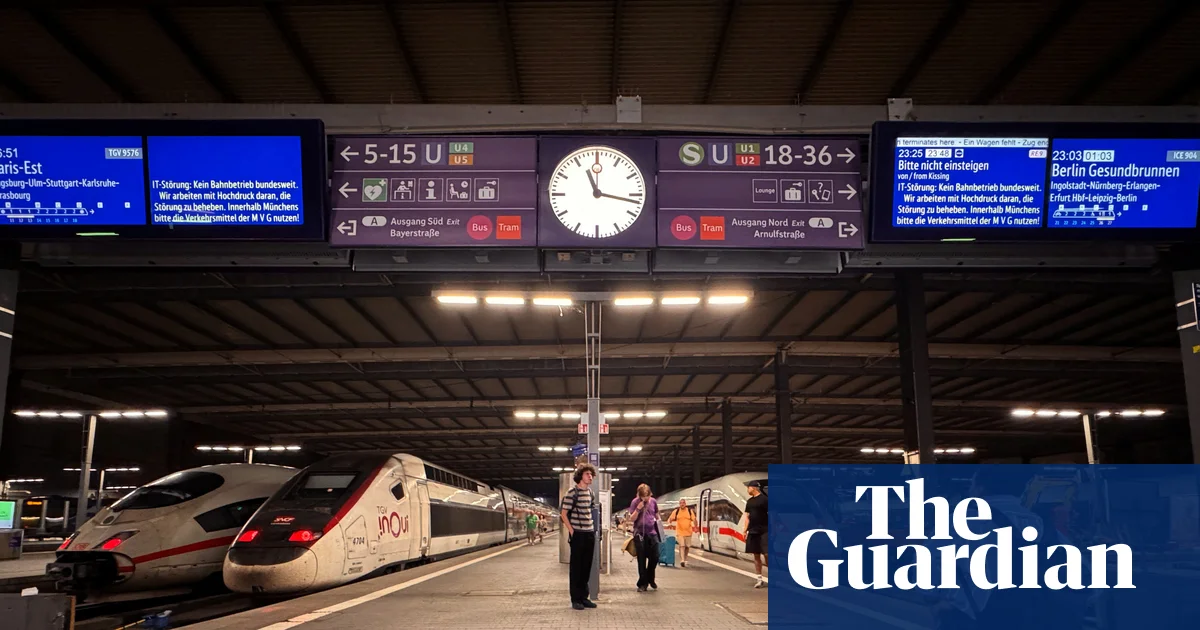
Germany's rail network ground to a halt late on Tuesday as a result of maintenance work that went wrong, leaving hundreds of thousands of passengers unable to get home. This was reported by Qazaqyia.kz citing The Guardian.
The Deutsche Bahn (DB) meltdown was initially thought to have been caused by a cyber-attack, but it later emerged that it was likely triggered by a scheduled attempt to replace an ageing component in the railway's internal communication network, without which the trains are unable to run.
Trains were brought to an abrupt halt as a precaution, leaving many stuck on tracks far between stops or standing in stations. Passenger and freight trains were affected.
A system reset was carried out after two hours, in the early hours of Wednesday, but undoing the chaos took much longer.
The railway operator delivered a grovelling apology on Wednesday. "We are analysing the exact cause of the disruption meticulously and with the highest priority, to ensure that the same problem can't recur," said Philipp Nagl, the chief executive of DB InfraGO, the state-owned company responsible for railway infrastructure.
"Currently it appears the cause of yesterday's disruption to the GSM-R digital radio system was the planned replacement of a technical component."
The nationwide chaos comes on the back of years of mounting problems with the railway, including frequent delays, cancellations and interruptions. Once the envy of the world, and a byword for efficiency and punctuality, DB has faced growing problems caused by underinvestment and overcapacity.
Punctuality stood at just 59% in February, compared with 66% a year ago, with one in three long-distance trains arriving late. At its height in the early 1990s, punctuality was about 85%.
As Germany goes through a period in the economic doldrums, the state of the railways is viewed as a bellwether of the country's fiscal and structural standing, and is often listed alongside creaking bridges and dilapidated roads and school buildings as an example of the catchup it needs. A pessimistic mood among the population over whether it can succeed is very palpable.
The rail network is undergoing a multi-billion-euro overhaul which is leading to further frequent disruption on major routes. DB's chief executive, Evelyn Palla, has said any significant improvement was likely to take several years.
The fact that the communications system that broke down is based on 1990s 2G technology used in the first mass mobile phones is reflective of the wider problems. A 5G network is not scheduled to be introduced until about 2035 – leaving the operator scrambling to find and buy up old components around the world, which it is stockpiling to ensure it can continue to fix the system when needed.
DB has unsurprisingly become the focus of the nation's ire and mirth, and the butt of many jokes. Even much of the widespread infrastructure around the rail network is viewed as fragile. Most of the 52 escalators at Berlin's sprawling central station malfunctioned recently and engineers had to be flown in from Finland to fix them.
Europe's biggest economy has a 20,750-mile (33,400km) rail network that carries about 50,000 trains a day, making it Europe's biggest and busiest.
DB was converted from a state administrative organisation into a private joint-stock company in 1994. The German government has always kept its 100% equity stake in the company.
There were angry reactions across the political divide to the latest chaos. "That all the rail traffic in Germany ground to a halt because of a technical defect is a new low in what are already poor operating standards," Oliver Krischer, the regional transport minister for North-Rhine-Westphalia state, told local media.