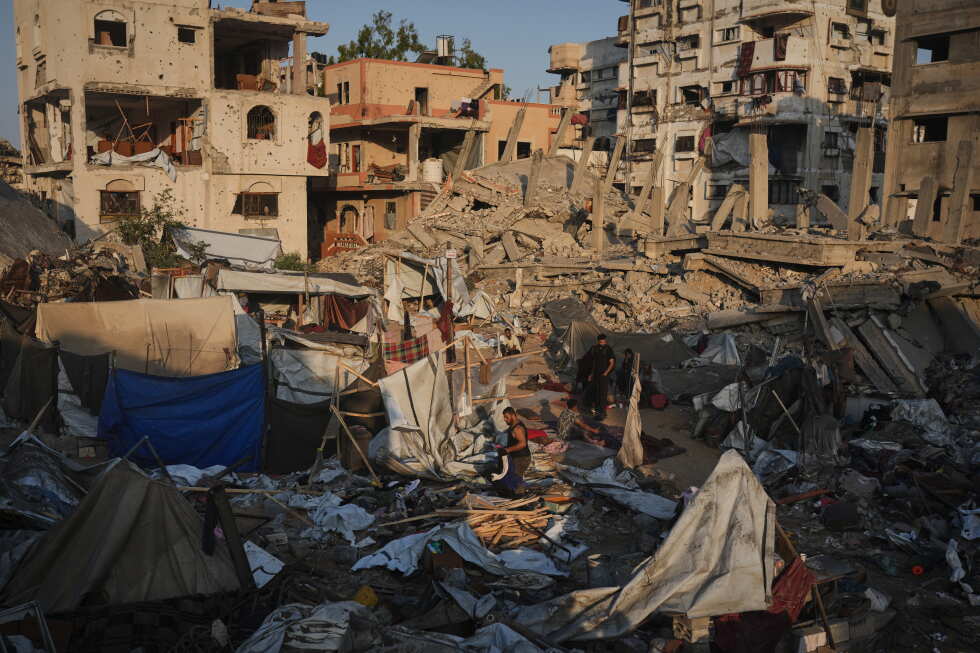
BEIRUT (AP) — Carrying out this week’s agreement for Gaza on the disarmament of the Palestinian group Hamas, Israel’s withdrawal and the transition to a civilian body to run the war-ravaged region will be a major test for the international body established by U.S. President Donald Trump to oversee the ceasefire in Gaza. This was reported by Qazaqyia.kz citing Associated Press.
The agreement announced by Trump late Thursday could pave the way for ending the latest Israel-Hamas war that broke out on Oct. 7, 2023, when Hamas-led militants stormed southern Israel killing over 1,200 people and taking 251 hostages. Israel’s retaliatory offensive in Gaza has killed more than 73,000 Palestinians, including hundreds who perished after a ceasefire went into effect in Oct. 10.
Few places in the Palestinian territory of over 2 million people have been left unscathed, and the United Nations, World Bank and European Union estimate that reconstruction will cost $70 billion.
Hamas officials said the group has agreed to the disarmament agreement. Israel has not commented.
The Board of Peace will have a major role in overseeing the deal’s implementation.
Here’s what the group is and what it is expected to do:
What is the Board of Peace?
The Board of Peace was first mentioned in September when the White House released Trump’s plan to end the Israel-Hamas war in Gaza.
Trump’s 20-point ceasefire plan called on Hamas to surrender its weapons and destroy its vast network of tunnels. It also envisions Israeli forces withdrawing from Gaza, the arrival of a new technocratic Palestinian government, deployment of an international security force and the rebuilding of the battered Palestinian enclave after more than two years of war.
More than two dozen nations signed on as the board’s founding members, including Israel and other regional heavyweights, as well as countries from outside the Middle East such as Indonesia, Paraguay and Vietnam.
Germany, Italy, Norway, Switzerland and the United Kingdom are among more than a dozen countries that have not joined the board but took part in a February meeting as observers.
Israelis are suspicious of the involvement of Qatar and Turkey, which have longstanding relations with Hamas. Earlier this year, Palestinians objected because their representatives weren’t invited to the board, even as it weighs the future of a territory that is home to some 2 million of them.
A $1 billion contribution secures permanent membership on the board instead of a three-year appointment, which has no contribution requirement.
During the first meeting of the board in February in Washington, members pledged $7 billion in aid for Gaza — just a fraction of the $70 billion that international bodies say is needed to rebuild the territory. The board also announced plans for international troops and police, and for reconstruction. But no timeline was given.
The agreement was reached after months of “very difficult negotiations,” Nickolay Mladenov, the director-general of the Board of Peace in Gaza, said in comments posted on X. “There were several points when I did not believe we would make it,” he added.
Mladenov, a former Bulgarian defense and foreign minister who served as the U.N. envoy to Iraq before being appointed as the U.N. Mideast peace envoy from 2015-2020, added, “Implementation and verification have to be real” and “withdrawal must move in lockstep with decommissioning.”
The National Committee for The Administration of Gaza, a Palestinian technocratic body that operates under the supervision of the Board of Peace, is tasked with administering Gaza in the interim period after Hamas gives up control. That includes setting up a new police force to replace the one previously run by Hamas and implementing the disarmament.