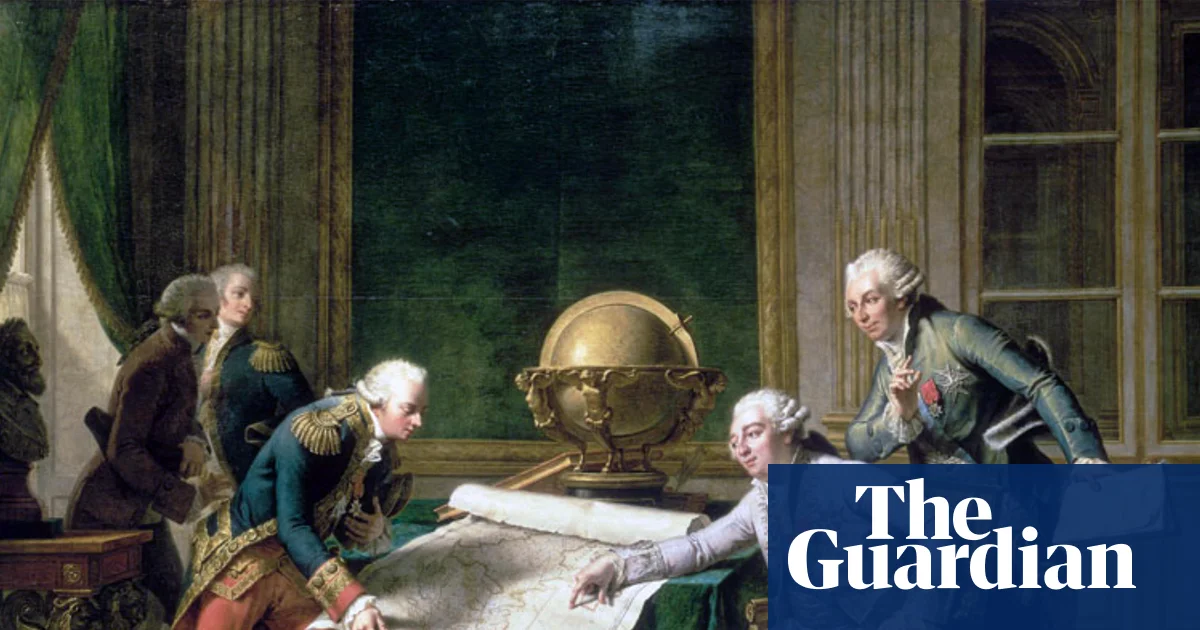
An 1817 painting by Nicolas-André Monsiau shows the French naval officer Jean-François de Galaup (the count of Pérouse), left, receiving orders for a round-the-world mission from Louis XVI. As he prepared to climb the scaffolding to be publicly executed by guillotine on 21 January 1793, Louis XVI is reported to have asked: "Is there news of Monsieur de la Pérouse?" He was referring to Jean-François de Galaup, the count of Pérouse, a naval officer and navigator whom the French king had dispatched in 1785 on a round-the-world scientific mission to rival discoveries made by the English explorer Captain James Cook. This was reported by Qazaqyia.kz citing The Guardian.
The two ships under La Pérouse's command, La Boussole and L'Astrolabe, disappeared three years later after leaving Botany Bay in Australia. The wrecks were only formally identified in 2005 and exactly what happened to them remains a mystery to this day.
Now rare letters written by an illustrious scientist who perished in 1788 have resurfaced, giving a new and personal account of the voyage. They are described as veiled love letters addressed to the married daughter of an aristocratic family, and were discovered hidden in a book of engravings being examined in preparation for auction.
Ludovic Miran, a book and manuscript expert for the auctioneers selling the letters next month, described the find as "a miracle".
"We have a certain number of documents from the expedition but they are almost all scientific, so these personal letters are extremely rare," Miran told the Guardian. "They throw a completely new light on what is in France an extraordinary scientific and historical event."
The La Pérouse expedition was launched at a time when Britain and France were in a period of intense rivalry over colonial expansion. La Pérouse was a great admirer of Cook and his maritime mapping and scientific discoveries, but Louis XVI had more political and trade ambitions. The French wanted to create trade routes and discover whether the secret information they had that Britain was planning to establish a permanent base at Botany Bay, giving it access to unexplored areas of the Pacific region, was correct.
La Pérouse's ships, carrying 225 crew officers and scientists, sailed from Brest on France's Atlantic coast on 1 August 1785 and for almost three years sent reports during stopovers including from Alaska, California, Asia, Russia and Samoa, where the captain of the Astrolabe and 11 men were killed.
At the time of Louis XVI's execution, there had been no news of the frigates since their departure from Botany Bay in March 1788. To La Pérouse's dismay, Captain Arthur Phillip and Britain's First Fleet had beaten him to the Australian coast – inhabited by an Indigenous population for tens of thousands of years – by just six days.
La Boussole and L'Astrolabe are believed to have foundered on coral reefs at Vanikoro east of the Solomon Islands during a tornado a few months later. Wreckage was discovered in 1826 and 1964 but only formally identified in 2005.
The letters were written by Jean-André Mongez, a brilliant scientist, director of an illustrious science revue and church canon who was with the expedition, to Louise Victoria Le Cloustier, the daughter of a minor noble family from Rouen, Normandy.
Miran said Mongez used the letters to express his unhappiness at her marriage and appears to repent for previous bad behaviour. "He writes several times: 'I will be back, I will be another man, a better man'," Miran said. "One has the impression he has not behaved well towards her and she has put him in his place."
This may, he added, have been behind Mongez's decision to undertake such a long and perilous journey. "The references are often veiled, but they seem to have had a very close relationship but he seems to have caused some offence at some point. They are intimate, very personal letters," he said.
"He tells her he is leaving 'a bit for the love of fame and the desire to acquire new knowledge', but he already had scientific glory and a good career and they would have all read James Cook's works before leaving so they knew about the dangers.
"We will never know why he decided to join this perilous journey, but it is clear he was leaving in part because of this emotional relationship."
Miran added: "The correspondence also provides answers as to how these young men endured three years of navigation around the world, a completely new and unimaginable experience. We learn how they withstood the shock of such a crazy journey and horrible conditions.
"He recounts how his friend and others were massacred on one stop. In his last letter he tells her the expedition has taken a sad turn and he now only wants to come home because such unhappiness is not compensated for by the meagre scientific results they have.
"Perhaps it is a journey of redemption."