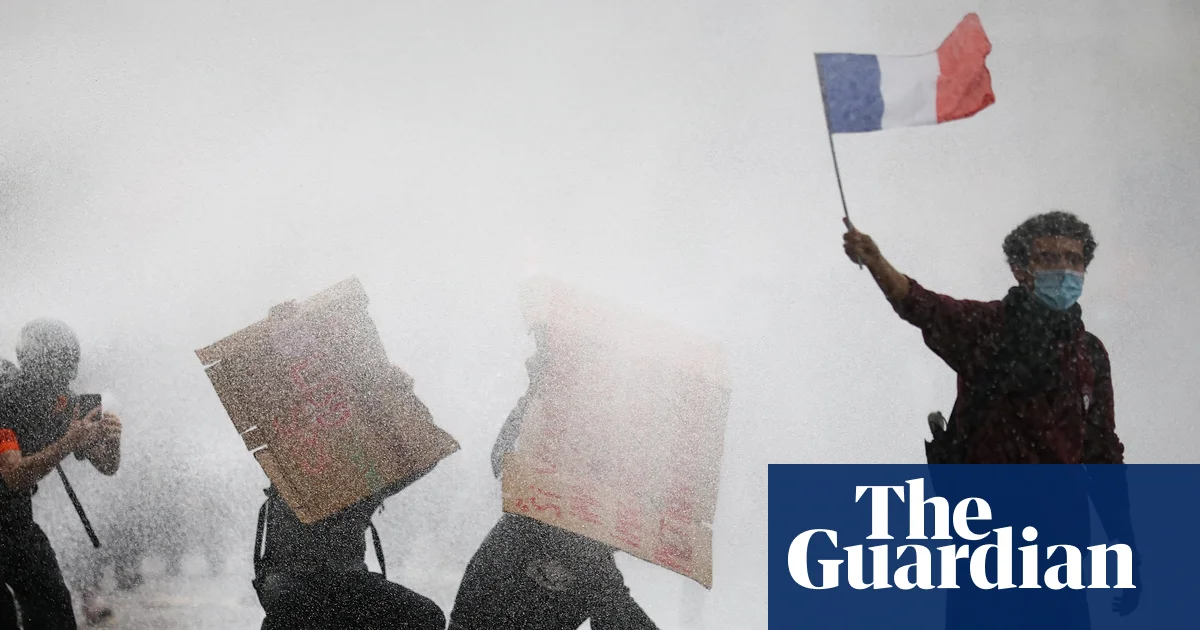
Say what you will about France's high schools, they still produce world-class slogan writers. Here's a brief selection spotted during three weeks of blockades and marches over chronic teacher shortages, overcrowded classes and crumbling buildings: This was reported by Qazaqyia.kz citing The Guardian.
"Pas d'avenir, pas de calme" (No future, no calm). "Diplômés aujourd'hui, précaires demain" (Graduates today, insecure tomorrow). "Vous détruisez notre futur, on bloque votre présent" (You destroy our future, we block your present).
A couple more: "Nos lycées tombent en ruines, comme nos espoirs" (Our schools, like our hopes, are falling into ruin). "On n'est pas mal éduqués, on n'est pas écoutés" (We're not badly brought up, we're just not being listened to).
Spot the common theme? The protests, which continued this week with more than 160,000 on the streets on Tuesday, might be over very material problems – but beneath them there clearly lies an altogether more existential worry.
This was reported by Qazaqyia.kz citing The Guardian.
This generation fears its future will be one of diminishing prospects, poorly paid, unstable jobs, unaffordable living costs and steadily decaying public infrastructure – the end, in short, of the basic socioeconomic security their parents, mostly, enjoyed.
That was the central theme of a 30-second Instagram post I recorded last week with the Guardian's social media team and that, at time of writing, had been watched almost 540,000 times – with young people in France the largest single group of viewers.
The same core concerns underlie youth protests elsewhere – notably, ongoing mass housing demonstrations in Spain, where the twentysomethings of Madrid and Barcelona are in revolt at the monthly rental on a one-bed flat costing an entire monthly median salary.
In France, teenagers in Seine-Saint-Denis, a low-income area in the north of Paris, show reporters pictures of broken chairs and desks, holes in walls, leaking ceilings, mould, shattered toilets and defective audiovisual equipment. Some have gone months without key teachers.
As Kitty Sayers, who went to school in France, explained, France's republic "was born of insurrection and has never forgotten it … The language of rights, citizenship and collective power is woven into French education."
This means that in French schools protest is "taught as a legally framed, fundamental right and a civic responsibility". But the government's response has also been arguably very French: riot police, teargas, baton charges and stun grenades.
More than 250 pupils have been injured, along with about 100 school staff and 750 police. One teen has lost a hand from a stun grenade, another the sight in one eye, a third his teeth. More than 6,000 people – almost all minors – have been detained.
After a public outcry, the interior minister last week suspended the use of stun grenades. But as Alexander Hurst observed, when pupils complain about the state of their schools "and the response is riot police, the government has lost the plot".
If the government hoped public opinion would be on its side, it miscalculated. Teachers' and other unions, parents and university students have marched with the pupils, and a poll this week showed 57% of the public approved of the protests, with 33% opposed.
They come at a particularly delicate time for France's political establishment. Presidential elections to replace Emmanuel Macron are due next spring, and without a parliamentary majority his government is caught in legislative deadlock.
Meanwhile, Marine Le Pen's far-right National Rally and the radical-left La France Insoumise of Jean-Luc Mélenchon are weaponising the protests, the former castigating an out-of-control youth, the latter an out-of-control police, and both blaming centrist incompetence.
Above all, the government's financial room for manoeuvre is all but nonexistent. As Philip Inman pointed out, with a debt-to-GDP ratio and a budget deficit both among the highest in the EU, France has no cash to spare – and the markets are watching.
So while cost-cutting will only provoke more unrest, the absence of it could trigger a boycott of French bonds, or even a default and bailout (although as the economist Paul Krugman says, France "may have crossed from too big to fail to too big to save").
Ultimately, there seems little doubt France will have to make some of the same painful adjustments to bring its debt back under control that Italy, Spain and Greece made a decade or more ago – and to which French public reaction could be dramatic.
We began with slogans; let's end with some. The best-known French youth protest – a revolution, more or less – was, of course, May 1968. Comparing its iconic posters with those of today's demonstrating school pupils is instructive.
In 1968, there was "Sous les pavés, la plage" (Beneath the cobblestones, the beach); "L'imagination au pouvoir" (Put imagination in charge); "L'ennui est contre-révolutionnaire" (Boredom is counter-revolutionary).
Those, you can see, were slogans born out of infinite possibility: a generation that, in overthrowing the old social hierarchies, never doubted its future.