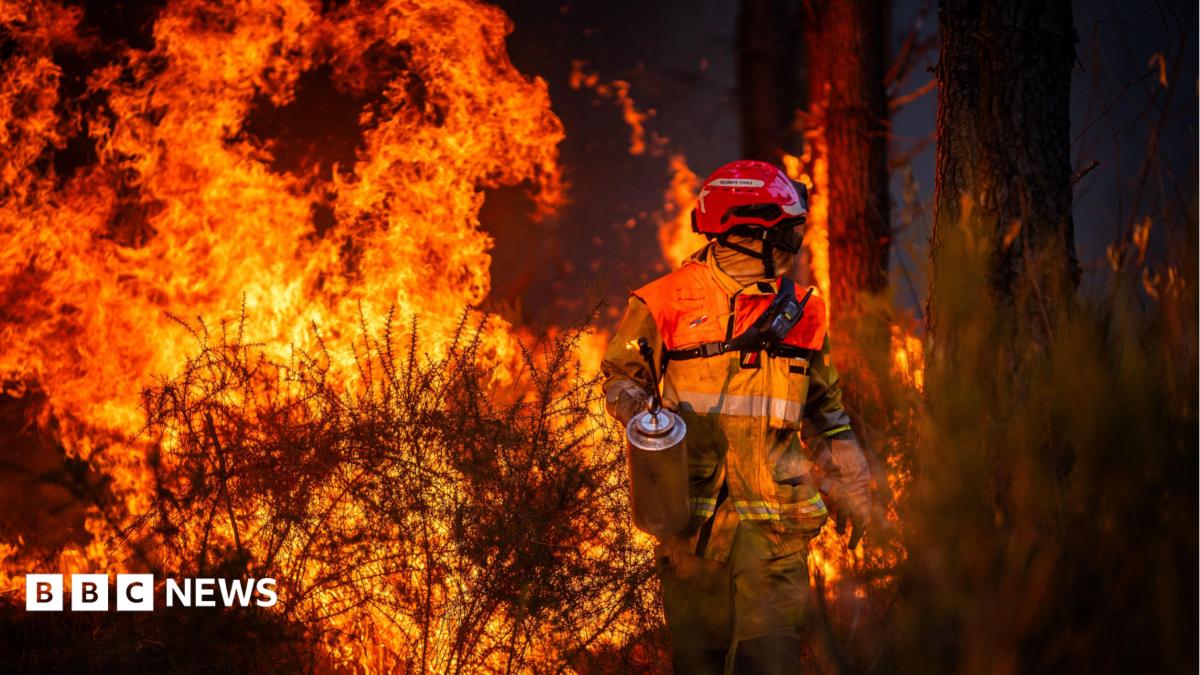
Wildfires in France have caused more damage this year than at any time since World War Two, with over 300,000 acres scorched. This was reported by Qazaqyia.kz citing BBC News.
The interior ministry has announced 420 arrests of people alleged to have started fires deliberately or by accident. Among them are 166 minors.
In one case, a 23-year-old man has been accused of deliberately starting 10 fires in five days in the Var area last month. He faces 15 years in prison and a €150,000 (£128,000) fine if convicted.
Another man received a three-year jail sentence for starting three fires in the Raon-L'Étape forest in the Vosges region, as reported by L'Est Républicain.
However, some prosecutions have been perceived as heavy-handed. A homeless man and someone with severe autism have reportedly been jailed for throwing cigarette butts.
Lawyer Muriel Gestas, who has represented several people accused of arson, including two firefighters, called the number of arrests "excessive." She doubts many will lead to convictions.
Le Monde newspaper also questions how thoroughly police have examined these cases given the short timeframe. The authorities' silence on details prevents meaningful comparison with previous years.
Bordeaux prosecutor Renaud Gaudeul told Le Monde that a tough approach is justified. "The conditions for a charge of endangering lives are met for those who throw a cigarette butt or light a barbecue in wooded areas. It only takes a tiny spark," he said.
Working out how a fire started is not easy. Investigator Eric Dufayet explains that in drought periods, a simple lighter is enough. After a fire is out, he maps its outline and traces back to the point of origin. If the wind is steady, the outline often forms a "V" shape.
"If someone deliberately starts a fire, they may not have used only one device," he says, improving chances of finding DNA or fingerprints.
Experts believe arson accounts for only a small fraction of fires. Most are accidental, from construction work, faulty electrical equipment, cigarette butts, and barbecues.
Dufayet mentions the "30" rule: for a cigarette to start a fire, there must be a temperature of at least 30°C, humidity of at most 30%, wind less than 30 km/h, and at least 30% of the cigarette unburnt. In the current drought, it is even easier.
Professor Michel Lejoyeux of Paris 7 University categorizes fire-starters into three groups: the careless, those who benefit (e.g., from insurance), and pyromaniacs. "The pyromaniac doesn't get money, has no spirit of revenge, has no utility of the fire, but he likes the fire," he says. Pyromania is rare and hard to diagnose.
Lawyer Gestas suggests some firefighters may have started fires to appear as saviours or for financial gain, especially volunteers earning tax-free overtime.
Concerns about wildfires persist. Forecasts indicate another heatwave is days away. President Emmanuel Macron says criticism should not be the priority. "We will have to replant and rebuild a different kind of forest because we must adapt to the structural conditions of climate change," he said.