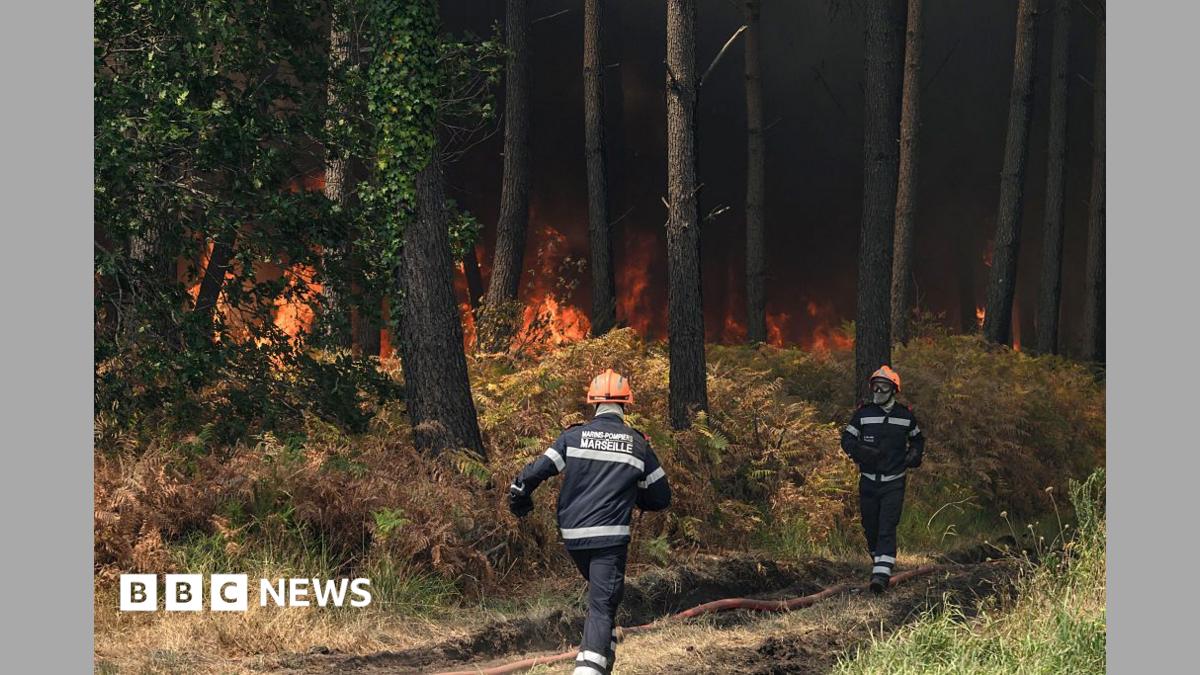
Wildfires in France's southwestern Gironde region have been raging for a week. Firefighters and volunteers are battling to contain the flames in 40°C heat. This was reported by Qazaqyia.kz citing BBC News.
Three Canadair aircraft are dumping water from the air, helping to suppress the fires. They bank towards a thick plume of black smoke and drop more than 1,000 gallons of water onto the flames. Helicopters then follow with streams of red fire retardant.
As the smoke clears, firefighters move into the forest on foot to contain new flare-ups. This is the main concern for the thousands of crews and volunteers combating the wildfires that have forced tens of thousands of residents and tourists to flee.
With temperatures peaking at around 40°C, fires restarting on their own are a constant threat. After about 20 minutes, one fire is brought under control, only for another to suddenly emerge on the opposite side of the road.
"Leave now!" shouts an irritable officer as he drives past. The smoke is becoming thicker and more aggressive. Time to leave.
The scale of the infernos is so vast that it is not always obvious where the smoke is coming from. It simply descends as you travel west from Bordeaux along empty roads and through deserted villages.
The soil is powder-like and covered in endless pinecones and dried leaves. This explains how the wildfires have spread so quickly.
Pierre Alexandre refused to leave his bungalow when firefighters asked him to. He sent his wife and daughter away but allowed his 19-year-old son, Clement, to stay. "I told him: 'Be careful because in front of us is a nightmare, we don't know what will happen,'" explained Pierre Alexandre.
He tried to protect his home but did not believe they could stop the fire alone. "No, we're not firefighters," he conceded.
For professionals, controlling these wildfires is like a lethal game of "cat and mouse" or "Whack-a-Mole". It is an operation of containment rather than cure.
Behind the professionals are an army of volunteers. They drive towards the danger to deliver water or spray it themselves.
"If it's too late, at least we tried," said a defiant Hugo, 26, as he refilled his water tank. "Fifty thousand hectares has already been destroyed, what will we tell our children?"
Hugo grew up in the area and has returned from his home in Bali to watch his mother's house in the village of Arès, which is perilously close to the wildfires.
"It's horrible, it's our home, it's our region, it's our forest, it's where we grew up, it's where our family live, where we live, it's horrible. I feel a lot of sadness," Maëlys, 23, told us, her face covered in soot. "I am a nurse and I'm here to help," she added. Maëlys said her friends own big water tanks, which they then use to try to put out fires that flare-up to prevent them from spreading.