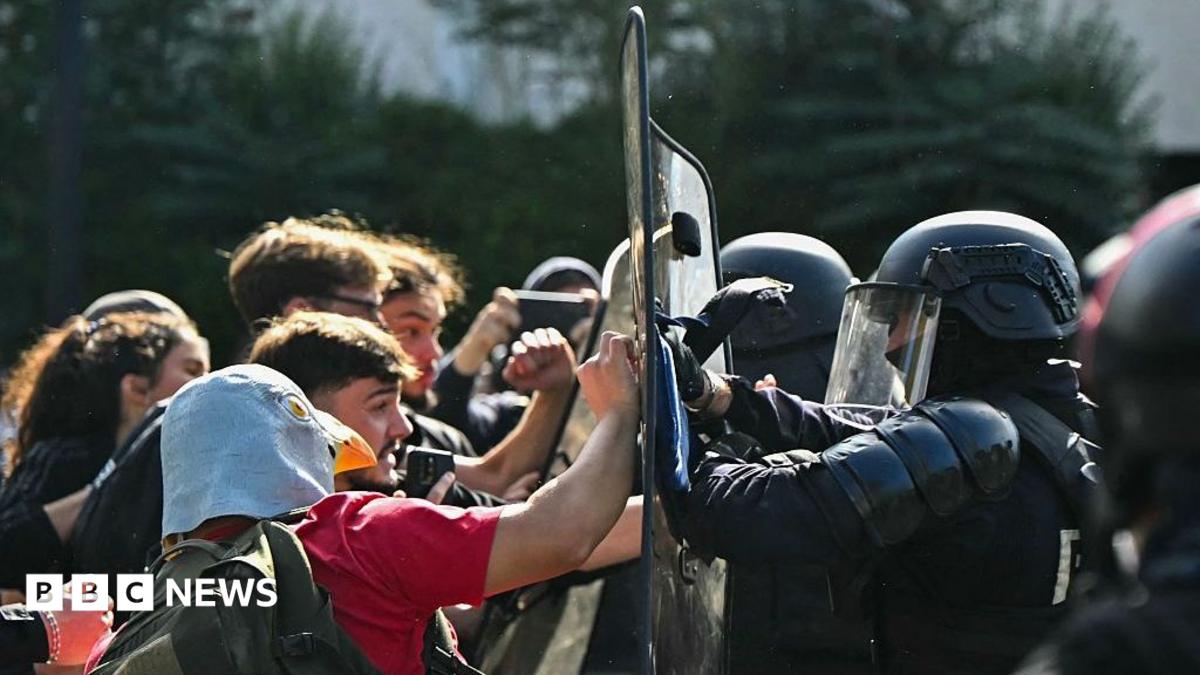
Protests by French lycée students have spread across the country, alarming the government. This was reported by Qazaqyia.kz citing BBC News.
A movement that started nearly two weeks ago in the low-income Seine-Saint-Denis area of northern Paris has in the last few days spread across the country. On Thursday — the high point so far — hundreds of lycées were being blockaded. On Friday, the situation had improved but around 400 lycées were closed in order to protect staff and students. Universities are beginning to join in.
Violence has erupted. On Thursday the main hall of a lycée in Nantes was destroyed by fire. Smaller fires too numerous to mention were lit at school entrance gates around the country. The cost of the damage is millions of euros.
According to Education Minister Édouard Geffray, 65 teaching staff including 40 school heads have been injured. "Most of the staff who were hurt said that the people they were facing… were not their own pupils," he said.
In addition, the government says that around 300 police and firefighters have been treated for injuries, and some 2,000 people – mainly minors – taken into custody. For their part, student groups say they have a long list of people injured by police. Two teenagers have serious eye injuries and one has lost many of his teeth.
The demands do exist, even if they remain vague. They are about money – the lack of it – and the need for more teachers, smaller classes and better buildings. On such matters, many in France would agree with the teenagers. Certainly using protest to demand money from government is such a national habit that even governments agree it's legitimate.
This week Prime Minister Sébastien Lecornu published his draft for next year's budget. The motif is "More cuts – and this time we're serious!" Whether or not he manages to remove €54bn (£46bn) from state spending, as he promises, remains open to question.
The far greater fear is that these student protests are being manipulated by the hard left – and that the violence of recent days is a foretaste of what awaits a dangerously polarised society in the year of elections that is coming.
For the right and centre, there is no doubt that behind the student trouble lies the cunning hand of the France Unbowed party (LFI) and its popular presidential candidate, Jean-Luc Mélenchon. LFI leaders have regularly appeared next to the students – notably in the Paris suburb of Saint-Denis whose mayor Bally Bagayoko was criticised for saying that "violence can sometimes be legitimate."
An internal report prepared for the Paris police department which was leaked to the media analysed the opening of the movement in Seine-Saint-Denis. It concluded that students were being "egged on by far-left elements from students unions… and political groups such as… LFI." It said the tensions "could be part of a flame-kindling strategy… aimed at imposing their ideas ahead of the national elections."
The LFI strongly denies doing anything more than lending its natural support to a movement it regards as legitimate. On Thursday Mélenchon called on students to avoid violence "which only serves our enemies' interests".