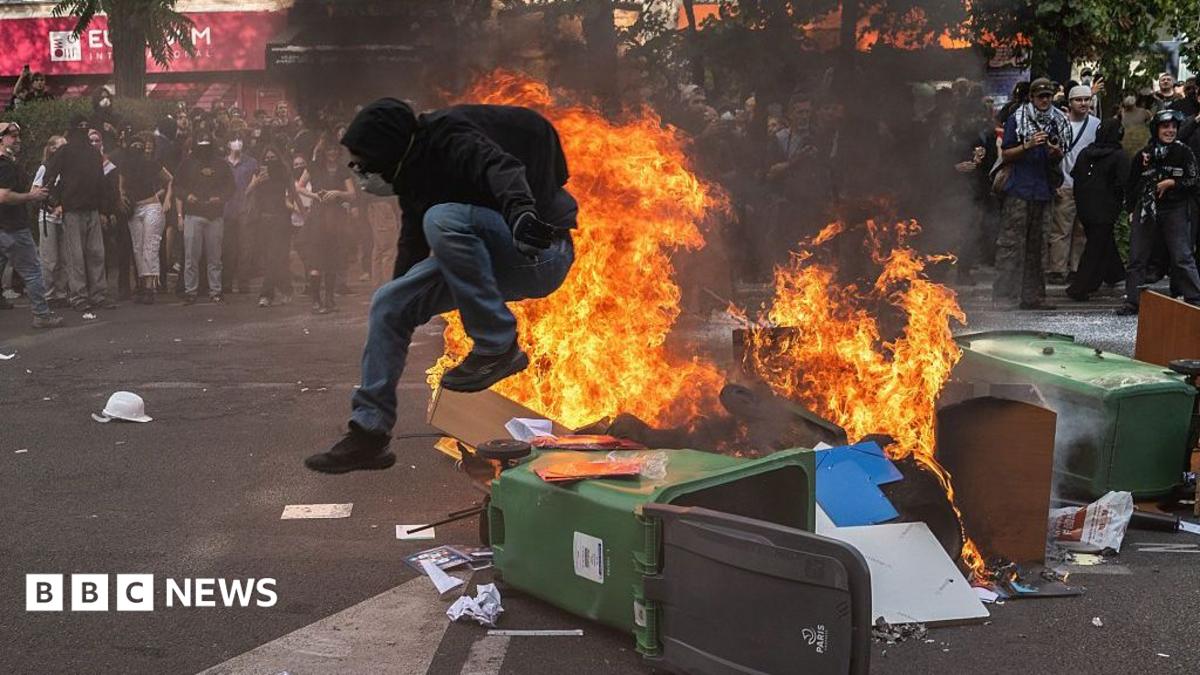
As dustbins burn and students chant "everyone hates the police" in the French city of Lille, one teenager explains why he and his friends have taken to the streets. This was reported by Qazaqyia.kz citing BBC News.
"There aren't even enough chairs. We have to go and find some at the start of every lesson," the 16-year-old, who did not want to give his name, says of his school. "We've got 50 minutes to eat at lunchtime but there are 2,000 of us that need to get through the canteen."
He is one of hundreds of thousands of students who have protested across France since the end of last month over staff shortages and dilapidated facilities in the country's lycées, secondary schools attended by 15 to 18-year-olds.
Despite the government's apparent attempts to make concessions, the students show no sign of backing down.
"They have armies, they have the police, they have the powers," says Massicella, 18, as she marches through Lille. "But we have the mass population."
The protests, which have turned violent, have become a focal point in France's polarised politics, with all sides accusing the other of escalating tensions. As a presidential election approaches, politicians on both the hard right and hard left have sought to capitalise on the unrest.
The protests - ignited at the Lycée Antoine-de-Saint-Exupéry in the deprived Paris suburb of Créteil - have struck a chord across the country. Videos of rats scuttling through corridors in other lycées soon hit social media. Other videos on TikTok and Instagram showed broken toilets, holes in walls and mouldy ceilings across the country. Students have complained of unbearable heat in the summer and freezing classrooms in the winter.
The anger has also focused on long school hours, chronic staff shortages, overcrowded classes and a deeply unpopular university admissions system.
The problem for the French government is that even if a tiny minority of schools have a problem with rodents, a very large number of pupils believe their own education is failing them.
On Tuesday, the government said 250,000 people marched, most of them young. The trade unions said it was more like half a million.
But it is not just students taking to the streets - their teachers are joining them. Secondary school teacher Marine Monins, who joined the demonstrations in Lille, shows us a laminated timetable which she says illustrates the problem. It has become normal for pupils to start at 8am and finish as late as 6pm, but the days are punctuated by hours-long gaps because of bad planning and staff shortages. When lessons do go ahead, the classes are typically packed with 35 pupils (by comparison, the average secondary school class in England has fewer than 23 pupils).
"It's now impossible to give every child the attention they deserve," Monins explains.
On Thursday, the French government made its first sign of ceding ground to protesters, with a promise of 3,000 extra supply teachers in the coming days. Prime Minister Sébastien Lecornu has said by the end of October there will be a plan unveiled to respond to the crisis. Ministers have said they could look again at resources for schools within next year's squeezed budget.
But this has been met with a collective shrug at barricaded school gates across the country.
"It goes beyond having decent toilets in schools," lycée student Alcidor says in Paris, under the statue of Marianne at Place de la République. "It's strong anger from the youth in France that doesn't feel represented, that feels abandoned, that feels unheard and is scared of what's coming in the future."
The unrest has resulted in widespread arrests and injuries. So far, almost 7,000 people have been detained during the disorder with more than 85% being children, according to the interior ministry.