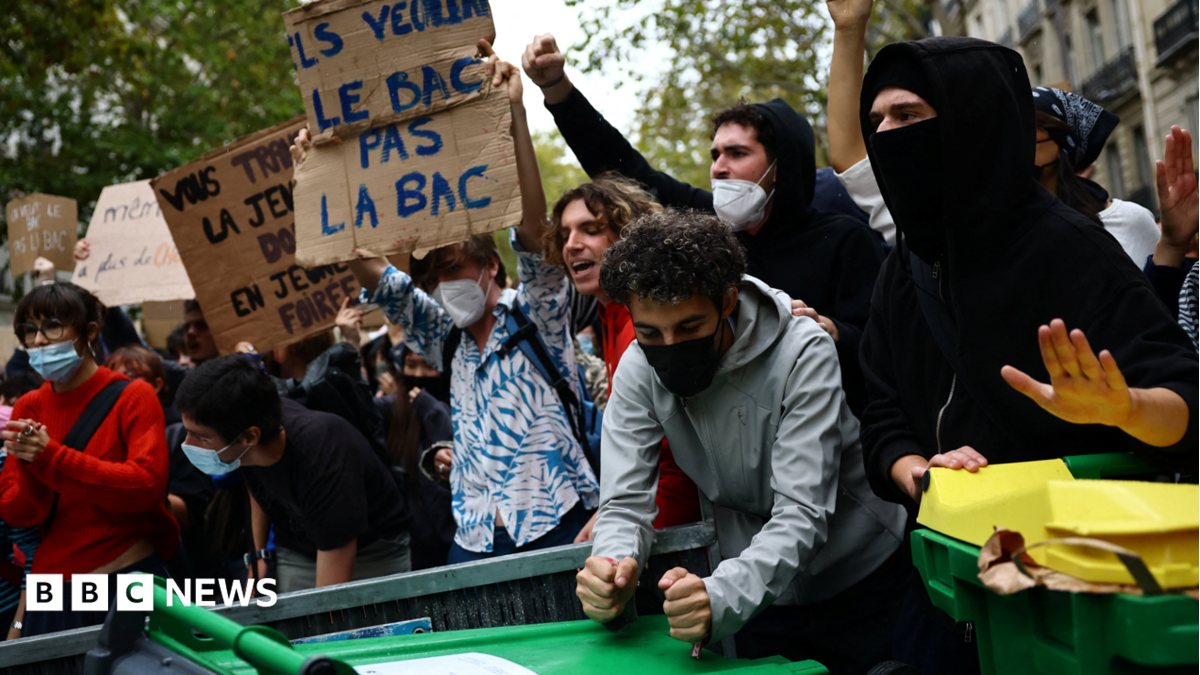
Since late September students across France have been holding protests against underfunding in education, and have been blocking access to many high schools. This was reported by Qazaqyia.kz citing BBC News.
The movement has turned violent in places – hundreds of students, teachers and police officers have been injured. Thousands of people – including an unknown number of outside troublemakers – have been arrested.
The protesters are complaining about staff shortages and dilapidated facilities in the country's lycées, schools which are attended by 15-18-year-olds. "Sometimes our teachers are absent for several weeks without being replaced," Madalena, a Paris student, told the BBC on Tuesday as demonstrations brought out hundreds of thousands across France. Her school buildings, she added, were "boiling hot" during the recent heat waves.
There is a variety of other complaints. Some resent the banning of mobile phones or school days that last until 18:00. "You get home at 7 pm, and have no time to sleep or do your homework," one lycéen told France 2.
France's online platform that allocates places in higher education, Parcoursup, is another sore point.
The frustration has deep roots. About 80% of each cohort now passes the baccalauréat, which entitles students to a university place - though not necessarily their preferred choice. This leads to a scramble for desirable courses, and an anxiety focused on Parcoursup, which many regard as opaque.
Those grievances are real. But do they by themselves explain the form the protest movement has taken? How does France compare with other countries?
According to a recent report by the OECD, a club of developed nations, the French government spends more per lycée student than the EU average for upper-secondary schools.
Teacher shortages are indeed acute, but no worse than elsewhere. By OECD measures they are actually milder – fewer posts go unfilled – although French teachers receive relatively low pay.
Schooldays that stretch into the late afternoon are indeed a problem for French pupils. This is the result mostly of long lunch breaks and complex schedules rather than making up for holidays, which are not especially long compared with other EU countries.
The extended day has always been a sad fact of French school life and can hardly account for the present eruption. Neither can pressure created by a dysfunctional higher-education system.
In most European countries, 80-90% of young people complete secondary education, and competition for good university places creates stress elsewhere too.
And while underfunding, dilapidated buildings and fears about the future are behind the students' discontent, those complaints do not by themselves explain why the movement has become "unprecedented" in terms of the number of schools, pupils and the degree of violence involved, in the words of Interior Minister Laurent Nuñez.
The scale of protests is all the more remarkable as those involved are taking considerable risks.
Blockading a school or university by threats or force is illegal, and draws in police, as well as casseurs (vandals), and pupils have become caught up in police crowd-control operations that are often heavy handed.
Prime Minister Sébastien Lecornu, in his latest message, has insisted security forces are not under orders to "confront high-school students", only to enforce the law.
To understand the pupils' tactics, one must look beyond the barricaded school gates to a political tradition. In France, the power has often resided on the street as much as in elected bodies. Students know this as well as anyone else.
In October 1990, a rape at a school in Seine-Saint-Denis – an area north of Paris that has been a focus for the present unrest – was the trigger for mass rallies against underfunding and staff shortages. It resulted in the government releasing the equivalent of €1.2bn (£1bn) in today's money for lycées.
In October 1998, 500,000 pupils marched across France over similar demands, resulting in almost €1bn to renovate schools and 14,000 extra staff.
On several occasions student protests defeated government reforms – such as a university overhaul in 1986 and a lower youth minimum wage in 1994.
Probably the most striking display of student power came in 2006, with the withdrawal of a law designed to loosen hire-and-fire rules for those under 26 to try to tackle youth unemployment.
The measure, passed by parliament and signed by then-President Jacques Chirac, was scrapped after weeks of blockades in universities and lycées often marred by violence.
French adults have shown how blockading roads can prevail over elected officials.
The gilets jaunes (yellow vests) uprising of 2018-2019 – which saw shops ransacked and government buildings attacked across the country – led the government to drop a rise in fuel taxes and approve €10bn in spending.