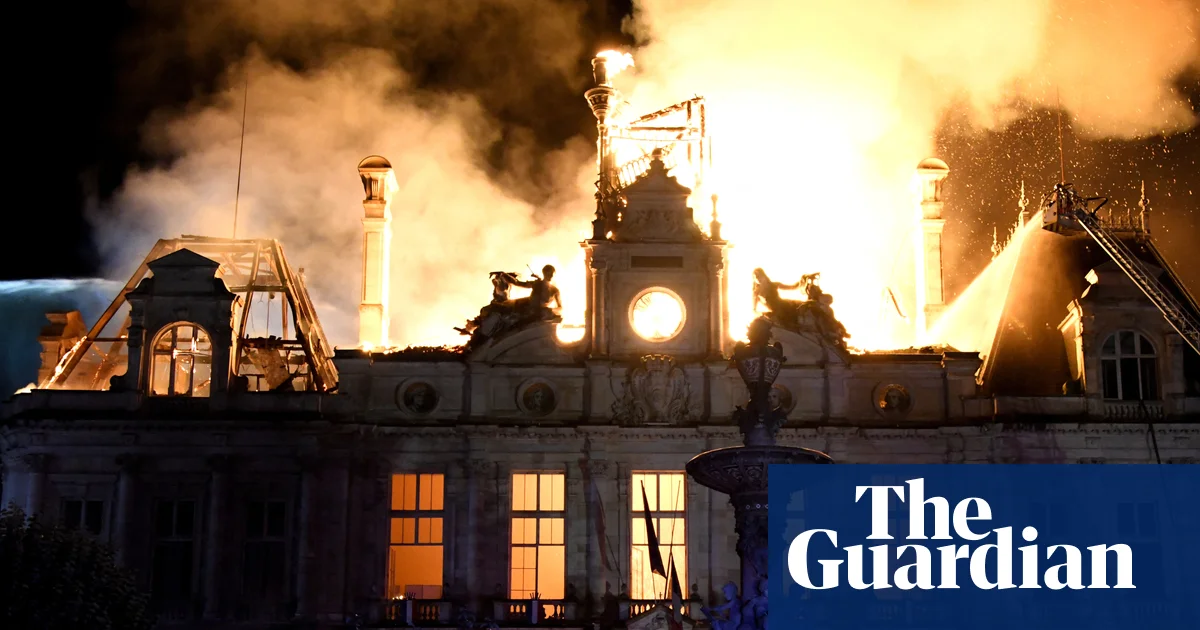
France experienced a weekend of mass protests and riots, with Limoges city hall destroyed and 855 arrested in Paris. This was reported by Qazaqyia.kz citing The Guardian.
On Friday, the evening before mass protests planned across France, President Emmanuel Macron attended a Céline Dion concert in Paris with his wife, Brigitte, prompting comparisons to Louis XIV and Marie Antoinette. On Sunday evening, he was forced to give a televised speech condemning the "unbridled violence" and riots that erupted in French cities over the weekend.
The rioters who burned makeshift barricades of bicycles in Paris, destroyed the steeple of Limoges' town hall and set fire to Lyon's tourism office were described as "LE CHAOS" on the front page of La Tribune Dimanche, and "SCENES D'INSURRECTION" on Le Parisien Dimanche. By Sunday, protests had also taken place in Spain, Portugal and Italy.
In the early hours of Sunday, cleaners started to remove the detritus from Parisian streets: shards of glass from broken shop windows, smashed bus shelters, burned out cars. The smell of teargas still lingered in the Métro station at Place de la République. "Areas of Paris looked like a wasteland," Paolo Stuppia, a sociologist at Sciences Po in Paris, tells me. About 855 people have been arrested in Paris, and a total of 2,400 have been arrested across France. Lamia El Aaraje, the Socialist deputy mayor of Paris, said the capital had experienced a level of violence "we had never seen before."
There have been so many incredible images of destruction that it's possible to forget Saturday was, for the most part, defined by peaceful protests. Hundreds of thousands of people, many of them schoolchildren and parents, joined marches across the country. A far smaller group of protesters, many wearing face masks, smashed street furniture and torched cars and bus stops. A third group took the opportunity to loot shops. "I saw teenagers running off with shoeboxes, clothes, and perfume," Angelique Chrisafis, the Guardian's Paris correspondent, tells me.
It's the second group that has dominated the headlines. On Saturday afternoon, people set the town hall in Limoges alight (its spire collapsed dramatically on Saturday evening), and broke into the city hall in Marseille. "It wasn't as if the peaceful protesters suddenly turned violent," Chrisafis says. "It was as if the government didn't have a hold on the situation, and suddenly, the police were really caught off guard."
The peaceful protesters: 'Our future is being stolen from us'
When a small number of people break the law during otherwise peaceful protests, there's a tendency to condemn such acts as "criminality, pure and simple" (to quote David Cameron during the 2011 London riots), and to disqualify the idea they represent a form of antagonism against authority. "If everything was going well in France, you wouldn't have young kids ransacking stores," Stuppia says.
Such criminal acts can also become a means of undermining peaceful protesters. "Some of those people are now pretty upset because they believe the government will be talking about burning barricades rather than the fact they turned out in such large numbers," Chrisafis says. French students have been protesting against the school system since September and calling for repairs to decrepit buildings, smaller class sizes, and reforms to a widely loathed university admissions system. Education is a particularly fraught subject in France, where academic credentials overwhelmingly determine job prospects. But their concerns are also broader; as Greta Thunberg put it recently, "our future is being stolen from us," a feeling that many young people across the continent share.
The student protests have since become the focus in a constellation of different issues, ranging from the cost of living to rising fuel prices and public service cuts. Those on Saturday drew in numerous groups, including unions and supporters of the Gilets Jaunes. "Gen-Z is really facing a polycrisis of different issues, from the climate crisis to the rise of the far right."