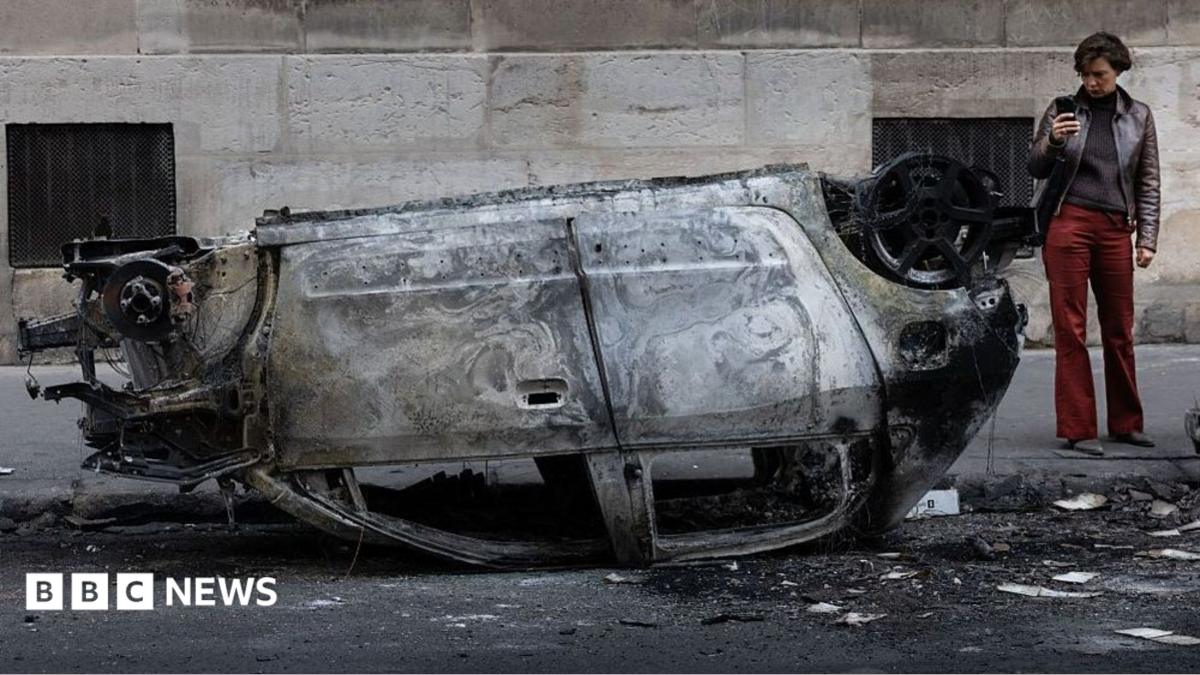
France is divided over who to blame for and what to learn from the weekend riots that took place on 17 October. Elisabeth, speaking in front of a row of smashed shop windows on a tree-lined Parisian street, said: "This is not the face of France! You media all focus on the violence and destruction of Saturday's protests. But that's not the majority. It's not 'us'. That's not France!" This was reported by Qazaqyia.kz citing BBC News.
Elisabeth's friend thinks this is civil war in France, but Elisabeth does not. She says Saturday is about something else entirely. But what exactly happened? Who was behind the riots? While much of the looting seemed opportunistic, the violence looked pre-planned. Why orchestrate it now, after weeks of student protests? And who most stands to gain from the destruction this weekend? Elisabeth wasn't entirely sure.
Different theories are doing the rounds - in and outside France. Black and white answers may be appealing, but the truth is there are many factors at play. The president of the National Assembly, Yaël Braun-Pivet, has proposed a parliamentary inquiry into the riots and how they were organised. French intelligence had briefed government circles earlier this month that left-wing anarchist groups were involved in the student protests. Their signature: a capital A, circled in black, was spray-painted on many buildings across France this weekend.
French media have played and replayed a video shot on Saturday showing groups of young men dressed in black, with a black folded kerchief around their face to hide their identity, apparently attacking a number of police vans with what look like large hammers or machetes. A French intelligence report dated 29 September, published by Le Figaro newspaper, details the "manipulation" of student demonstrations by student unions and political movements aligned with the radical left. It suggests the far-left political movement La France Insoumise (LFI) was relying on violence as an electoral strategy ahead of the 2027 presidential elections.
The mass looting of what's said to be over 3,000 shops and businesses on Saturday appears to have been largely opportunistic, according to French reports. Many youngsters immediately went online trying to sell their stolen wares, including designer trainers. Some didn't bother to cover their faces. Did they feel a sense of impunity? Online sales platforms now say they'll work with the French authorities to track down as many of the looters as possible. Police say they're examining CCTV and social media footage. President Macron insists all those responsible for violence or theft will be brought to justice.
Suggestions that some were encouraged to join in the violence by social media posts has led former French Prime Minister Gabriel Attal (a hopeful in France's upcoming presidential election) to call for selected social media blackouts to quell further violence. Belgium has also been experiencing violent protests these last days. On Tuesday, Belgium's Interior minister Bernard Quintin, warned of the 'TikTokisation' of violence. Footage of riots is widely shared on social media, reaching a large audience of impressionable young people, he said, while also blaming violence on the streets of Brussels and Liege on "known far left groups".
In France, Prime Minister Sebastian Lecornu and his Interior Minister Laurent Nunez have also clearly implicated the "hard left" in Saturday's mayhem - "pouring oil onto the fire," said Nunez. On Tuesday Mr Lecornu spoke of "insurrections" planned by "small far-left and ultra-left groups". Previously he'd accused the "far left" of weaponising student demos. It's something anti-capitalist LFI leader, Jean-Luc Mélenchon, who also hopes to become French president, has vehemently denied. Mélenchon took part in Saturday's planned protest. Politicians from his LFI movement have been present at the student demonstrations since they started a month ago in the socially deprived outskirts of Paris, with demands for better state education for all.
In Saint-Denis suburb on Monday, I met Lisa Cordat, of the FSE student union. She told me that students organised themselves for demos via social media messaging or through student-led organisations. She said it was "insulting" to suggest they were being manipulated or "told to do this, or do that" by politicians. "Student anger comes from the ground up," says Lisa. But there is also a palpable frustration amongst many in France at what they see as the politicisation of Saturday's violence. Lina, who is 25, told me: "Politicians are hunting for scapegoats but don't ask why it all happened. The root causes of Saturday. We feel scared and abandoned."
France's leading politicians have indulged in a festival of finger-pointing since Saturday. The presidential election here in six months' time is hotly contested and the volatility on French streets funneled immediately into France's already febrile politics. Mélenchon, currently running in second place in most polls, ahead of centrist candidates, accused France's centrist Prime Minister of being "responsible for the chaos" either due to "incompetence or a worst-case strategy." Mélenchon went on to apparently imply Mr Lecornu may have allowed the violence to unfold, so as to position itself as a "party of order", after Saturday's lawlessness.