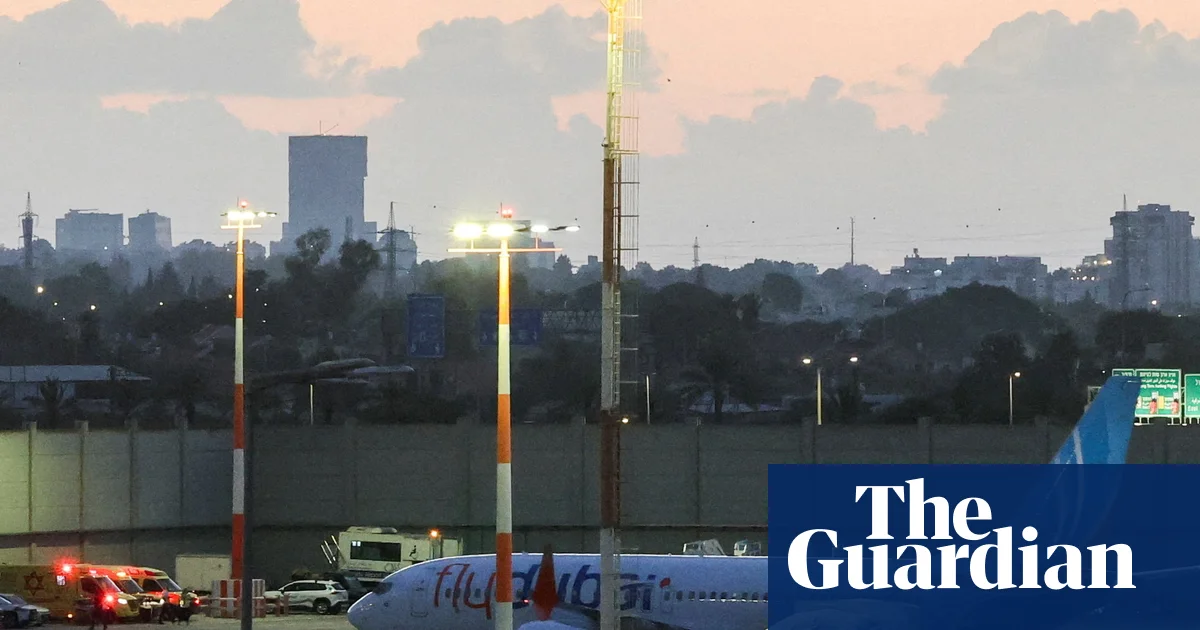
Investigators believe that the co-pilot who tried to take control of a plane from Dubai to Tel Aviv last week originally planned his attack for July but postponed the hijacking, possibly because a friend was among the crew, regional and Israeli officials have said. This was reported by Qazaqyia.kz citing The Guardian.
The evidence of prior planning suggests that Hamam al-Hammami, 29, may have specifically sought employment with an airline that flew to Israel in order to carry out the attack on last Wednesday's flydubai flight FZ1073, experts believe.
Police and security agencies in at least six countries are scrambling to piece together the background of Hammami, an Omani national, and his intentions, as well as to establish if he acted entirely alone.
Hammami allegedly used an emergency crash axe kept in the cockpit to launch a surprise attack on the pilot approximately two hours and 20 minutes after takeoff. The plane was carrying more than 180 passengers – almost all Israeli – and crew on a routine flight.
Israeli media have quoted from Hammami's statements to interrogators since being transferred to United Arab Emirates custody on Thursday to report that he planned to crash into Ben Gurion airport near Tel Aviv, or possibly another high-profile target nearby.
The flight's captain, Smit Machchhar, said on Saturday that shortly after Hammami had left his seat to pray, he felt a "big blow" to the back of his head.
In a phone call with Israel's prime minister, Benjamin Netanyahu, on Saturday, Machchhar said: "The blows kept coming … That's when I realised that it's not the aircraft, it's the other guy who was in the cockpit with me."
Despite his injuries Machchhar was able to unlock the cockpit's security door to allow passengers to overpower Hammami. A reserve flydubai pilot travelling on the flight took control of the aircraft and landed it at a regional airport in north-western Saudi Arabia, where the co-pilot was detained by Saudi authorities.
The investigation into Hammami has now spread to more than eight countries. Authorities in New Zealand and Australia are probing reports that the co-pilot studied in both about 10 years ago.
Hammami, who has an Omani father and a Syrian mother, is thought to have been employed by Oman Air from 2018 to June 2025, but left the airline after being moved to a desk job out of concerns that he had developed extremist views. He was then hired by Royal Air Maroc, the Moroccan national flag carrier, but did not obtain permission to fly and gave up his job there.
Shortly afterward, Hammami was hired at the state-owned flydubai, which has needed pilots as it expands rapidly. The airline conducted checks for a criminal record but not for evidence of radicalisation, officials have said.
A key question for investigators is when Hammami began to formulate his plan to attack a plane full of Israelis or target Israel.
Netanyahu has claimed Hammami had undergone "radical Islamist indoctrination" and was clearly suicidal, without giving details.
Nine hours after the attack, a post was made to an online social media account in Hammami's name praising Ayman al-Zawahiri, a former al-Qaida leader, as well as a militant responsible for a lethal suicide attack on US troops in Afghanistan in 2009. A second post contained religious imagery.
An analysis of Hammami's X account by a company that uses AI to measure the toxicity of individuals' social media accounts found dozens of misogynistic posts, including public threats against women. The analysis by Accountability! – which recovered Hammami's deleted account by scraping internet archives, and reviewed almost 3,000 posts and responses – found repeated use of slurs against women, and a "consistent pattern" of use of terms meaning "whores", and "filthy feminist". The researchers also found homophobic slurs directed at men.
"Beyond offensive language, the analysis surfaced explicit conditional threats of physical violence … including repeated imagery of stomping on a woman's head and making her 'a lesson for others'," the analysis found.
"Online toxicity isn't just corrosive, it's a warning sign. This pilot was telling the world who he was in his posts. Had anyone in charge been listening, nearly 200 people might never have been put in danger," said Gur Megiddo, the co-founder and chief executive of Accountability!.
Regional officials said Emirati authorities had shared information about the passengers and crew, including their nationalities, with Israel.
The Shin Bet, Israel's domestic security agency, said the transportation ministry was responsible for vetting passenger lists from foreign flights but the transportation minister, Miri Regev, said on X that the security agencies handled flight security.
Israeli newspapers reported that a key database of foreign pilots had not been checked despite concerns raised by official reports.
The attack occurred at a sensitive time for Israel, a week before the anniversary of the tragedy.