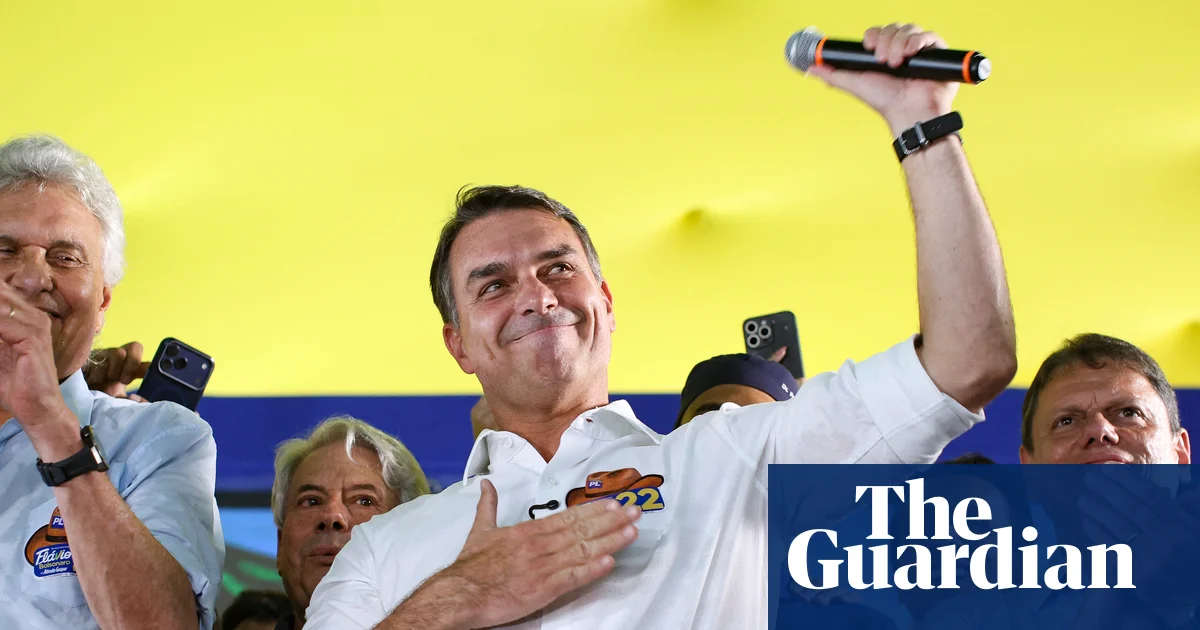
Flávio Bolsonaro won 47% of the vote in the first round of Brazil's presidential election, putting him in pole position ahead of the 25 October runoff against incumbent president Luiz Inácio Lula da Silva, who was backed by 44.2%. This was reported by Qazaqyia.kz citing The Guardian.
The result is an unnerving jolt to climate and nature campaigners. For the Amazon rainforest, the prospect for at least the next four years is more fire, more ash, more crime, more death, and a globally important ecosystem driven ever more rapidly towards a point of no return.
Lula's administration has reduced deforestation in the Amazon by almost 50%. But that success secured little noticeable electoral traction for either Lula or pro-forest candidates in other polls held the same day. Former environment minister Marina Silva lost a bid for the Senate, and Joenia Wapichana, a former head of Brazil's Indigenous affairs agency Funai, failed to win a seat in Congress. Out of 57 Indigenous candidates, only two won.
Flávio Bolsonaro is the heir to the political legacy of his father, Jair Bolsonaro, a former army captain whose four years in power resulted in a 59.5% increase in Amazon deforestation, roughly equivalent to destroying 2bn trees.
If he wins, Bolsonaro has promised to free his father, who was imprisoned for plotting a military coup and attempting to annihilate democracy in Brazil. He has said that his father could have any position he wants in his administration.
Flávio Bolsonaro has shown that he will be just as willing as his father to dismantle protections for climate and nature and allow illegal miners, loggers and land grabbers to invade Indigenous territories. As a lawmaker, he backed a 2019 bill to eliminate requirements for landowners in the Amazon to conserve a proportion of native vegetation. In his manifesto, he completely ignored the climate crisis. And he has courted support from some of the most predatory landowners in the rainforest.
He is also part of a movement – Bolsonarism – that is geared towards maximising profits for extractive industries regardless of the environmental cost. Take its victorious candidate for the Amazonian state of Pará, Daniel Santos, who was fined $275,000 (£208,000) for deforestating 280 hectares (692 acres) of his land without authorisation and is now promising to waive such penalties. As a result of Sunday's election, Bolsonarists now control seven of the nine states in the Brazilian Amazon, and could win an eighth in the runoffs.
Bolsonarist influence in the legislature, which is dominated by agribusiness interests, is also growing. Jair's brother, Eduardo, and mother-in-law, Michelle, were elected to the Senate, while an uncle and brother won seats in the lower house of deputies. Even before the election, Congress had been pushing hard to weaken environmental protections. Now it will be almost impossible to stop, particularly given the current chaos in the supreme court, which has been a partial check on untrammelled expansion by miners, ranchers and monoculturalists. Against these forces, Lula would struggle to govern even if he wins the runoff.
As a result, it is not just the Amazon that is in peril, but all of Brazil's biomes, its traditional peoples and the stability of the global climate. The question now is why voters paid so little heed to these concerns.
That inquest is already under way. Many focus on the influence of social media, which has been used far more effectively by the far right. During the Bolsonaro administration, his sons were part of the "hate cabinet" that spread fear and disinformation via WhatsApp groups and other online channels – Bolsonaro's second son, Carlos, was indicted by federal police for leading the group. Environmentalists were often the target.
Another factor is the expansion of US-style Pentecostalism, which is steadily supplanting Catholicism across Brazil, particularly in the Amazon. The political and environmental consequences of that religious shift can be seen by comparing the pro-nature treatise of the past two popes with the sermons of many evangelical preachers who encourage followers to seek wealth today as much as, if not more, than following moral creeds to ensure a good afterlife.
Lula, 80, has been slow to adapt. Although he is arguably the most iconic and successful Latin American politician, the election result showed that his environmental achievements were not a decisive factor for voters.