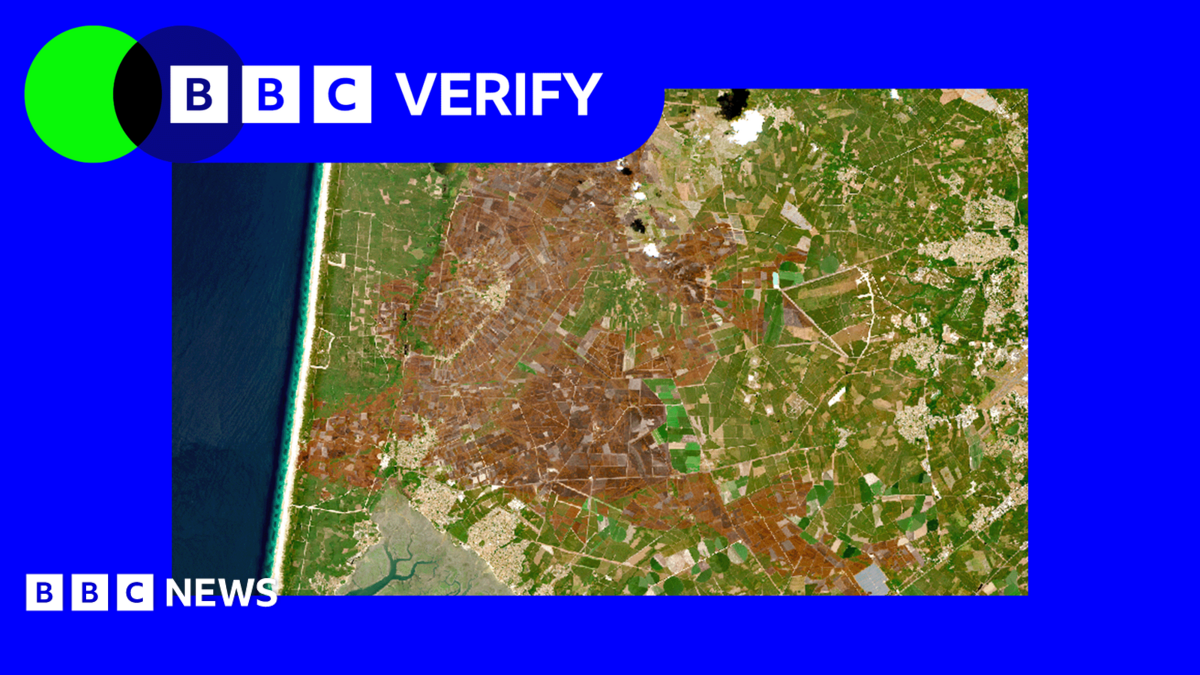
The impact of this summer's extreme temperatures on western Europe can now be seen from space after successive heatwaves since May. Satellite images examined by BBC Verify show shrunken glaciers, scorched areas left by wildfires, green fields turned arid and lower river levels. This was reported by Qazaqyia.kz citing BBC News.
Some landmarks have been affected, too. The Palace of Versailles, south of Paris, appears as an island of trees surrounded by brown fields.
The EU's climate monitoring service, Copernicus, has confirmed that western Europe experienced its hottest June-to-July period on record. The immediate cause of the heatwaves has been persistent high-pressure weather systems bringing clear, sunny skies and allowing temperatures to build, according to the Met Office. But climate change, mainly due to the burning of fossil fuels, has been raising average temperatures for decades and making hot spells much more likely and intense.
Danube and Rhine rivers
The waters of the Danube, Europe's second-longest river, have dropped to their lowest levels for 30 years in several countries. This has led to unusual discoveries on the river bed, including the bones of a mammoth in Bulgaria and a sunken WW2 warship in Serbia. Nuclear power stations in Hungary and Romania have been forced to shut down or run at reduced capacity because of an inability to use river water for cooling. On the Rhine, some cargo vessels have been left stranded and river cruises have been cancelled.
Alpine glaciers
Even the snow-capped peaks of the Alps have not escaped the heat. Ongoing measurements suggest this summer could become one of the worst ever recorded for melting Alpine glaciers, with more than a month of the season still to go. After a mild winter, glaciers had less snow cover than usual at the end of April - and an unusually early heatwave the following month accelerated the melting of snow. This exposed the ice beneath, leaving the glaciers vulnerable to melting faster in subsequent heatwaves. Satellite imagery suggests much of the front of Rhône Glacier in Switzerland has retreated by 50m (160ft) or more since the same time last year. In a stable climate, glaciers would be expected to remain more or less the same size over the long-term.
Dr Lander van Tricht, glaciologist at the Swiss Federal Institute of Technology, said in recent years climate change has led to "much less snow in winter and much, much more melt in summer. And if we continue this trend, then the future looks very dramatic for the Alps."
Wildfires
Wildfires have transformed parts of western Europe this summer, too. More than 90,000 hectares (900 sq km or 350 sq miles) has burned in France. This is already its worst year on record, according to the European Forest Fire Information System. The largest fire in Gironde region, where the city of Bordeaux is situated, burnt about 42,000 hectares of land - roughly equivalent in size to the Isle of Wight. Part of the reason this year has been particularly bad for wildfires is that land has been tinder-dry. Dr Douglas Kelley of the UK Centre for Ecology and Hydrology tells us extreme wildfires are becoming "more and more frequent" as climate change is creating ideal conditions, with higher temperatures drying out vegetation and soils faster.
Vegetation changes
Even zoomed-out satellite imagery of western France shows a striking increase in the browning of land compared to last year. To assess whether 2026 is unusual we used the Normalised Difference Vegetation Index (NDVI), a measure which uses satellite data to assess how green and healthy vegetation is. The NDVI this summer came in below a five-year benchmark of 2021 to 2025 across about 70% of France. Close to half the UK and roughly 40% of western Germany showed the same.
Prof Andrew Challinor, from the University of Leeds, said the images were "consistent with widespread water stress", which "does not bode well" given much of Europe's land is covered by crops meaning it could hit the agriculture industry and food production. In the worst-affected areas, soil moisture is lower than on about 98% of comparable dates in the historical record, according to Prof Luis Samaniego, from the Helmholtz Centre for Environmental Research.