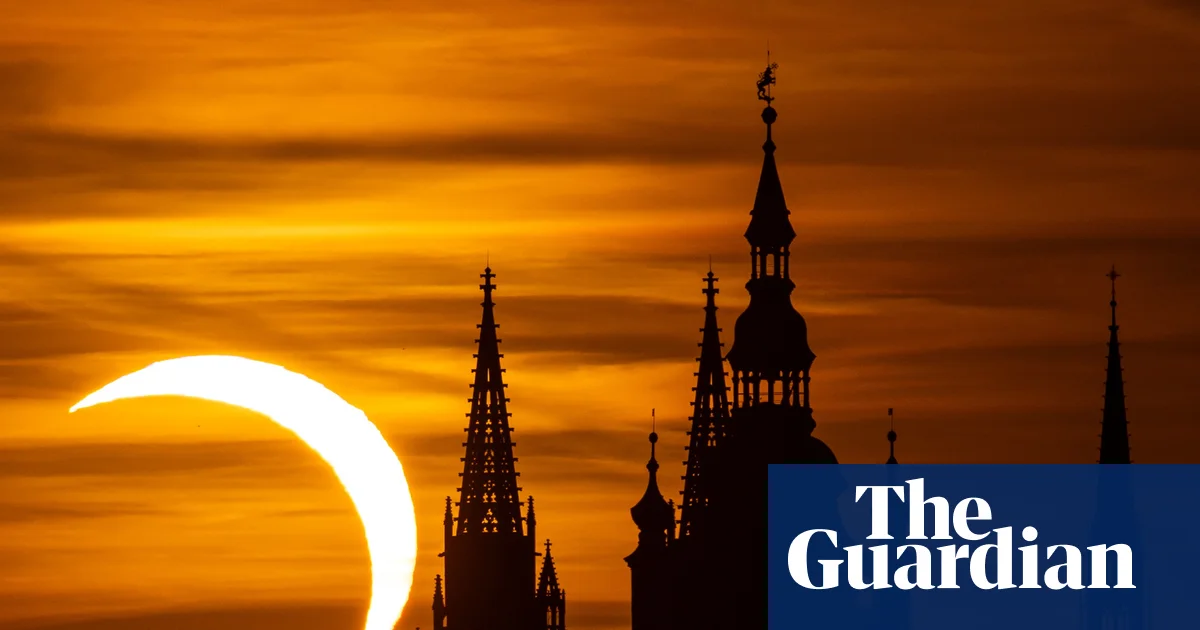
Wednesday's solar eclipse awed millions across Europe: the sun's light was blocked, plunging parts of the continent into daytime darkness, with temperatures dropping and birds falling silent. This was reported by Qazaqyia.kz citing The Guardian.
The eclipse began in Russia's remote Arctic north and traced an arc over much of western Europe. From the UK to northern Italy, tens of millions of people turned to the sky as the light of the setting sun was almost completely blocked out.
The most sought-after experiences were in Greenland, Iceland, and Spain, along with a small strip of Portugal. It was in parts of these countries that totality—when the moon completely covers the sun's light—was on offer, drawing millions of locals and thousands of tourists from across the globe.
"It was one of the most beautiful things I've ever seen in my life," said Sara García Alonso, a reserve astronaut for the European Space Agency, told broadcaster RTVE. "It gave me goosebumps."
Standing next to her, astronaut Pablo Álvarez Fernández nodded in agreement: "It had been described to me so many times, but it was much more beautiful than what I had expected."
In Iceland, people flocked by air, land, and sea to witness the country's first total solar eclipse in 72 years. Amid concerns that clouds would block the view, a record 31 cruise ships plied the waters off the western part of the country, hoping to secure a top view for about 53,000 passengers and crew.
Eclipse-themed activities included a day-long music festival hosted by Icelandic artist Björk in Víðistaðatún park, offering a DJ-curated backdrop. The 10-hour set list included two minutes set aside for totality, the artist said on social media, while the festival website noted that every ticket included a pair of approved solar eclipse glasses.
Those watching from Iceland included NASA, which followed the moon's shadow using a high-altitude WB-57 aircraft, while NASA-funded teams launched balloons to study the atmospheric impact of the sudden darkness and cooling.
In Spain, where some of the best views of the total eclipse were expected, the hours leading up to the celestial alignment were filled with frenzied debate about weather forecasts and where best to watch the phenomenon.
More than 450,000 tourists had arrived in the country from as far as Canada and Australia, crisscrossing Spain by train, bus, and caravan to stake out the perfect viewing spot.
"Our car was cancelled," one woman, who had traveled from Brazil with her sister, said on social media. After her appeals to hitch a ride to their chosen site were met with no response, they took matters into their own hands. "So we took a 3-hour bus, 20 min taxi, and 2-hour hike. Arrived at the location!"
About 10,000 meters above sea level, Spanish airline Iberia livestreamed the moment when the sun, moon, and Earth aligned from a special charter flight. "Some flights take us to new destinations. Others allow us to see the world from a different perspective," the airline said as it announced the charter flight.
Spanish officials estimated that as many as six million people were expected to flock to the path of the eclipse, which stretched about 124 miles (200km) from A Coruña in Spain's north-west to the Mediterranean island of Mallorca.