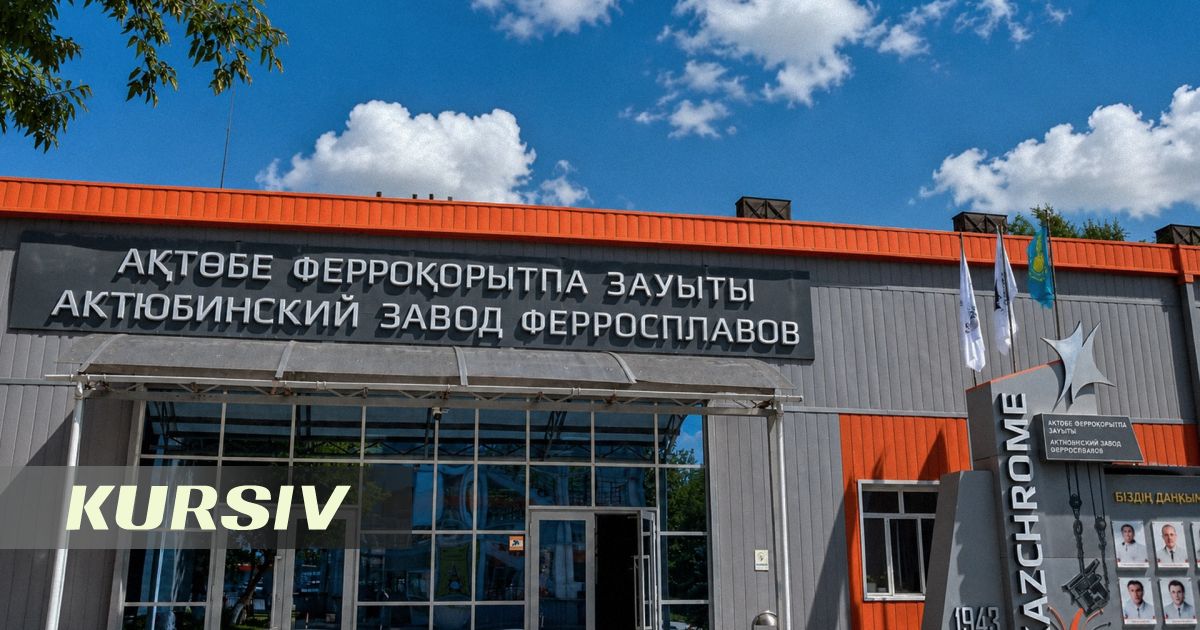
Kazchrome, which includes the Aktobe Ferroalloy Plant (AZF), has completely switched from Russian carbon-containing materials (coke, coal) to products from Shubarkol Komir, also part of ERG, AZF director Yerzhan Abdulabekov told Kursiv during a press tour of the plant. The switch to Kazakhstani fuel reduced the cost of ferrochrome, used in steel production. Kazchrome posted a profit of 137.4 billion tenge in 2025, compared to 5 billion tenge in 2024. This was reported by Qazaqyia.kz citing Kursiv Media.
"In the fourth workshop, we previously used Russian anthracite. Roughly speaking, we bought 300,000 tons per year from Russia... The coal division's unit based on the Shubarkol deposit built a new plant for producing special coke. With its launch, last year and this year, we are working 100% on our own reductant — Kazakhstani raw materials," he told Kursiv.
According to him, Russian coke/anthracite was purchased, for example, from the Novosibirsk region. Switching to its own coke improved the plant's economics. "Yes (the cost of ferrochrome production became lower — Kursiv)," he told Kursiv.
Two years ago, Abdulabekov noted that half of the coke/coal for AZF's old furnaces was imported from Russia. At that time, special coke from Shubarkol was already being used for the plant's new furnaces.
AZF uses its own electricity generated by the group's power plants in Pavlodar and Aktobe regions for ferrochrome production. However, when using electricity from Pavlodar region, the plant must pay KEGOC for its transportation. Additionally, Abdulabekov noted that the deficit western zone of Kazakhstan is not yet operating in parallel with the country's Unified Electric Power System. Therefore, Kazchrome is systematically increasing its own generating capacity to produce all necessary electricity in Aktobe region.
One project is a power plant that will run on waste ferroalloy gases from AZF. These gases will be burned to generate electricity. The plant's capacity will be 80 MW, costing about $100 million. Previously, the company planned to launch it in 2026; now it is scheduled for 2027.
"Previously, we burned this into the atmosphere; now we will use it. This is also a kind of green technology element, renewable energy sources. Yes, at the end of 2027 (the 80 MW power plant will be launched — Kursiv)," the plant director noted.
AZF's total electricity demand is 450 MW.
"We have our own natural gas power plant with a capacity of 137 MW. The rest we took from other regions, but these are also our power plants — Aksu GRES in Pavlodar region, Pavlodar CHP at Aluminum of Kazakhstan. We transport electricity from there. But this involves transportation costs and a significant burden on the region," Abdulabekov said.
In 2025, Kazchrome launched a 150 MW wind park in Khromtau, consisting of 24 turbines. After the ferroalloy gas power plant starts, other enterprises and the region's population will receive additional electricity. It should be noted that while the gas power plant's fuel issue is resolved, the wind farm depends on weather conditions.
AZF also continues furnace modernization. The youngest fourth workshop has new, efficient furnaces, while other workshops require upgrades.
"Here we have the first workshop with seven furnaces; two have been modernized, and work is underway on a third," Abdulabekov said.
Previously, Russian equipment was used for furnace modernization, but due to Western sanctions, the company now orders equipment from China. This also optimized investment costs for furnace upgrades.
Main consumers of the plant's products are European countries, Japan, South Korea, China, and others. AZF's high-carbon ferrochrome has 69-70% chromium content, compared to the market average of 50-55%, attracting buyers.
"In premium markets — Europe, Japan, South Korea — our product share is very high because they prioritize quality. We know what quality products Japan, Korea, and Europe produce; they buy our chrome specifically. Why? Because we have high chromium content," the plant director said.
Additionally, the content of harmful impurities like phosphorus and sulfur, which greatly affect final steel quality, is very low in Aktobe ferrochrome.
"First, it is rich; second, it is pure in harmful impurities. These are our competitive advantages, and we maintain a high share in high-margin markets. We sell the same ferrochrome not 5-6% but 20-30% more expensive due to quality," Abdulabekov said.
According to him, the company does not plan to aggressively increase ferrochrome production for now.
"Production expansion is not planned yet; we are balancing ore production and output. Such plans exist, but through increasing furnace efficiency. For example, our target is to smelt 2 million tons; we currently smelt a maximum of 1.86 million tons, but we want to reach 2 million without building additional furnaces," he told journalists.
AZF is gradually improving production indicators.
"In 2023, we produced less than 700,000 tons, roughly 690. In 2024, we produced 708,000 tons, and in 2025, we produced 727,000 tons of products," he said.
Abdulabekov noted that the company has invested in projects.
This was reported by Qazaqyia.kz citing Kursiv Media.