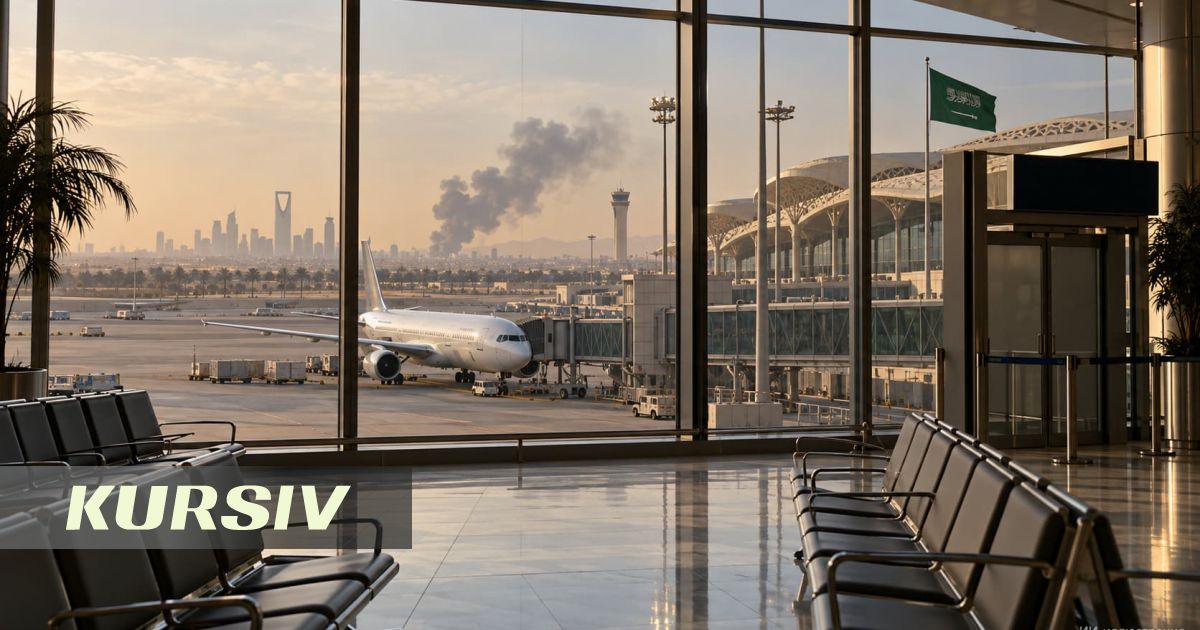
Saudi Arabia has extended the closure of King Khalid International Airport in Riyadh following a missile attack that killed 12 people and injured more than 300. This was reported by Qazaqyia.kz citing Kursiv Media.
According to Associated Press, the airport will remain closed at least until the evening of October 11. The strike is believed to have been carried out by Yemen's Houthis, an Iran-backed armed movement.
US President Donald Trump said he is considering the possibility of joining Saudi strikes on the Houthis. According to AP's assessment, Washington's intervention could push the group to block an important maritime route and create additional obstacles to oil supplies from the region.
The strike on the airport occurred on October 10. According to a regional official who spoke to AP on condition of anonymity, the missile hit a complex with terminals No. 3 and No. 4, which serve domestic flights.
Saudi authorities reported that among the dead are four citizens of the kingdom, two citizens of Bangladesh, as well as citizens of Palestine, the United States, Egypt, Jordan, Syria and Sudan. The injured are receiving assistance in several hospitals.
US Secretary of State Marco Rubio confirmed the death of an American citizen and condemned the attack. According to Egypt's state-run Al-Qahera News channel, the Egyptian citizen killed was 28-year-old Azza Ramzy, a flight attendant for the Saudi airline Flynas.
According to flight tracking service Flightradar24, cited by AP, the airport closure was extended at least until 21:00 on Sunday, October 11.
The Houthis said Saudi airports remain targets for attacks. The movement's military spokesman, Yahya Saree, called on "everyone to take our warnings seriously."
The attack was condemned by Iraq, Lebanon and Syria, UN Secretary-General Antonio Guterres and European Commission President Ursula von der Leyen.
"Attacks by forces acting in Iran's interests are dragging the region into a spiral of violence. They destabilize key global transport and energy hubs," von der Leyen wrote on X.
On Sunday, October 11, the Houthis also reported two airstrikes on Yemen's capital Sanaa, accusing Saudi Arabia of carrying them out. At the time of AP's publication, Saudi authorities had not commented on these statements, and no information on casualties had been received.
The Houthi-controlled health ministry claims that over five weeks of strikes by the Saudi-led coalition, 91 people were killed and 168 injured. According to the ministry, 60% of the dead are women and children.
After the attack, Trump said he was assessing the possibility of US forces participating in strikes on the Houthis.
"Possibly. We will look into this issue. We just learned about the latest attack, so we will make a decision. We act very quickly," the US president said.
Later, he said he plans to speak with Saudi Crown Prince Mohammed bin Salman. No final decision on US participation in the operation has been announced.
Earlier this week, the Houthis claimed responsibility for attacks on King Khalid Airport that killed three Saudis, including a pilot. According to AP, there are no military facilities on the airport's territory.
Strikes on airports, military facilities and oil infrastructure have intensified since the start of a major Saudi coalition offensive against the Houthis.
Saudi Arabia entered the civil war in Yemen in 2015, supporting the internationally recognized government in the fight against the Houthis. After the 2022 truce, a relative lull set in, which ended in July 2026.
At that time, the Houthis resumed attacks, claiming that Saudi forces shelled Sanaa airport as a plane from Iran was approaching landing. This again exacerbated disagreements over the blockade that isolated a significant part of the movement-controlled territories.
Currently, the Saudi coalition is providing air support to Yemeni government forces trying to retake territories near the Red Sea. The Houthis' recent advance in this area has allowed them to better monitor shipping through the Bab-el-Mandeb Strait.
This route serves as an important alternative to transportation through the Strait of Hormuz, where, according to AP, Iran attacks vessels. The expansion of the conflict could create additional obstacles to oil exports from the region.
Saudi Arabia is also experiencing a shortage of interceptor missiles. In September, regional officials told AP that the kingdom had requested air defense assistance from France, the United Kingdom, Pakistan and Egypt. According to one of the agency's interlocutors, US stockpiles have also decreased due to the war with Iran.