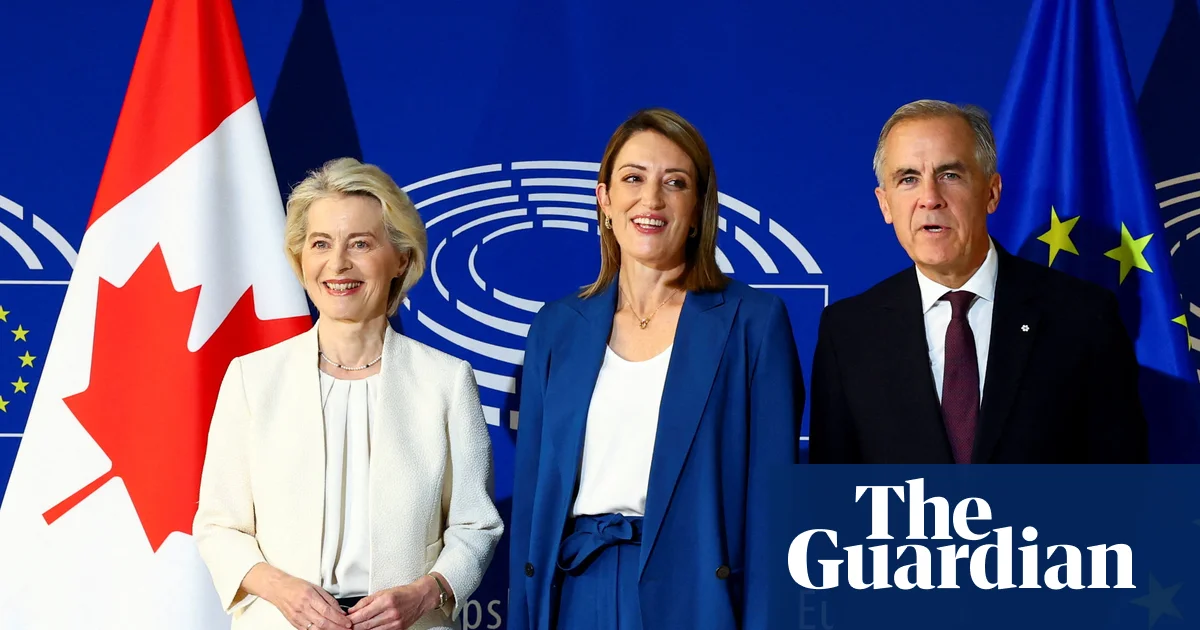
European Commission President Ursula von der Leyen told Canadian Prime Minister Mark Carney on Wednesday that she wants to open the door for his country to become the EU's first associate member. This was reported by Qazaqyia.kz citing The Guardian.
The overture comes as Trump's tariffs and repeated talk of making Canada the 51st state have pushed Ottawa to seek closer economic and security ties with Europe. Carney has called for a "unique alliance" with the EU as Canada seeks to reduce its heavy dependence on US trade.
"I would like to work with you on opening the door for Canada being the first associate member of the EU," von der Leyen told Carney during her annual state of the European Union address. Carney received a standing ovation from European lawmakers. He is due to address the European parliament on Thursday.
Von der Leyen said Canada and the EU would build on their existing free trade agreement, known as Ceta, with a broader "alliance for the future" aimed at creating "a common prosperity and economic security space".
The commission president described that closer relationship as rooted not just in trade but in shared democratic values. "Above all, dear Mark, Europe and Canada believe in democracy," von der Leyen said.
"We believe that power does not belong to the strongest, the richest or the loudest, but to all of us. That democracies have the freedom to choose with whom to work."
Von der Leyen said the expanded partnership would cover advanced manufacturing, technology, defence production, the Arctic, energy, critical minerals, batteries, AI, quantum computing, cybersecurity and economic security.
"This is a partnership not against anyone else, but for our common strength," she said. "In short, we want to bring the relationship with Canada to the highest level possible."
The news comes amid concerns over the Trump administration's trade policies. Canada has long had close economic ties with the US, but has recently begun to expand its relationship with Europe. Carney's call for a "unique alliance" with the EU is part of this direction.
Associate membership in the EU is an intermediate status before full membership in the union. This status typically involves a wide range of political and economic cooperation but does not grant the rights of full membership. If Canada obtains this status, it will become the first associate member of the EU.
Von der Leyen's statement reflects a significant shift in EU foreign policy. The EU has traditionally prioritized strengthening relations with its neighbours, but is now interested in expanding ties with partners across the Atlantic. This may be related to changing geopolitical circumstances.
Carney's address to the European Parliament is scheduled for Thursday. He is expected to discuss further cooperation with the EU then. How exactly relations between Canada and the EU will develop is still unknown.
Discussions about EU enlargement and partnerships have taken place before. But for a major economy like Canada to become an associate member is a new phenomenon. This could be a step aimed at strengthening the EU's role on the international stage.
According to experts, such a partnership could bring economic benefits to both sides. For Canada, it is a way to reduce dependence on the US. For the EU, it is an opportunity to expand its global influence. However, reaching a concrete agreement could take a long time.
In von der Leyen's speech, special attention was paid to democratic values. This shows that they are the main criterion for the EU in choosing its partners. Canada is seen as a country close to the EU in its democratic traditions and shared values.
This news marks an important change in international relations. The deepening of cooperation between the EU and Canada could serve as an example for other countries. Especially for those who have faced trade conflicts with the US, this could be an alternative path.
However, it is unclear how quickly this process will proceed. Internal agreements and procedures of the EU could take a long time. It is also likely that some member states may oppose this initiative. Nevertheless, von der Leyen's initiative defines a new direction in EU foreign policy.