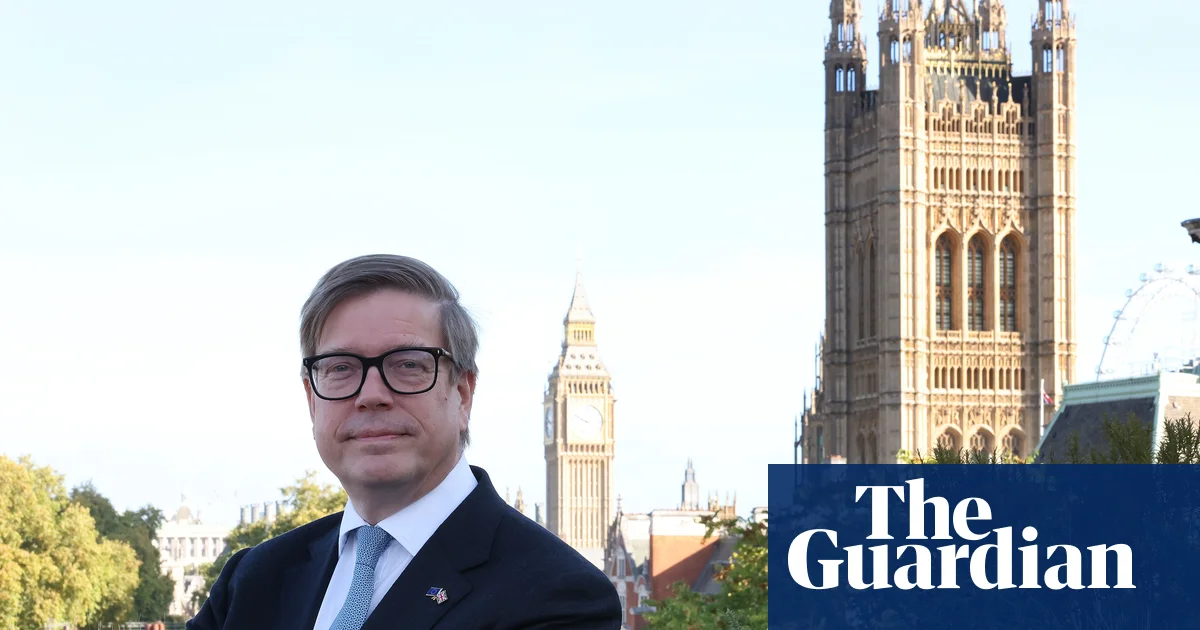
Jukka Salovaara, the newly installed European Union ambassador to the UK, is likely to become a ubiquitous figure in national politics as the Andy Burnham government grapples with the question of its future relationship with the European Union. This was reported by Qazaqyia.kz citing The Guardian.
Burnham has been clearer than his predecessor Keir Starmer in saying that what exists now is not working and that a full range of options, including rejoining, has to be on the table ahead of Labour's next election manifesto.
Salovaara, aged 58, sees his role over the coming years as a "facilitator", testing both sides like a good diplomat on what might fly and what will not work. He will not sit at the negotiating table, but he will be "very close to it".
"Everyone tells me my job is explaining London to Brussels and Brussels to London". The UK, he says, remains "the European Union's first and foremost partner". When the two have made agreements, it has always been to "our mutual benefit".
A former permanent secretary in Finland's foreign ministry, who also served as his country's ambassador to the UN, this is his first job with the European Commission, but not his first posting in the UK. As a young diplomat in the summer of 1996, he handled European affairs in London for Finland at the onset of Cool Britannia, just as Tony Blair was on the cusp of gaining power.
"The 1990s was such an optimistic time," he says of that era. "World trade was growing. Interdependence was expected to provide security, and global norms and rules were strengthening. There was a feeling that globalisation and a rising tide would lift all boats." The Labour government, he recalls, came "very close" to joining the euro.
Since then, different ghosts have dominated UK politics. His office in Smith Square is just one floor up from that used by Margaret Thatcher in Conservative Central Office. The building was also a haunt for Nigel Farage when he was an MEP.
Burnham's first EU summit is now pencilled in for November. Salovaara says issues such as how UK traders can avoid being caught up in the EU's plans to prevent subsidised Chinese products flooding European markets will not be up for decision. The EU will not have completed its own legislative proposals by the time of the summit.
Salovaara says there are plenty of themes – food standards, linking the UK and EU carbon emissions trading scheme, youth mobility, and security – to keep the summit meaningful. On food, he points out: "When we have common standards we don't need border checks. Nearly 60% of the UK's food exports go to the EU market and 70% of the UK's food imports come from the EU. Losing the red tape carries a lot of benefits."
Negotiations between the two sides over the details of any "youth experience scheme", including the number of 18-to-30-year-olds able to participate and the rights to work and study they would enjoy, are still under way. The UK has initially offered 50,000 places a year, according to EU officials, but Brussels is pushing for 150,000.
As to the parameters of a future relationship, Europe must wait to see what the UK wants rather than setting out a collective opinion of its own, he says. "The ball is very much with the UK in terms of having this debate then looking at the options … and then the EU [will be] ready to engage.
"The approach up until now had been step by step, but this prime minister wants to assess all the options."
But he acknowledges the difficulties. Charles Grant, the head of the Centre for European Reform, has said he cannot envisage Europe wanting the UK back as a full member unless there is a political consensus to rejoin inside the UK. Salovaara admits: "When you do something that is very fundamental it usually makes sense to have a strong consensus, but it is for the UK to decide if consensus must be proven through a further referendum."
He runs through the other options in the regulatory staircase – such as joining the EU single market or customs union – but points out other novel, if as yet undefined blueprints are evolving, including associate membership, which is the option being proposed for Canada.
Another scheme – associated with Alexandre Adam, chief adviser to the European Commission president, Ursula von der Leyen – proposes that countries, including those locked in the Balkans EU accession waiting room, join the EU but without full rights of market access, which would be granted in time in return for commitments to democracy.
He points out that in the 1990s, European Economic Area countries such as Norway saw the relationship purely in economic terms, but have since come to see it a