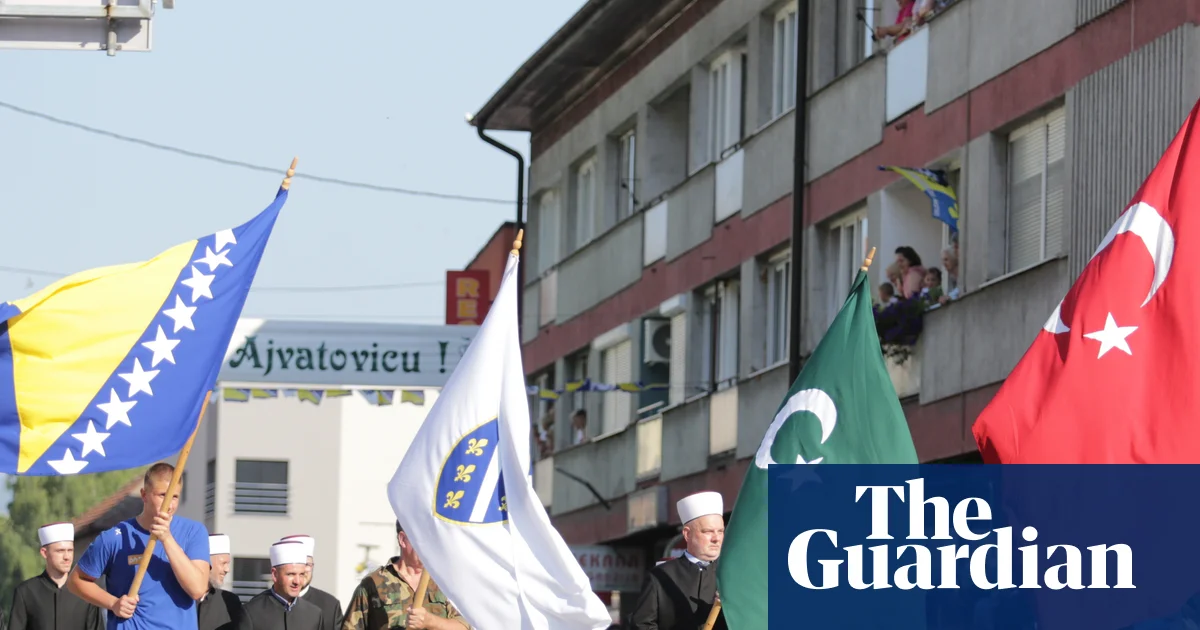
Diplomats from the US and Europe have been unable to resolve their differences and agree on a new top international envoy in Bosnia and Herzegovina, in a standoff which has become a transatlantic test of wills over influence in the Balkans. This was reported by Qazaqyia.kz citing The Guardian.
A meeting in Sarajevo to select a new high representative, a post with far-reaching powers, ended without a compromise, in a spat that has undermined western cohesion in the region in the Trump era.
All that was agreed on Tuesday was that the current high representative, the German politician Christian Schmidt, should end his tenure immediately, as the US has been demanding, and his American deputy take on the role for two weeks pending a decision on a successor.
In a statement on Tuesday evening the Peace Implementation Council (PIC) steering board said it was "committed to reaching agreement on the selection of a new high representative as soon as possible, with the goal of completing the appointment no later than 14 July 2026".
In recent months, US policy has prioritised the pursuit of advantage for US firms, and in particular a company run by associates of Donald Trump, while European powers have so far refused to yield to US demands, despite threats from Washington to cut off funding and participation in the international presence in Bosnia if its wishes are not fulfilled. The Balkan country has consequently become a testing ground for Europe's capacity to unite and stand up to US Maga foreign policy in its own back yard.
The major power contest could have far-reaching implications for Bosnia itself, which has functioned as an international protectorate since a war that ended more than 30 years ago with a settlement which has stopped the bloodshed, but also stifled political and economic development.
Ambassadors from the US, UK, France, Germany, Italy and the EU, as well as envoys from Canada, Japan and Turkey, met in the Bosnian capital to make a second attempt to agree on a new high representative, after the first try broke up amid acrimony in early June.
In the run-up to that initial meeting, the Trump administration had rattled European capitals by insisting that the current high representative be removed after he defied US wishes. Under a compromise with Germany, Schmidt was persuaded to resign, but would stay in his post until Bosnian elections in October. In recent weeks, however, the Trump administration reneged on that understanding and demanded Schmidt's immediate departure.
Washington achieved that goal on Tuesday. Kurt Bassuener, co-founder of advocacy group the Democratization Policy Council, said: "This was involuntary. This was not Schmidt leaving of his own accord. This was the Americans kicking him out."
However, the US has so far not prevailed in its choice of Schmidt's successor. Recently, American officials have been campaigning aggressively for a 76-year-old Italian diplomat, Antonio Zanardi Landi, to replace him, much to the bewilderment of most other PIC steering board members.
Landi has no significant previous experience or apparent knowledge of Bosnia. He was once posted in Serbia, but he has not shown much interest in its southern neighbour until now.
There has been no clear explanation from Washington for its abrupt manoeuvring, but European officials in Sarajevo suspect it is closely related to the new US priority in the region: to clear the way for a $1bn gas pipeline contract, the Southern Interconnection. This has been provisionally awarded to AAFS Infrastructure and Energy, a US-based company with minimal infrastructure experience, but strong personal connections to Donald Trump.
Last month, the Trump administration announced a new policy for the Balkans, stating that henceforth US actions in the region would be guided by the need to pursue "direct return" for American companies, in place of what it called "open-ended institution building".
Jim O'Brien, a former US diplomat, writing on the European Council for Foreign Relations website, said the announcement "reflected what is already happening in the region under the second Trump administration", as "politically connected Americans seek to earn money by weakening … international institutions".
"This behaviour undermines the peace that has held for 30 years," O'Brien said.
The pipeline deal was awarded without tender, prompting a warning from the EU that this could jeopardise Bosnia's long-term European integration and generating a confrontation that has culminated in the row over Landi and the high representative's job.
Landi is serving as the Sovereign Military Order of Malta's ambassador to the Vatican. Contacted by the Guardian, he said it would be "unwise for me to step into the heated debate", but argued his "key points and focus" manifesto that has been circulated among PIC steering board members was "perfectly in line with the European positions".
The Landi manifesto, seen by the Guardian and first published by the Bosnian investigative journalism website Istraga, promises not to overturn the decrees of previous high representatives, to consult the PIC before taking substantial actions, and not to unilaterally close down the office of the high representative.