Football World Cups are rarely completely politics-free but never has the beautiful game navigated a geopolitical high-wire act of this kind. The main host is at war with a participant, whose team must commute in on match days from another country. This was reported by Qazaqyia.kz citing BBC News.
Add to that the quite astonishing coincidence of the US, Canada and Mexico, the three co-hosts of the 2026 World Cup, being in the midst of an epic trade war. Indeed, in the period in between the opening ceremony at the Estadio Azteca, and the final in New Jersey's MetLife Stadium, the three will be renegotiating the USMCA, the North American free trade area.
Donald Trump is extremely focused on the tournament, its sponsors and the impact from his return to the White House last year. The US president has even joked that his loss to Joe Biden in the 2020 election had the great benefit of allowing him to return for this World Cup, and the Los Angeles Olympics in 2028.
After renewed hostilities between Tehran and Tel Aviv, Trump was rather direct in calling for an end to attacks. And as the minutes ticked down towards the tournament's kick off on Thursday night, he appeared to call off new air strikes and seemingly promised that a deal to end the war was close at hand. Earlier in the day he had vowed to hit Iran "very hard". As ever with Trump, much can change very quickly.
He has already controversially accepted a Peace Prize from FIFA, before initiating the war with Iran that has led to a significant global energy and economic shock. There is even a chance the US and Iran could play each other in the knockout stage on the weekend of the US' 250th independence celebrations.
Gianni Infantino, president of FIFA, has previously called for ceasefires during World Cups. If the World Cup helps quicken the pace of moves to de-escalate, there could be a material impact on energy prices, supplies and the world economy.
Whether the World Cup can actually influence the world's major economic conflict, who knows. But make no mistake - there is another part of the economic jigsaw that is happening right in front of the eyes of football fans worldwide. It's a complete shakedown of football's economics and also one of the most visible examples of how some of the world's major economies increasingly operate.
"Football is nothing without the fans," the legendary late former Scotland World Cup manager Jock Stein once said. Some fans however at the globe's biggest party will have paid previously unheard-of amounts for what may turn out to be dead rubber games, while forking out roughly the normal ticket price just for the commuter train to get to the stadium. Witness the New Jersey Transit train ticket - normally $12.90 return, but $100 for the tournament.
The fans are being squeezed like never before because this is a very different tournament economic model to what has gone before. For a start, it is largely taking place in borrowed American football stadiums (a quarter of the games are in Canada and Mexico), with the US oval ball sport leaving its mark, perhaps indelibly.
This tournament turns the beautiful game into the bountiful game, for organisers FIFA. This could be the most impactful World Cup ever in economic terms, but not for the conventional reason of driving economic activity among the host nations or sparking feel-good spending among those back home in countries that enjoy a good run.
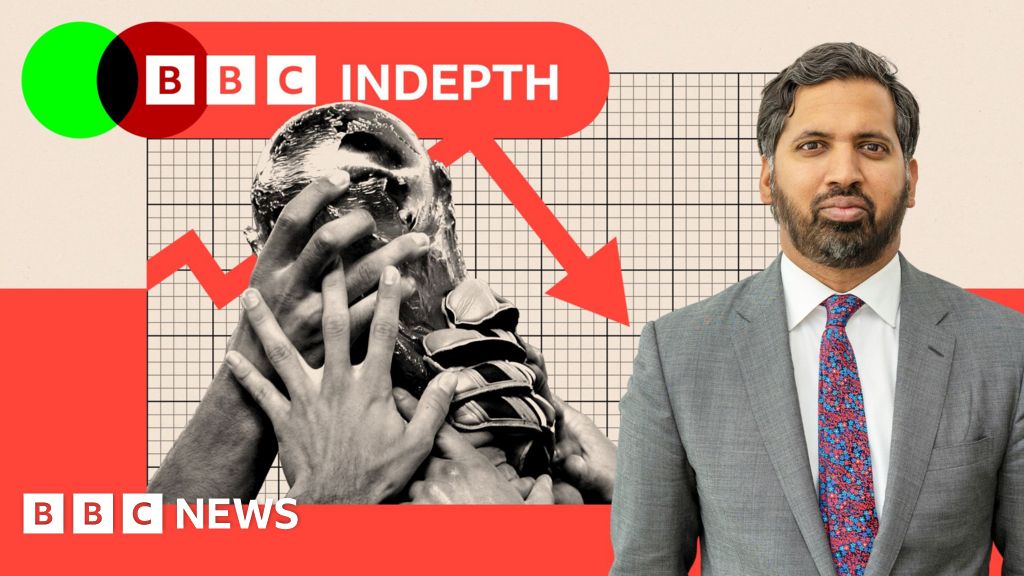
Instead, it is a case study of what is known as the K-shaped economy within the world's traditional advanced economies - where different groups within society experience very different financial outcomes - which when plotted on a graph show one line going diagonally upwards (as on the letter K) and another diagonally downwards (again as on the letter K).
And it is based on a type of attempted economic revolution in the pricing mechanism that clearly does value a certain type of fan more - those on the diagonally upwards line of that graph. It's important to say FIFA has a very different view of things and stresses those bountiful ticket revenues will be redistributed Robin Hood-style to develop football in the world's poorest nations.
This tournament is very, very big. The biggest stadiums, the largest number of games by far because the tournament has been expanded from 32 to 48 teams, it will probably have the highest global TV audience of any event ever, and it occurs across the largest mass of land, from Vancouver to Mexico City, ever seen. It is feasible that the winning team will have had to travel a distance the equivalent to the diameter of the Earth.
Then there are the prices. In comparison to the cost of watching elite level football in any other setting, the prices being charged to attend are beyond astronomical. Five-figure dollar amounts for the final, $1000 being the rough typical price for a ticket for one of the more attractive looking group games at the start of the tournament, and even the "bargains" costing a few hundred dollars, for a non-prestige match.
And it is the largest scale trial of an attempt to change the pricing mechanism for events such as this. The use of dynamic pricing, adjusting prices higher and higher in respect of rising demand, has been seen in music concert tickets, and some sports events, but never on this scale.
They may call the game soccer in America, but this is definitely American Football economics. In the NFL, seat pricing is designed for yield management - revenue maximisation is prized above the act of selling out the stadium. US sport is priced at the luxury top end, and so much so that the stadiums are mostly shrinking in capacity, rebuilt for many billions with hospitality suites and lounges where once there was seating.
The supply of these experiences is limited by the length of the season - in the NFL you have just nine home games, roughly half the number of major European football leagues and so in the NFL every game counts even more.