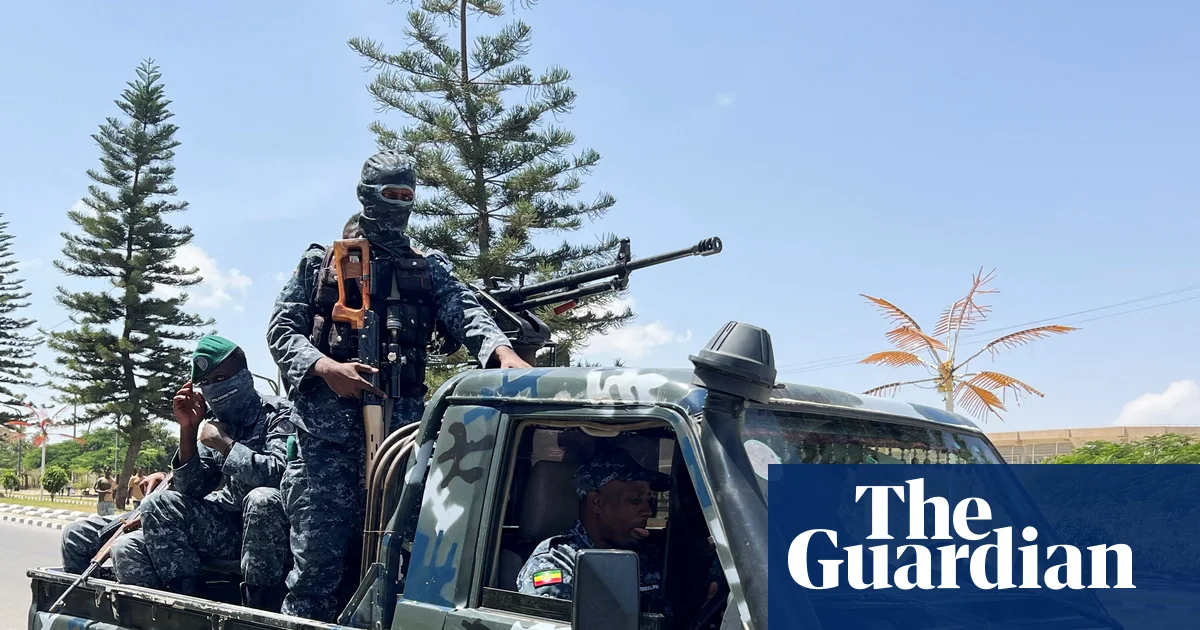
Eritrean troops who crossed into Ethiopia's Tigray region have come under drone attack from government forces, raising the risk that renewed internal conflict in Ethiopia could trigger an all-out regional war between the neighbouring countries. This was reported by Qazaqyia.kz citing The Guardian.
Military vehicles carrying soldiers drove across Eritrea's southern border into Tigray on Wednesday, reaching the town of Adigrat 25 miles (40km) south, according to civilian witnesses, a militia commander and the conflict monitoring group Acled.
Eritrean troops were then targeted by Ethiopian government drones on Wednesday evening and Thursday morning, Acled said.
Eritrea has a historical enmity with the Tigray People's Liberation Front (TPLF), which launched an offensive against the Ethiopian government on 23 September, but that previous hostility has been superseded by Eritrea's desire to head off a perceived risk of Ethiopia invading it, in order to access the Red Sea.
In the last two weeks, the TPLF and six other armed groups in Ethiopia have fought the government in Tigray and the neighbouring regions Amhara and Afar. Ethiopia's military pushed back and an allied militia, the Tigray Peace Force, took over Tigray's regional capital, Mekelle, on 4 October after the TPLF withdrew from the city.
Eritrea's information minister, Yemane Ghebremeskel, said in a statement: "We are not in the business of refuting wild allegations or narratives." He did not explicitly confirm or deny the presence of Eritrean troops in Ethiopia.
Ethiopia's foreign ministry said in a statement on Monday: "Ethiopia stands ready to defend its sovereignty, territorial integrity, and core national interests, while urging all regional actors to address shared challenges through constructive dialogue, partnership, and adherence to the principles of good neighbourliness rather than confrontation and zero-sum approaches."
The TPLF and Ethiopia's government fought a brutal civil war from 2020 to 2022. Between 300,000 and 800,000 civilians died, according to British government estimates. Both sides and their allies were accused of war crimes.
Eritrea intervened on the side of Ethiopia in that conflict, after a rapprochement between the two countries in 2018, which earned Ethiopia's prime minister, Abiy Ahmed, the 2019 Nobel peace prize.
Eritrea, which gained independence from Ethiopia in 1993, has a long enmity with the TPLF, which ruled Ethiopia from 1991 to 2018. The two countries fought a war from 1998 to 2000.
Relations between the countries have deteriorated again in recent years. Abiy has said Ethiopia needs access to the Red Sea, and state media has claimed the country has historical rights to the Eritrean port of Assab. The US-Israeli war on Iran – leading Iran to limit shipping through the strait of Hormuz – has further raised the stakes of Red Sea access.
In its statement on Monday, Ethiopia's foreign ministry said: "Any serious discussion of regional maritime affairs and security architecture must account for Ethiopia's legitimate interests and its enduring connection to the Red Sea."
Yemane said in a post on X on Wednesday that Ethiopia was "incessantly beating the drums of war and openly stating … that it will launch a war of aggression against Eritrea to acquire what it calls 'sovereign access to the sea' … In recent weeks, it has tried to repackage this war agenda in terms of 'self-defence' by fabricating various allegations against Eritrea."
Magnus Taylor, Horn of Africa deputy director at the Crisis Group thinktank, said: "The big worry is that [Abiy] might try to solve all his problems at the same time, by invading Eritrea, possibly a regime change move and also a land grab for the Red Sea port, and also solving his problem with Tigray at the same time. It's a very ambitious military agenda, though."
While the full impact of the fighting on Tigrayan civilians is not clear, reports have emerged of the TPLF forcibly recruiting boys as young as 15 to fight.
"The civilians in these three regions [Tigray, Amhara and Afar] didn't get healed from the first round of violence that was halted by the peace agreement [in 2022]," said Acled Ethiopia analyst Jalale Getachew Birru. "They just started healing recently."
Associated Press contributed to this story