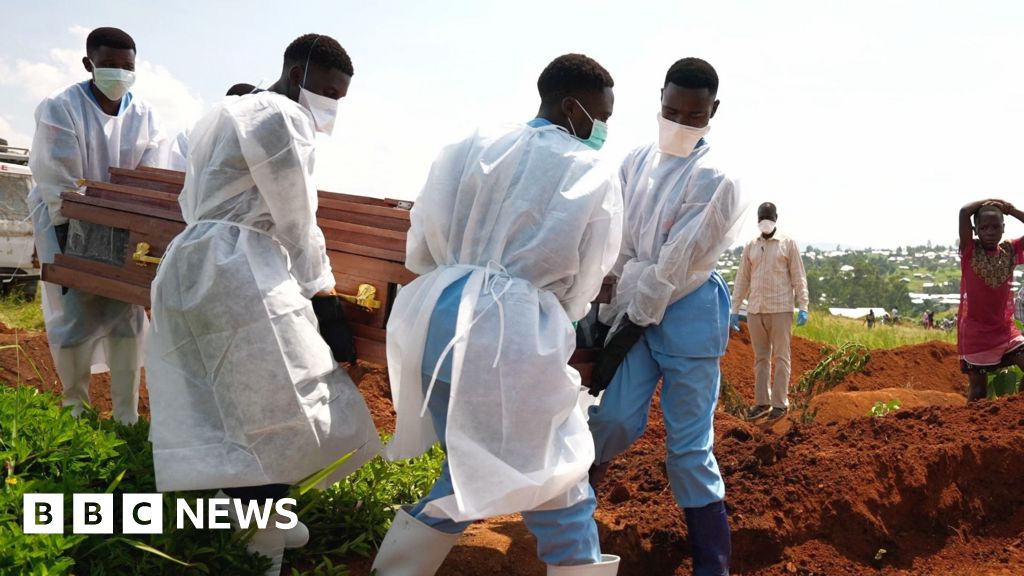
Nyamurongo cemetery in Bunia, a city in north-eastern Democratic Republic of Congo that is the epicentre of the current Ebola outbreak, is much busier than usual. This was reported by Qazaqyia.kz citing BBC News.
"Today is the sixth time I have come to the cemetery," says Joel Lonza Makumbu. "Yesterday I buried my father. Today I have come to say goodbye to my mother." He has also lost three sisters and a brother-in-law to Ebola. "I want to say for all people [to hear] that Ebola is true," he says.
The outbreak has killed almost 200 people in the last few months, mainly in the province of Ituri. The current outbreak has been caused by a rare species of Ebola known as Bundibugyo, which kills about a quarter of those infected.
Ebola is transmitted through contact with infected bodily fluids. Safe burials are vital to stop it spreading. One traditional practice that is now strongly discouraged is the washing of dead bodies by family members before burial.
Julienne Anoko, an anthropologist with the WHO, says communities in Ituri believe a dead person is "travelling from one world to the other world - to the world of the ancestors". "Women are dressed in a wedding dress with make-up… They sing, they celebrate that person, because it's a journey, it's not the end of the life," she explains.
But in the case of someone who has died of Ebola, they must immediately be put in a leak-proof body bag for burial. Maria Munoz-Bertrand, public health emergency co-ordinator for the IFRC, says efforts are being made to accommodate the needs of families. In Ituri this means that coffins are used - with the body bag placed inside. The coffin has a few transparent panels on the side to allow mourners to be able to see inside. Another change has been to body bags, which now have clear film at the top so the face inside can be seen.
"We need to be very close to the communities and engage with them very closely and make sure that they understand what's going on, they're informed and they consent," says Munoz-Bertrand. "If the family asks for something special to be included in the procedure, as long as it respects the infection prevention and control measures, and it doesn't put anyone at risk, we will try to accommodate the wishes of the family as much as possible."
I joined a team of IFRC volunteers as they went to an Ebola treatment centre at a hospital in Bunia to pick up a body for burial. Family members sat by the roadside waiting to accompany their deceased kin to the cemetery. One of the groups included a weeping mother who had lost her child. A tent just outside the treatment centre acts as a temporary morgue or transit zone where we see health workers in full PPE take a body bag and place and seal it inside a coffin. Then the IFRC team, made up of six people also in full protective gear, goes inside the tent from the opposite side to pick up the body and take it to a truck.
It contains the body of a 34-year-old mother of four, whose father and brother-in-law quietly observe the process from a distance. "This is a big blow for us," says her father Simone Nyal. "She was ill for just one week before she succumbed. She has left us her four children - I don't know how we will cope." At the cemetery her mother and sister wait by the newly dug grave. In under 10 minutes, the burial is complete. The volunteers decontaminate once again before departing, leaving three gravediggers to cover it with soil.