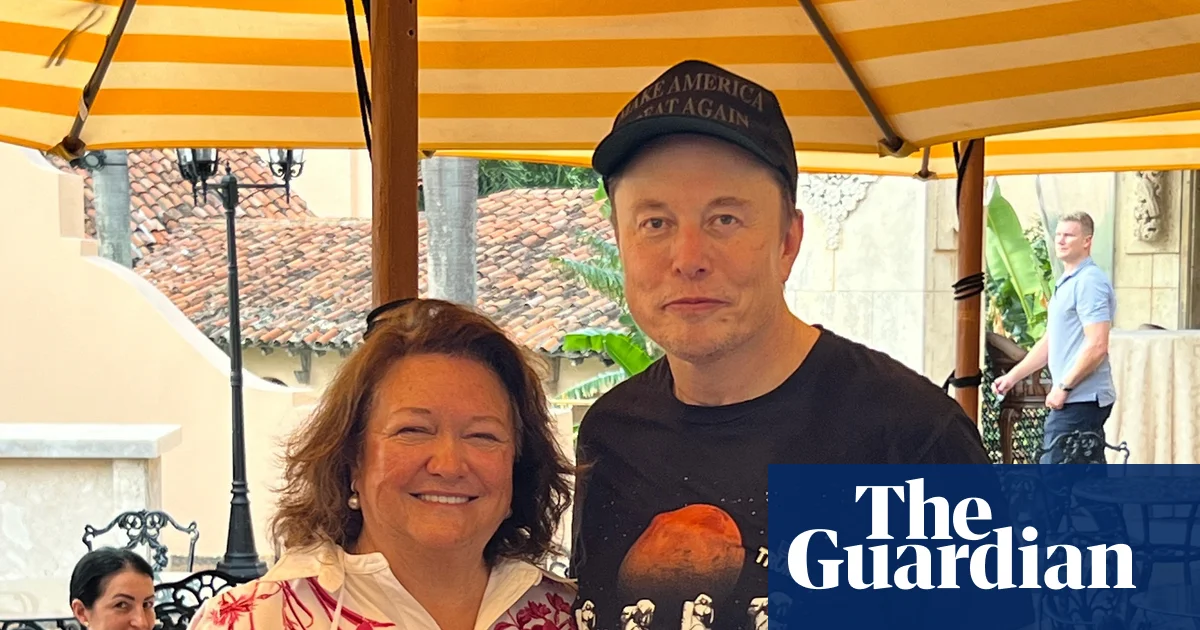
Australian billionaire Gina Rinehart's company has made a 'significant investment' in Elon Musk's SpaceX and hopes to collaborate on AI infrastructure. This was reported by Qazaqyia.kz citing The Guardian.
Hancock Prospecting secured shares as SpaceX began trading on sharemarkets on Friday, Rinehart said in a statement today. The figure, which Rinehart did not confirm, is reportedly at least A$1.4bn.
The Australian billionaire said her investment reflected her confidence in Musk and congratulated him on his initial public offering (IPO).
'Elon has done what very few people in history have done – he has not just imagined the future, he has built companies capable of delivering it, and helped to keep American technology at the forefront,' Rinehart said.
'We see SpaceX as a rare business: led by a truly exceptional person, technically exceptional and operating in sectors that are crucial, and with long-term potential. Hancock favours investing in industries led by sensible, hard working, patriotic and exceptional people. Elon excels in every regard.'
The rocket, satellite and AI company raised US$75bn from its record-breaking IPO, and is now valued at US$2.1tn after its first day of public trading.
SpaceX has proposed launching up to 1m datacentres into space and aims to establish colonies on the moon and Mars. Its prospectus warns it may never become profitable and runs at a loss of billions annually.
'Our mission is to build the systems and technologies necessary to make life multiplanetary, to understand the true nature of the universe, and to extend the light of consciousness to the stars,' SpaceX's investor prospectus reads.
Rinehart praised SpaceX's early rocket efforts and Starlink satellite communication network but expressed excitement at its AI prospects.
'Its work will continue to shape industries, economies and opportunities for decades to come,' she said.
Hancock Prospecting's chief executive, Garry Korte, said Hancock used the Grok AI platform and could work with SpaceX as a supplier of critical minerals for its advanced technology infrastructure.
'We look forward to the potential of working with the SpaceX team on its exciting journey,' Korte said.
The company has already seen a 20% return on its investment. Investors bought their allocated shares at $135 on Friday morning and the share price closed at $160.95.
Hancock Prospecting declined to detail how large its investment was, when asked about the Wall Street Journal's report that Rinehart bought over US$1bn (A$1.4bn) worth of the US$2.1tn (A$2.97bn) company.
If accurate, SpaceX would represent Hancock's biggest US shareholding. Its US-dollar holdings include $0.7bn in an Invesco Nasdaq index fund, $0.7bn in MP Materials, a rare earths company, $73m in Amazon, $61m in Meta, $57m in Google's parent company Alphabet, and $7.7m in Musk's Tesla among others disclosed in May.
Rinehart and other investors do not have direct voting influence over the company, as per the terms of the IPO. Musk, the chair and chief executive, owns a majority of both of SpaceX's share types, making him the world's first trillionaire after the company's debut.
The company is the eighth-largest company on the tech-heavy Nasdaq, worth more than Tesla and Meta. It is behind only the Taiwan Semiconductor Manufacturing Company, Amazon, Microsoft, Apple, Google and Nvidia.
Investors worldwide, including Australians in default superannuation funds, are expected to become indirect backers of the company as it moves into Nasdaq 100 index funds.
SpaceX has not yet been required to disclose its investors but they include Musk, employees and Peter Thiel, a cofounder of PayPal and founder of Palantir, who holds a reported $50bn worth of stock via his Founders Fund.
SpaceX's AI rivals, OpenAI and Anthropic, have also filed to go public some time this year and are predicted to raise record sums at valuations near $1tn.