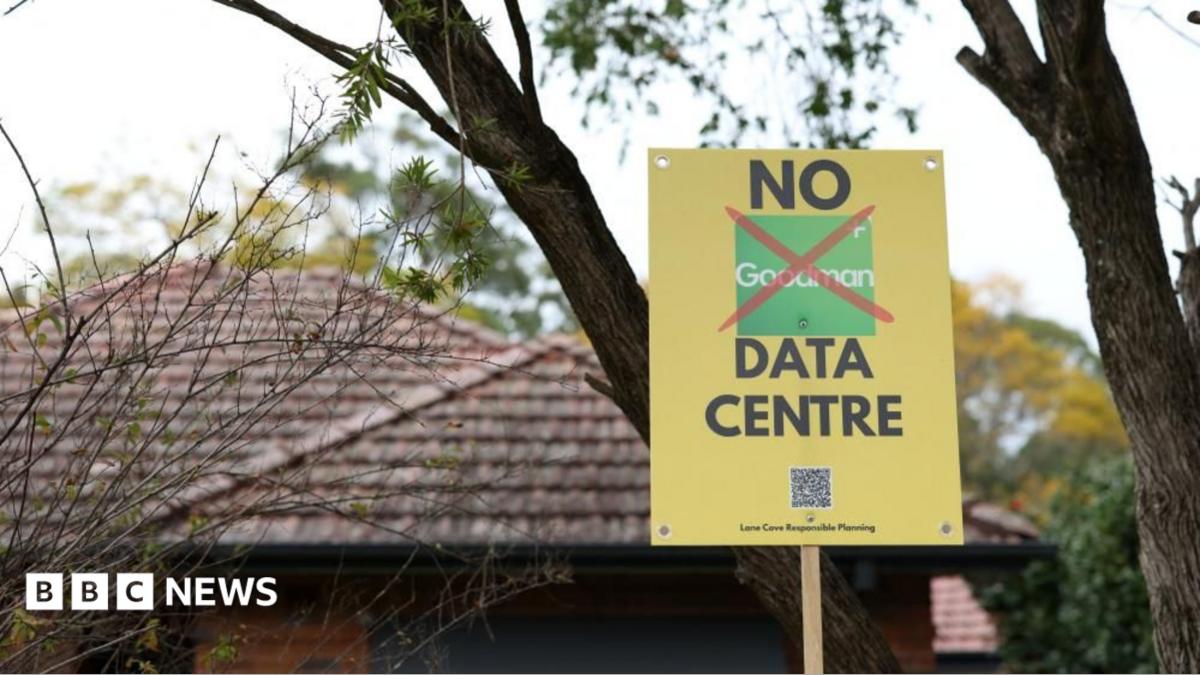
Australia is rapidly building data centres, but local residents are concerned about noise and environmental impact. Lucy*, who lives in the Lane Cove suburb of Sydney, says she hears a constant humming when putting her child to bed. Her home is just 350 metres from a data centre, and four more are planned at the local industrial park. This was reported by Qazaqyia.kz citing BBC News.
Australia has quickly become a global destination for data centres, attracting investors with its abundance of clean energy, natural gas reserves, and land. Earlier this year, OpenAI CEO Sam Altman said Australia could become a data centre capital of the world if it wanted to. Currently, there are 162 data centres across the country, with plans for 90 more, and an estimated more than A$155bn (£80bn) of investment lined up.
If approved, one of the world's biggest data centres will be built in western Sydney. At one gigawatt, it is expected to be Australia's largest single energy user. In Marsden Park, also in western Sydney, the biggest data centre in the Southern Hemisphere is already under construction only 100 metres from a local community.
Data centres have been essential to the digital economy since the arrival of the internet. They were originally built to process and store data for emails, online banking, and cloud services. But everything changed after 2022 when ChatGPT launched and AI exploded in popularity. Australia has roughly 13.6 million users of AI every month, making them the sixth most active users of the tech globally.
Experts say having data centres in Australia will lower the barrier to building more of its own AI companies. Belinda Dennett, CEO of Data Centres Australia, says if infrastructure is not built, the country becomes just a user. She highlights Australia's attractiveness for foreign investment due to land availability, political stability, the Five Eyes security alliance, a skilled workforce, and renewable energy potential.
Leading business experts and economists say that without Australia's data centre boom over the last couple of years, the country would likely have headed into a recession. Jon Whittle, a former director of the digital research centre at CSIRO, agrees and says the government doesn't really have a choice but to continue down the investment path. "We need to lean into it," he says.
However, leading energy and environmental experts argue Australia has little capacity to meet the massive energy and water demands of new data centres. The Australian Energy Market Operator says data centre energy demands could triple by 2030 nationwide. According to the Climate Council, without significant new renewable generation, data centres could push power prices 26% higher in New South Wales by 2035. There are fears the boom will trigger a new generation of coal and gas power plants. A recent report by Greenpeace Australia Pacific found that no data centre operator adequately proved their claim of driving the country's renewable energy growth.