There are two cardboard boxes in Meenu Rana's living room in Delhi. One is filled with Diwali decorations and twinkling lights. The other holds air purifiers. "The mornings have already started feeling stuffy. It will get worse in the coming days, so it's better to be prepared," says the 43-year-old teacher. This was reported by Qazaqyia.kz citing BBC News.
She is not alone. Every year, as winter and the festive season approach, residents of India's capital begin preparing for something far less celebratory: months of breathing polluted air.
Delhi and its satellite cities record some of the world's highest pollution levels through the year. But as winter sets in, the air often becomes unbearable.
Falling temperatures and slower winds trap pollutants close to the ground instead of allowing them to disperse. Smoke from crop residue burning in neighbouring states adds to emissions from vehicles and factories, as well as construction dust. Firecrackers used during festivals often worsen air quality.
The result is noxious air and a familiar question: why does pollution return year after year, and why hasn't more been done to tackle it?
This year, however, the Delhi government announced its Winter Action Plan months before the worst of the smog arrived. The plan is in place from 1 November to 28 February, covering the months when pollution usually spikes.
Experts have called this a step in the right direction, noting that in previous years measures were often rolled out only after the air quality got too bad to ignore. However, they say this by itself won't be enough, calling for more holistic, long-lasting measures.
Just days after the plan came into effect, the city is slipping back into a depressingly familiar pattern.
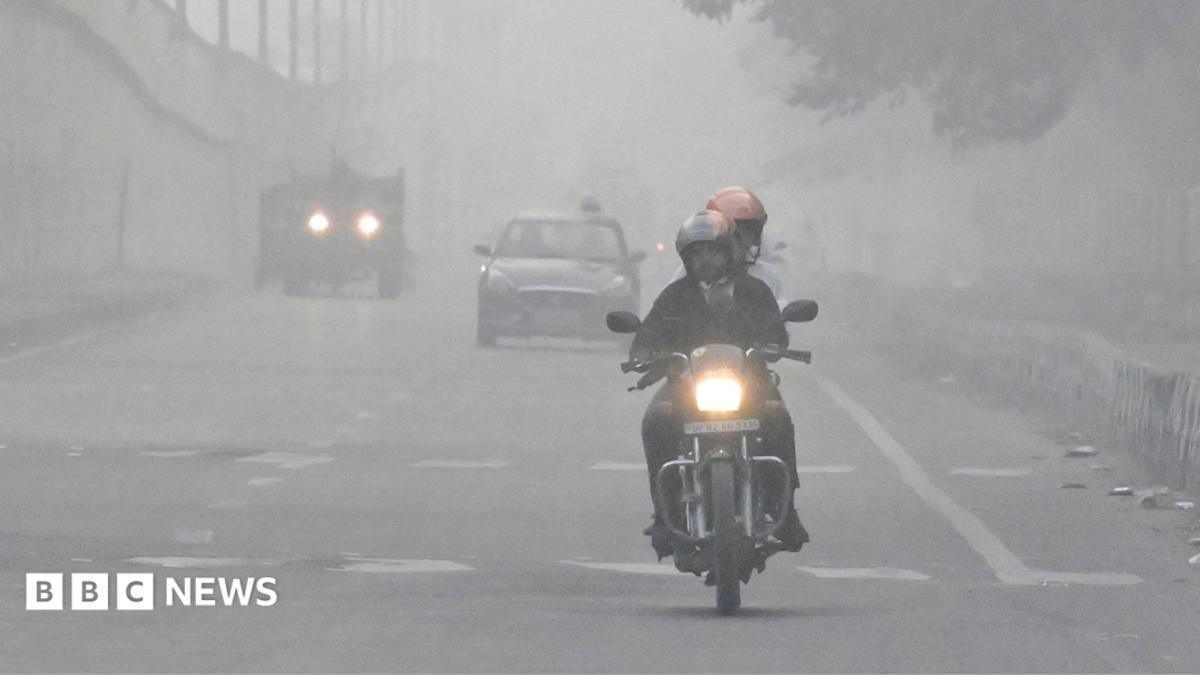
This week, a grey haze hangs over Delhi, along with a distinct smoky smell that residents unwillingly recognise. People complain of irritation in their eyes and difficulty breathing, and coughs and sneezes are heard everywhere.
For those who can afford them, air purifiers have become a household necessity. Outdoors, people wear masks or cover their faces with cloth, trying to protect themselves from the worst of the pollution.
Tackling pollution was among the promises made by the governing Bharatiya Janata Party during its election campaign last year. Its winter action plan is now a major test of that pledge.
The plan restricts the entry of older, more polluting vehicles registered outside Delhi and denies fuel to vehicles without a certificate which shows they meet emission standards. Demolitions and outdoor construction work that generate dust have been temporarily banned.
Private vehicle use is being discouraged - the government has asked offices to allow half of their employees to work from home, introduced staggered office timings for its staff and doubled parking charges. It says it will also strengthen pollution monitoring and enforcement and promote public transport and electric vehicles.
These measures are separate from the Graded Response Action Plan (Grap), which is overseen by the federal Commission for Air Quality Management.
Grap introduces restrictions in stages, with stricter measures kicking in as pollution levels rise. This week, its second stage is in force, restricting the use of diesel generators and burning of coal and firewood.
Expert say on paper, these actions collectively provide a roadmap for responding to rising pollution levels but their success ultimately depends on enforcement.
"There are a lot of positive changes as far as planning is concerned, but when it comes to execution, we probably still stand at the same level," says Parthaa Bosu, strategic adviser at the Environmental Defense Fund, a non-profit group focused on delivering climate solutions.
Others argue that the problem goes much deeper.
"If we want to reduce pollution, we need to set targets for every sector - including power generation, industry and transport - not just vehicle entry, construction and stubble burning," says Manoj Kumar, an analyst at the Centre for Research on Energy and Clean Air.
"We know how much each sector and each state contributes to pollution. We can set targets to reduce emissions from each of them over the next five years."
Bosu points out that an issue which does not get enough attention is secondary pollutants - when gases in the air react with sunlight, water vapour and other substances to form harmful particles that contribute to pollution.
"Pollution is not just caused by biomass burning or vehicles," he says. "Dust being stirred up from the ground, coal and fly ash, materials burned at brick kilns and the large-scale burning of urban waste are also contributing to the problem. And much of this is still not being stopped."
Delhi's pollution problem is also affected by what happens outside the city. Pollutants travel into Delhi from neighbouring states and other parts of northern India, worsening the situation, Bosu explains.
This means that measures taken by Delhi can achieve only so much. Tackling the problem requires neighbouring states and the wider northern region to work together, he adds.