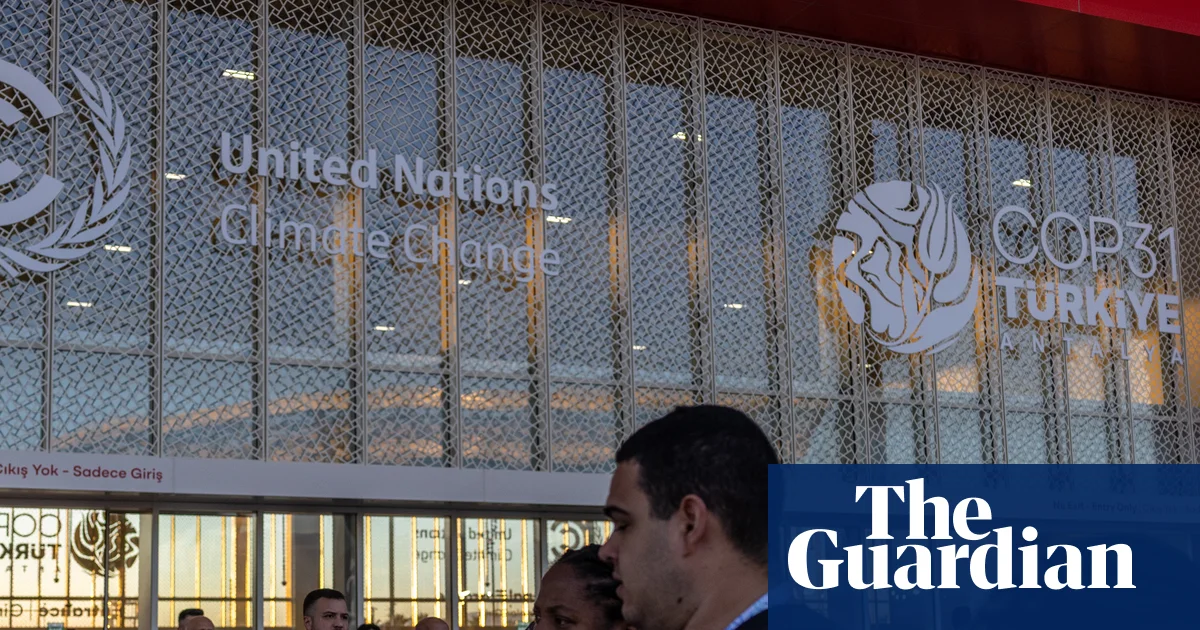
The Cop31 climate summit has begun in Antalya. This was reported by Qazaqyia.kz citing The Guardian.
Hosting Cop was a key pledge from Australia’s prime minister, Anthony Albanese, in 2021 while in opposition, before his successful election campaign. But arcane rules meant the country had to wait its turn to bid and was then embroiled in an angry row with Turkey over the hosting. The final compromise put Australia in charge of the negotiations which will take place in the Turkish city of Antalya. The bitter taste left by the row lingers and Australia has seemed to some a rather half-hearted host. The country’s media has been much quieter on Cop than previous host countries, and although Albanese will speak at the opening of the leaders’ segment, he is unlikely to stay long.
Chris Bowen, Australia’s climate and energy minister, will be in daily charge of the negotiations. As aspects of Australia’s energy supply also fall under his portfolio, he has been in the sometimes uncomfortable position of having to boost fossil fuels while insisting on the need for a clean energy transition.
Yet Australia has a positive story to tell on decarbonisation: while remaining one of the world’s major fossil fuel exporters, the country has also invested heavily in renewables, and solar power has now expanded so much that consumers are sometimes offered free electricity.
Recep Tayyip Erdoğan, Turkey’s autocratic president, showed little interest in climate and environmental concerns before bidding to host this year’s Cop summit.
In the last five years, Cop has also been held in Egypt, the United Arab Emirates, Azerbaijan, all in the same broad region. This has given an outsize role to the Arab group of countries, who are neighbours in the region and have a strong interest in ensuring that fossil fuel interests – including their lobbyists – are well represented.
Australia runs the overall direction of the negotiations, and Turkey’s government, with the environment minister, Murat Kurum, has control of the action agenda, a programme of voluntary initiatives. Erdoğan has used this to push forward a key interest of his wife, Emine Erdoğan, in cutting waste and promoting the circular economy. She has called for an end to “throwaway culture” and for recycling instead of landfill – though Turkey still has sites that leak vast quantities of methane.
Fatih Birol, the head of the International Energy Agency and one of the world’s leading energy economists, is understood to be one of the advisers behind this year’s emphasis on electrification, displacing fossil fuels with electricity for heating, transport and industrial uses. This could halve the amount of energy we need, and is the next biggest step, after boosting renewable energy generation, needed for a low-carbon world.
The recently re-elected President Lula da Silva will come to Cop31 for his first trip abroad after winning his historic fourth term, and will bring two roadmaps, one a global plan for the transition away from fossil fuels, the other for halting and reversing deforestation. These are non-binding, and contain no deadlines or firm requirements from governments, but show a series of steps that governments can take to achieve these goals.
Xi Jinping, the president of China, will not come to this year’s Cop, but his country’s rapid energy and industrial transformation will determine the course of the planet’s future. China is the world’s second biggest economy and the biggest emitter of greenhouse gases, making up nearly a third of global annual carbon output, owing mainly to the use of fossil fuels to power its explosive economic growth for the last 25 years. But it has also invested in renewable energy, which is reshaping the global energy business.
Xi may not be present in Antalya, but the top officials he sends will know that petrostates – including Russia, Saudi Arabia and the UAE – are his important allies. However, countries pushing for a low-carbon future may be more important still – as China’s customers.
For several months this year, India’s prime minister, Narendra Modi, mulled an intriguing proposition: to host the Cop33 UN climate summit in 2028. In the end, India withdrew its bid in April without specifying why, leaving the field open. India is torn between its burgeoning clean energy sector – it now has the world’s third biggest installed capacity of renewable energy, after China and the US – and its coal sector, which still supplies about 70% of electricity, and has close links to Modi.
Bhupender Yadav, India’s environment minister, who leads its Cop delegations, enjoys a mutually supportive relationship with the UK’s Ed Miliband, and a reputation as a forward thinker.
The attention of Donald Trump has been fixed on the crucial midterm elections, a verdict on his second term as president that has shown Republicans the electoral dangers of an unpredictable White House. No US delegation is expected at Cop31, and soon Trump’s withdrawal of the country from the UN framework convention on climate change will mean none can take part.
Trump’s shadow was felt at Cop30 in Belem last year, as he started to dismantle the US’s renewable energy sector and boost fossil fuels, setting the US on course to start increasing greenhouse gas emissions.