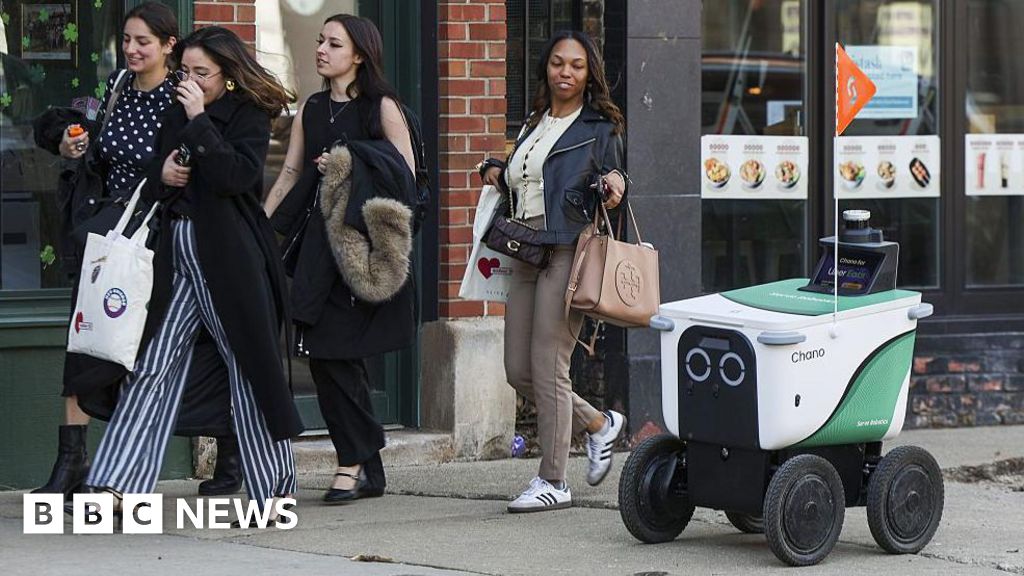
Chicago resident John Roberts was initially impressed when he first saw a delivery robot on his street, calling it futuristic. But his attitude changed when, while walking with his family, he had to dodge a robot. "We were on the strip reserved for walking, and we were having to get out of the way. If there were dozens of robots with lights and cameras zipping around, what would it be like to go for a walk as a family?" says Roberts. This was reported by Qazaqyia.kz citing BBC News.
This was reported by Qazaqyia.kz citing BBC News.
Autonomous delivery robots have appeared on sidewalks in several US cities, as well as in the UK, Japan, South Korea, and Germany, transporting groceries and fast food using cameras, sensors, and GPS. Operators claim the robots reliably avoid obstacles, cross streets safely, and reduce traffic and emissions.
However, some local authorities in the US and Canada, along with members of the public, are less enthusiastic. San Francisco has limited robots to less busy areas, and Toronto has banned them from sidewalks since 2021. In Chicago, robots are banned in two small areas.
Roberts wants the robots suspended across Chicago until safety tests are conducted and clear rules are set. His petition has gathered around 4,400 signatures. People often have to step into the street to get out of the robots' way, says Roberts. "There have been reports of collisions and injuries. I saw someone struck by a robot's safety flag. Robots cause traffic issues and block emergency vehicles by acting erratically at crosswalks."
Similar concerns have emerged in Glendale, California, where the city council is considering a temporary ban. Councilmember Ardy Kassakhian says the robots appeared without warning, and initially no one knew which company supplied them. "The increased visibility of robots downtown, questions about accessibility and pedestrian movement, uncertainty about regulatory authority—no one asked permission—and the impact on workers and public places," he says. Kassakhian personally witnessed a "stand-off" between a robot and an elderly person, as well as broken-down robots causing obstructions.
In the UK, in Sheffield, there have been reports of Uber Eats robots being vandalized. Starship Technologies, the supplier, says the robots are safe. "The robots are friendly, polite, and programmed to be careful. They've slotted into everyday life in many communities since 2018," says European operations director Danny Pass.
The Independent Workers Union of Great Britain (IWGB) is concerned about job impacts. President Alex Marshall says, "If this becomes a permanent reality, we'd have to pressure for a ban because the human impact would be massive. Many precarious workers in London would suffer."
According to a report by Transforma Insight, there will be 2.1 million autonomous delivery robots worldwide by 2034. Currently, regulations vary: South Korea and Japan have taken a liberal approach.
Roberts is fighting for the best outcome for pedestrians in Chicago. "There's a sense that change like this, even when unwanted, is inevitable. But even if none of us can stop the future, we can at least choose which future we move into," he says.