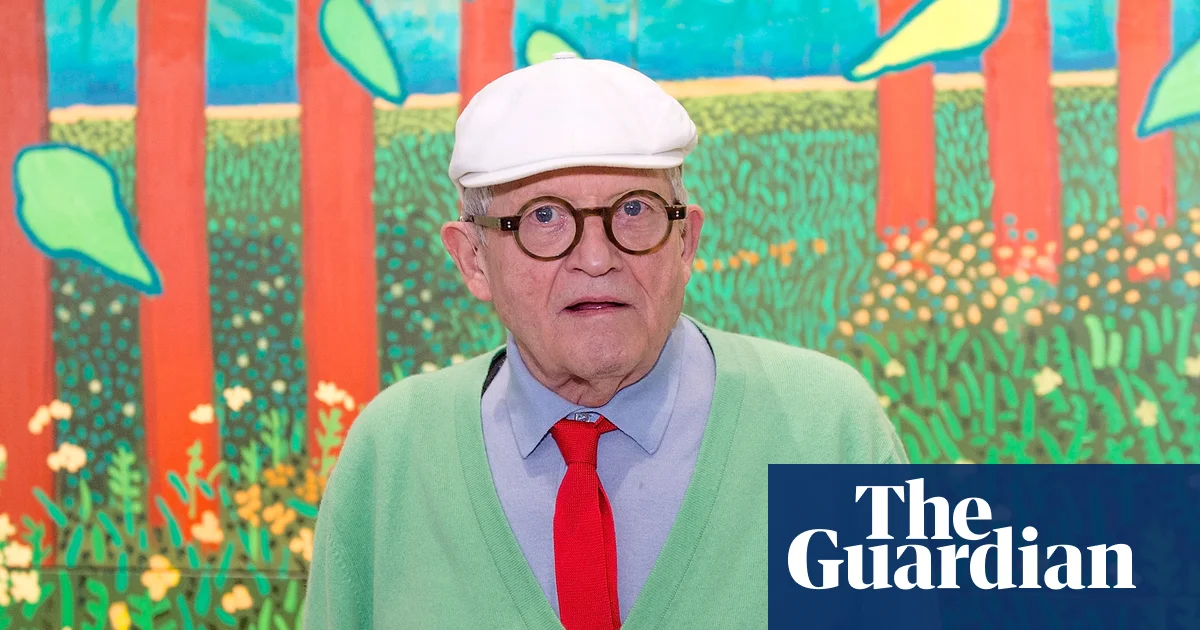
David Hockney, the iconic British painter who cast a revolutionary gaze across 20th-century art, has died aged 88. This was reported by Qazaqyia.kz citing The Guardian.
He made his name as a pop artist during the swinging 60s and was perhaps best known for his paintings of swimming pools that helped define the Los Angeles aesthetic. Works such as "A Bigger Splash" and "Portrait of an Artist (Pool With Two Figures)" depicted hedonistic scenes of love, lust and loss taking place below the city's sun-soaked skies.
But Hockney's six-decade career cannot be defined by a single era. He produced perspective-shifting portraits using photo-collage, experimented with abstract landscape painting and, in later life, investigated the possibilities of creating artworks out of emerging 3D technology.
The UK prime minister Keir Starmer was among the first to pay tribute to Hockney. "The prime minister is saddened to hear of the death of David Hockney, one of Britain's most celebrated artists," a spokesperson said. "His vivid, instantly recognisable work influenced generations of artists, and the prime minister's thoughts are with his friends and family."
A statement from Hockney's representatives said: "The celebrated British artist David Hockney, one of the most important figures in contemporary art in both the 20th and 21st centuries, passed away peacefully at home on 11 June 2026, one month short of his 89th birthday." It added: "David Hockney's enduring legacy reflects his underlying enthusiasm for life, his outstanding sense of humour, his immense generosity and his investigative curiosity encapsulated by his signature phrase: Love Life. Details of memorials will follow in due course."
Director of London's Tate Britain art gallery Alex Farquharson described Hockney as an "immensely important figure". "David was an endlessly inventive artist, with a unique vision of the world," Farquharson told the BBC. "He was always completely and courageously himself, both in his work and in life. He taught us about the joy of looking, seeing things the rest of us failed to notice – his witty and sharp observations a constant presence within his work and in person. The loss to the art world is immense: David's passing brings to a close an extraordinary body of work characterised by reinvention."
The Tate is planning to stage a major exhibition of his work at Tate Britain next year, as well as a multimedia installation in the Turbine Hall of Tate Modern, and said it would continue to work with Hockney's team to ensure both would go ahead.
The Pompidou Centre in Paris, with which Hockney collaborated for two landmark exhibitions, described him as "unquestionably one of the major figures of contemporary art". It added that the works he leaves behind remain "dazzling, alive and eternal".
Born in Bradford, West Yorkshire, in 1937, Hockney was the fourth of five children in what he described as a "radical working-class family". His parents encouraged their son's early artistic promise. He studied art at Bradford College and sold his first painting – a portrait of his father – for £10 at the Yorkshire Artists Exhibition in 1957.
As a conscientious objector, he completed his two years of national service as a hospital orderly before enrolling at London's Royal College of Art in 1959. He swiftly gained a reputation as a unique talent, albeit one with a rebellious streak. His refusal to paint a life drawing of a female model almost stopped him from graduating – pointedly, he submitted "Life Drawing for a Diploma", which depicted a muscular male figure from an American physique magazine. Hockney also declined to write an essay required for the final examination, believing he should be assessed solely on his artworks. The RCA, aware of the talent it was fostering, bent its rules so it could award him the diploma.
It was the start of a career in which Hockney had no qualms about challenging conservative society. His 1961 painting "We Two Boys Together Clinging", named after a Walt Whitman poem, was an early indicator of that. Works that followed, such as 1962's "Cleaning Teeth, Early Evening (10pm) W11", with its phallic Colgate tubes and chains, would depict gay life with an honesty and openness that was almost completely at odds with a Britain in which homosexuality remained a criminal offence until 1967.
With his signature bleach-blond hair, round, thick-rimmed spectacles and cigarette dangling from his lip, Hockney became a figure on the 60s party circuit in London and the US. He partied with Andy Warhol, Ossie Clark and Dennis Hopper, earning himself a reputation as a playboy and a flâneur. Yet while he indulged in the pleasure-filled life of a drug-taking bohemian, he never lost sight of his strong Yorkshire work ethic. Even after a stroke in 2012, which temporarily impaired his speech, he continued working.
After moving to LA in the mid-60s, his more mature and restrained works garnered acclaim for their ability to transport deep and complex emotions on to the canvas. "Man in Shower in Beverly Hills" (1964) found the artist hitting his stride as he developed towards a more realist style. In November 2018, Hockney's 1972 masterpiece, "Portrait of an Artist (Pool With Two Figures)", sold for $90.3m (£70.2m) at Christie's, a world record for a living artist at the time. The work was inspired by Hockney's breakup.