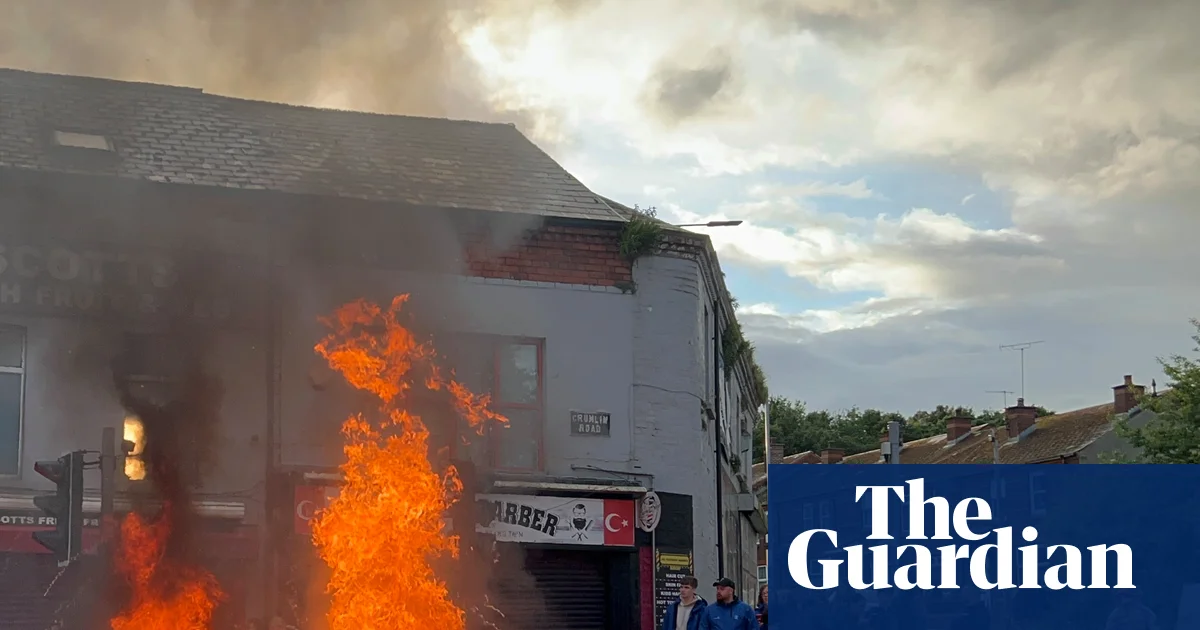
Who is safe on Britain's streets? Two acts of gross violence – the murder of Henry Nowak in Southampton and the stabbing of Stephen Ogilvie in Belfast – have been ruthlessly exploited by the far-right, and now the spaces we all share are contested. This was reported by Qazaqyia.kz citing The Guardian.
It is an entirely human response to feel unsafe when we watch a clip of an assailant wielding a knife over his victim, or police officers handcuffing a distressed, dying young man. Much as it is when we see ethnic minority families fleeing burning homes in Belfast, or a menacing crowd in Glasgow setting about black people as they pass.
Tensions have escalated sharply, but how safe people feel wearing a hijab or a kippah, holding hands with a same-sex partner or driving a wheelchair, has been eroding for years.
Today, I speak to our community affairs correspondent, Aamna Mohdin, about how the mood at street level has changed for visible minorities, and set out some very practical steps for what we can all do to make our shared spaces safer.
First the headlines
Middle East | The US launched new strikes against targets in Iran for the second consecutive day after Donald Trump promised to "hit them hard again" as a two-month-old ceasefire appears close to collapse.
UK politics | Keir Starmer's closest aides are "war-gaming" how to win a leadership contest ahead of Andy Burnham's much-anticipated return to Westminster if he wins the Makerfield byelection, the Guardian understands.
Belfast | Elon Musk's X will face no action to remove a mass of posts inciting violence in Northern Ireland for at least two months, despite widespread condemnation of the platform and its billionaire owner.
Environment | Temperatures in the Antarctic climbed above 15C this month, shattering the previous winter heat record for the usually frozen region and raising concerns about the speed of climate breakdown.
UK news | One of the government's key contractors has launched an investigation into allegations of racism, antisemitism, Islamophobia and hate speech among staff working in immigration removal centres, the Guardian has learned.
Street-level reality
On Monday evening, Stephen Ogilvie was stabbed on a Belfast street. Sudanese asylum seeker Hadi Alodid has been charged with his attempted murder. Horrific footage of the bloodied attacker straddling his victim circulated on social media, and was seized on by far-right agitators, who escalated local shock and exhorted people on to the streets.
On Tuesday evening, some did, and their protest erupted into violence, as masked crowds blocked roads and burned vehicles, houses and shops. Families were forced to flee their homes. And on Wednesday, police used water cannon to disperse a crowd of about 300 people who burned a truck and reportedly planned to target a nearby hotel that was believed to host migrants. Yesterday, Ogilvie's family stated: "We do not want this terrible tragedy to be used to divide people or fuel hostility." Their plea was strikingly similar to that of the father of Henry Nowak, who was murdered by Vickrum Digwa, a British Sikh, last December. Both calls were ignored as Reform politicians, Rupert Lowe, and far-right actors including Elon Musk and Tommy Robinson, co-opted these dreadful losses for their own cynical ends.
Minority fears
Aamna and I started discussing this last month, while working on a story about how minority communities were braced for a surge in racism following Reform's historic election success.
Four weeks later, it's clear that the fear has intensified. "But many Black, Muslim, Jewish, LGBTQ+ and disabled groups describe this worsening atmosphere that stretches back years, not weeks," Aamna tells me. For her, the starting point was Brexit, in particular the language and intention of the Leave campaign in the run-up to the 2016 referendum. "There was a shift in the way politicians and the media talked about these communities. This hostility has become increasingly normalised in mainstream discourse and we're seeing the consequences at street level."
Political rhetoric doesn't stay in Westminster. "It filters into conversations that people are having at work, on buses, in schools," she says, "and it explodes in the race riots we saw in the summer of 2024 and now on the streets of Belfast."
While Home Office data indicates a long-term decline in violent crime, hate crimes have increased steeply in recent years; racially and religiously motivated offences in particular.
And crime is now often seen through a racialised lens, "so if a person of colour commits a crime an entire community is held in collective punishment" – as British Sikh and Sudanese communities have described to our reporters.
What's the reality at street level for visible minorities?
While reports of physical assaults and attacks on places of worship are now shockingly familiar, some of this on-street hate takes more insidious forms: dirty looks, muttered comments, shouted slurs, vocally discussing how a person might have arrived in the UK or whether they're entitled to a disabled parking space. "Muslim women, particularly hijabi-wearing women, often take the brunt of this," says Aamna.
Incremental attacks affect people's daily decisions: where to walk, where to live, which school to send children to. This erosion of safety has long-term psychological effects and limits the use of public spaces.
What can be done?
Aamna suggests several practical steps: intervene if you witness an incident, report hate crimes, support minority communities, critically evaluate political rhetoric, and engage in public discourse. "Each of us can contribute," she says.
In conclusion, making streets safe for all requires conscious effort to counter hatred and division, and to make public spaces inclusive.