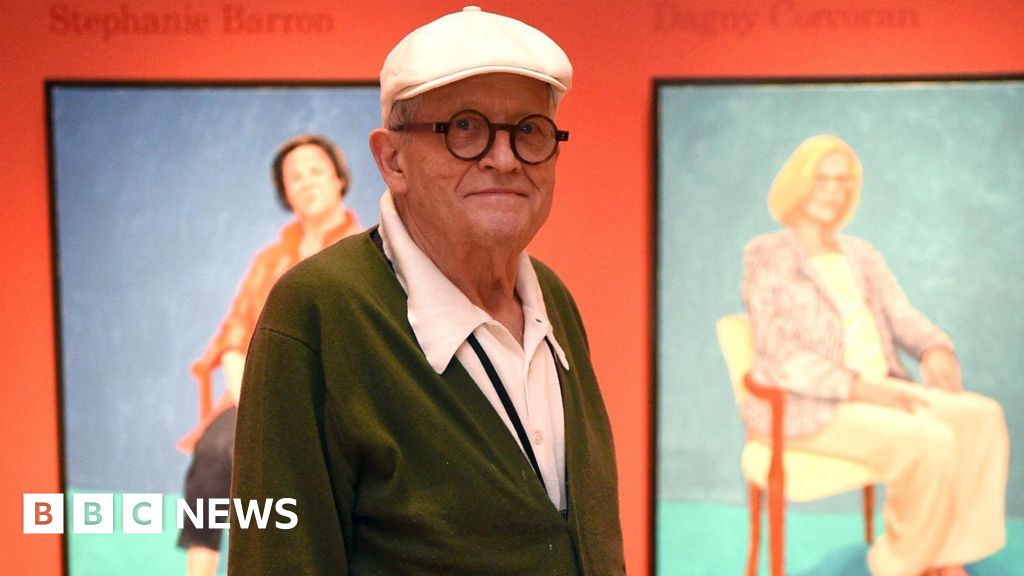
David Hockney, one of the UK's most important and popular artists, has died at the age of 88. This was reported by Qazaqyia.kz citing BBC News.
Prime Minister Sir Keir Starmer said he was "saddened" to hear of the death of "one of Britain's most celebrated artists".
Artist Dame Tracey Emin said she felt privileged to have known Hockney, adding: "A great artist and a wonderful man, who with the power of art changed the perception of Britishness. A proud chain-smoking homosexual, who flew the flag higher than any other British artist."
Over his seven-decade career, Hockney was famous for his vibrant and innovative artworks, including landscapes of his native Yorkshire, sun-drenched paintings of Los Angeles swimming pools, and iPad portraits of his friends and family.
A Downing Street spokesman added that the artist's "vivid, instantly recognisable work influenced generations of artists, and the prime minister's thoughts are with his friends and family".
Alex Farquharson, director of the Tate Britain gallery, described Hockney as an "immensely important figure" and "an endlessly inventive artist, with a unique vision of the world". He remembered Hockney as someone who was "always completely and courageously himself, both in his work and in life".
"He taught us about the joy of looking, seeing things the rest of us failed to notice - his witty and sharp observations a constant presence within his work and in person," he continued.
"The loss to the art world is immense: David's passing brings to a close an extraordinary body of work characterised by reinvention." He also praised "his astonishing talent, his love for art and life, and his profound and unconventional insights".
The Pompidou Centre in Paris described Hockney as "unquestionably one of the major figures of contemporary art", adding that his works remain "dazzling, alive and eternal".
Announcing his death on Friday, Hockney's representatives said: "The celebrated British artist David Hockney, one of the most important figures in contemporary art in both the 20th and 21st centuries, passed away peacefully at home on 11 June 2026, one month short of his 89th birthday."
The statement added that his "enduring legacy reflects his underlying enthusiasm for life, his outstanding sense of humour, his immense generosity, and his investigative curiosity encapsulated by his signature phrase: Love Life".
The Tate said they would continue to work with Hockney's team to stage two planned projects next year. One is a major exhibition at Tate Britain, spanning seven decades of his work, and the other is a multimedia installation in Tate Modern's Turbine Hall.
The Tate said its Hockney exhibition in 2017 was the most visited in Tate Britain's history.
Tracy Brabin, the mayor of West Yorkshire, called Hockney "quite simply one of Yorkshire's finest". "A Bradford boy who changed the art world forever. But words alone don't do David justice. His work, those pioneering pieces that burst onto the scene with vivid colour, changed the trajectory of modern art, and will continue to inspire generations to come," she posted on X.
London Mayor Sadiq Khan called the artist "a true icon and revolutionary of British art who never stopped reinventing his work," saying his "vivid paintings of our changing seasons helped me see the beauty and fragility of our natural world - and why it must be protected".
Dominic James Bilton, co-leader of the Queer British Art Network told the BBC: "We've lost one of those people who were making changes in society before it was socially and culturally acceptable to be gay. He pioneered queer British art before it was fashionable to do so, before contemporary society built upon it."
Labour peer Lord Cashman added that the artist "spoke truth to the world, whether the world was ready for it or not", adding that when gay rights group Stonewall was founded, Hockney donated an artwork worth $250,000 to pay for its early years as a charity.
Antiques Roadshow art expert Frances Christie told BBC Radio 5 Live that Hockney's art appealed to a wide audience. He painted "really everyday, ordinary subjects - he painted people, he painted the landscapes around him, whether they were in Yorkshire or the Grand Canyon or in California or in Normandy or in France", she said.
She added that he was a "master of colour", adding: "He wasn't scared to use bold dynamic colour combinations, and above all, I think there's an energy in his pictures. They're often just joyous, you can feel his energy and warmth in them, but equally he can also elicit lots of very different emotions as well."
Art historian Richard Morris posted on X: "His huge achievement was to make serious painting look effortless. He carried forward one of the most sustained investigations into vision, space and representation by any post-war artist. British art has lost a giant."