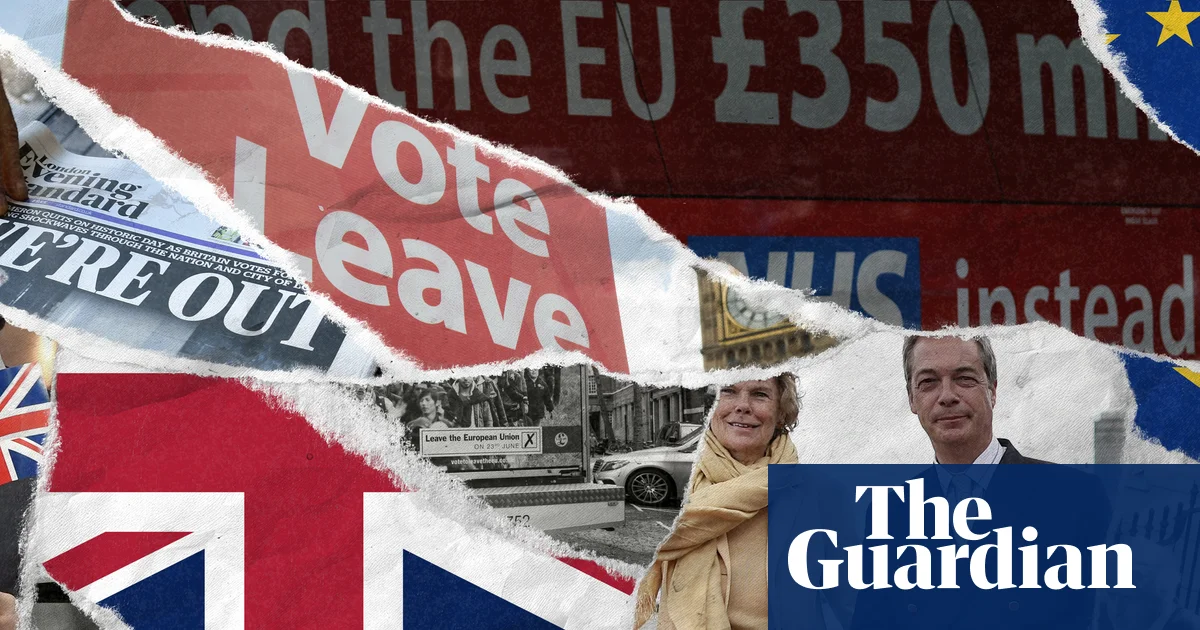
An oral history of the Brexit campaign, told by those with a front row seat, reveals how five months in 2016 that encompassed Boris Johnson siding with Vote Leave, Jo Cox's murder and David Cameron's resignation shaped the UK's future. This was reported by Qazaqyia.kz citing The Guardian.
20-21 February 2016
David Cameron, having promised in 2013 that a future Conservative government would offer a referendum on Britain's membership of the EU, announces the date of the vote: 23 June 2016. The next day, Boris Johnson, then the mayor of London, says he will campaign for leave.
Bernard Jenkin, a senior Conservative backbencher, campaigned for leave: "The starting gun was really fired in the 2013 speech. I went to see David Cameron after that and begged him not to hold an in/out referendum, simply because it would smash the Conservative party. He said to me: 'I know 50 Conservative MPs may vote leave, but we can live with that.' And I immediately realised he didn't really understand the Conservative party at all."
David Lidington, minister for Europe 2010-2016 and a close Cameron ally, campaigned for remain: "Holding the referendum was very much a prime ministerial decision. I didn't think it was the right one, but I understood David's reasoning. He was the prime minister, and his view was that this was an opportunity to lance the boil of disaffection within the Conservative party over Europe. I always felt that it was like chucking lumps of red meat to pursuing wolves from the sled. They would gobble up the lump, and then they would sure as hell come back for more."
Craig Oliver, director of communications for No 10 and for the official remain campaign, Britain Stronger in Europe: "The feeling for me at the start of the campaign was that we were in real trouble – not because we thought we were going to lose the referendum, but because it was such a battle inside the Conservative party. The beating heart of the party felt very, very much around leave, and anybody who had fought on the side of remain was not going to be acceptable as a prime minister. So I entered into the campaign with a fairly bleak view of our prospects. I thought we probably would just about get over the line, but very quickly after it the Conservative party would come for David Cameron."
Will Walden, director of communications for Boris Johnson: "I was with Johnson that weekend in almost its entirety. For the vast majority of the country, people were unsure which way to go. I don't think Boris was any different. Was there any political calculation in his eventual decision? Probably there was, but I think the truth is he was genuinely divided. He was pro-European. He just had problems with the EU. He spent the weekend at his Oxfordshire farmhouse, being buffeted from all sides – Cameron, Osborne, family. By the time he arrived back in London to the press pack sitting outside his house, he genuinely hadn't made up his mind. He veered all over the place like the proverbial shopping trolley. He was very stressed. At one stage, he looked at me and said: 'What should I do?' And I said to him, in fairly colourful language: 'I'm not making the most consequential decision you'll ever make. You need to make that decision.' He went: 'You're right, let's get on with it. Let's make the decision.' It took him another hour of prevaricating to reach the decision. He went outside, and I think that announcement changed the course of history."
Lidington: "David Cameron and his political team were pretty shocked and fed up at Boris Johnson's decision. Though I think David was more upset by Michael Gove's decision to opt for leave. That represented the breach of a much closer personal friendship. I don't think there was ever much belief on David Cameron's part that Boris Johnson was doing this out of some issue of high principle. I think it was recognised that ambition and a desire to position himself as the favourite son of the hard right of the Conservative party – with a view to the eventual succession – was very much in his mind."
Jess Phillips, Labour MP, campaigned for remain: "I can't say that I remember thinking that Boris Johnson was a particular danger, and that is foolishness on my part. To me, Boris Johnson was just a fool, and I genuinely couldn't believe why anybody would think that anything he said was anything other than a lie. So, I just thought, does it really matter which campaign he backs?"
Campaigning begins in earnest when a government leaflet about the dangers of Brexit is sent to every household. Leave campaigners dismiss this as part of "project fear".
Phillips: "I quite quickly got involved with the remain campaign, but it wasn't like any campaign I'd ever been part of. It was very disorganised. Trying to knock doors in my constituency, for example, became an impossibility, because you had no base to go from. We were making up what we were doing. We were thinking, OK, we'll go to people who are Labour supporters, who maybe are more likely to be remain. That was absolutely not the case. I remember feeling that the campaign was quite elitist."