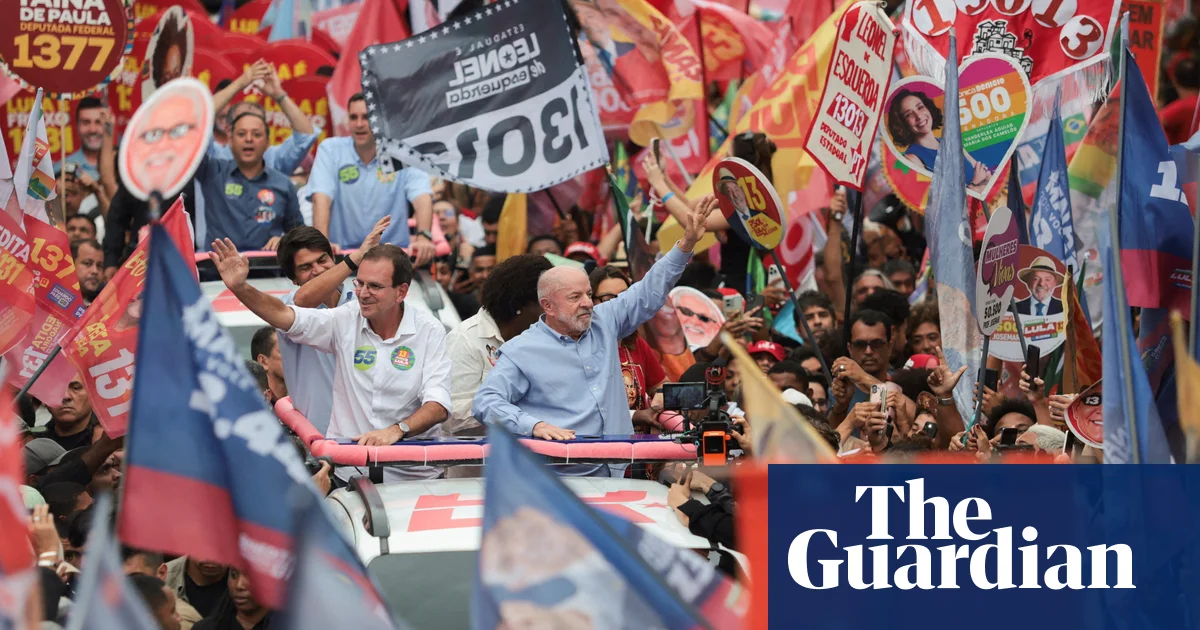
Brazil's presidential election on Sunday, 4 October, is being watched far beyond the country's borders, with analysts saying it could determine the balance of power across Latin America. This was reported by Qazaqyia.kz citing The Guardian.
Shortly after his controversial speech to the United Nations general assembly in September, Donald Trump gathered a dozen like-minded Latin American leaders and boasted that rightwing candidates had won all seven presidential elections held in the region since he began his second term. "Everybody I've endorsed has won," the US president said in New York to most of the leaders of the Shield of the Americas, an anti-drug cartel coalition of 15 countries governed by the right or far right.
Those electoral victories – and the US takeover of Venezuela after capturing Nicolás Maduro – have left just six Latin American countries under leftwing governments: regional heavyweights Brazil and Mexico, small Uruguay and Guatemala, and the isolated regimes of Cuba and Nicaragua.
On Sunday, Brazilians go to the polls in a presidential election that many believe will determine more than Latin America's largest country's fate for the next four years.
Given Mexico's geographic proximity and unique economic relationship with the US, analysts see Brazil as perhaps the last country in the region still capable of saying "no" to Trump's whims – something that could change dramatically depending on the election result.
Polls indicate a neck-and-neck race between Luiz Inácio Lula da Silva, the 80-year-old leftist incumbent who is seeking a fourth non-consecutive term, and Flávio Bolsonaro, 45, the far-right senator son of former president Jair Bolsonaro.
"Trump really does take seriously the idea that the Americas should be his back yard," said Pedro Telles, a professor at the School of International Relations at Brazil's FGV university.
"Mexico will remain relevant, and its president, Claudia Sheinbaum, is one of the most popular leftwing leaders. But if Flávio wins, it would be a real blow to the left and a major boost to the far-right agenda globally," added Telles.
"There is a lot at stake," said Sandra Borda Guzmán, an associate professor of political science at Colombia's Universidad de los Andes. "Instead of taking the opportunity to expand our region's autonomy, a far-right victory would align the region unconditionally with the dictates of the US," she added.
Lula and Bolsonaro differ sharply on the US, including over what has become Trump's main foreign policy for the region: the so-called "war on drugs" used to justify dozens of airstrikes on boats that have killed more than 230 people and joint operations involving US military personnel on land.
While Bolsonaro has pledged to join the Shield of the Americas and to follow an "iron fist" approach to crime, Lula has raised concerns about sovereignty and said it is "sad to see the inferiority complex of Latin American presidents" who are part of the Trump-created coalition.
Lula and Trump's relationship has swung between not speaking and public displays of warmth, but it is currently at a low point, with the Brazilian president and Democratic members of the US Congress accusing Washington of trying to interfere in Bolsonaro's favour.
"Brazil is a big prize," said Michael Shifter, adjunct professor at Georgetown University's School of Foreign Service, adding that amid endless conflicts in Iran, Ukraine and Israel-Palestine, "US foreign policy is going very badly in the rest of the world."
A victory for Bolsonaro in Brazil, he said, would be used "triumphantly" by Trump for producing an "almost completely aligned region".
At the latest Shield of the Americas meeting, Trump made clear that it was not all about security. The US president also referred to the "tremendous natural wealth" of Latin American countries, which he said could not "be taken over by hostile outside powers" – widely understood as a reference to China.
Privileged access to Brazil's rare earths and critical minerals was one of the conditions Washington imposed in exchange for not applying tariffs, which Lula rejected. Bolsonaro, on the other hand, has offered those natural resources as the "solution" to help the US "break its dependence on China".
"Democracy is also kind of on the line here," added Shifter, noting that Bolsonaro was only running because his father cannot – Jair Bolsonaro is under house arrest after being convicted of attempting a coup to overturn his defeat by Lula in the 2022 election.
"So it's not just a question of one more country moving to the right, but of a right that has a very problematic relationship with democracy," he said.
As in recent elections across Latin America, the race includes other candidates but is polarised between two camps.