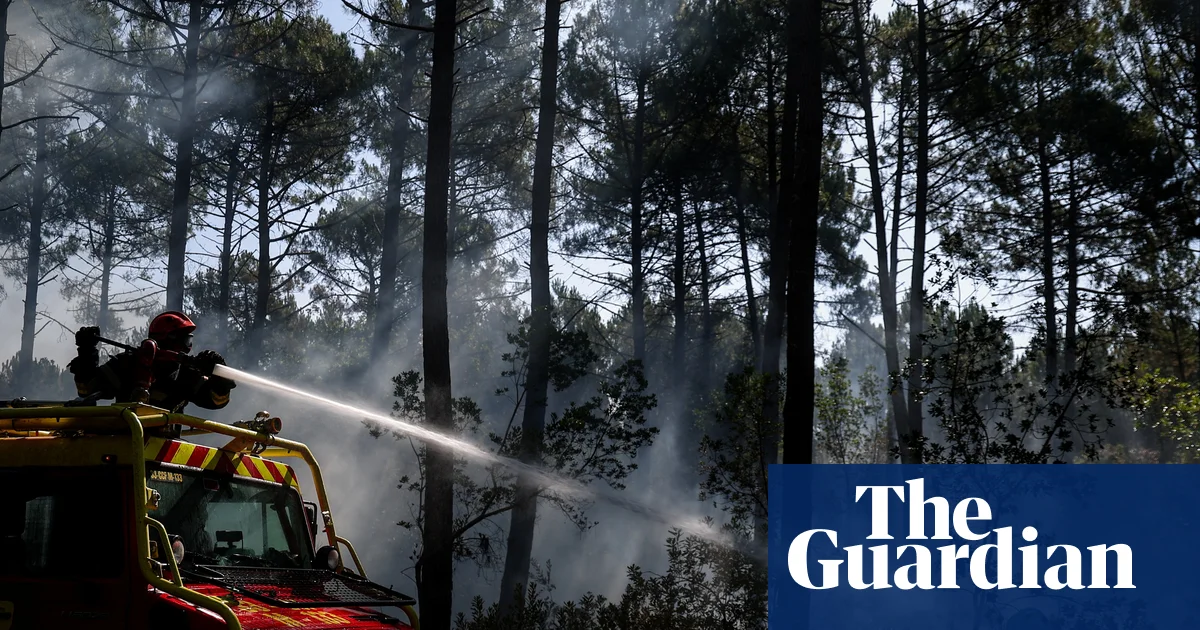
Nearly 4,000 people have been evacuated from tourist sites on France's Atlantic coast as the return of winds and extreme heat jeopardises firefighters' battles to contain wildfires raging in France and Spain. This was reported by Qazaqyia.kz citing The Guardian.
The precautionary evacuation order in France covers campsites, holiday villages and other tourist accommodation around the resort of Lacanau to the west of Bordeaux. French President Emmanuel Macron described the situation as the "toughest" since World War II.
On a visit to a crisis centre in Bordeaux on Tuesday, Macron warned that "the coming weeks will be tough and we have to hold out."
In Spain, a woman injured in a wildfire in the southern province of Almería died in hospital, bringing the death toll from that blaze to 14. The woman was treated at Seville's Virgen del Rocío university hospital, an AFP spokeswoman said.
In France, Rémi Lassoureille, a fire commander in the Gironde department, told Le Monde that the blaze, which has destroyed 42,000 hectares of forest, was "relatively under control," although firefighters feared a "potential flare-up of the fire on its north-west flank towards Lacanau."
"That is why we decided to evacuate the campsites," he said.
Other large fires have been contained in the nearby Landes and the Écrins massif in the French Alps, although one in the Gros Bessillon massif in the Var area of south-east France has not yet been fully brought under control.
Wildfires in France, Spain and Italy have forced the evacuation of about 330,000 people over the past week. Spain is entering Europe's fourth intense heatwave of the summer.
Spanish Prime Minister Pedro Sánchez said the country faced "difficult hours" before the new heatwave. He later said authorities were beginning to "see light at the end of the tunnel in the fight against wildfires."
A fire in the hilly terrain of Ávila, west of Madrid, has become Spain's largest on record, burning 50,000 hectares. Firefighter Javier García told Associated Press he had never faced anything like it in his two decades of work.
"This doesn't have a precedent," he said, adding that the ferocity of the wildfire was forcing firefighters to fundamentally change their tactics.
EU spokesperson Anna-Kaisa Itkonen said a number of firefighting planes and helicopters from member countries had been deployed to France and Spain. She said it was "important to clarify that no country can maintain alone all the resources that are needed to tackle every possible natural or other disaster and crisis."
EU officials have said wildfires could still be burning until early November. According to the European Forest Fire Information System, wildfire weather across the bloc has been more severe this year than ever before.
In France and Spain, the cumulative numbers of fires in 2026 have also set new records. European wildfires have struck at the same time as ferocious North American ones, while torrential rains have flooded countries across Asia.
"The climate alarm is blaring, from every direction," said Simon Stiell, the executive secretary of UN Climate Change. He said the human and economic costs of the climate crisis were reaching "national emergency" levels.
Western Europe had a wet winter and spring, which encouraged heavy plant growth. It has been followed by a dangerously hot and dry summer, feeding the flames. The climatic drivers have been made worse by the long-running abandonment of farmland.