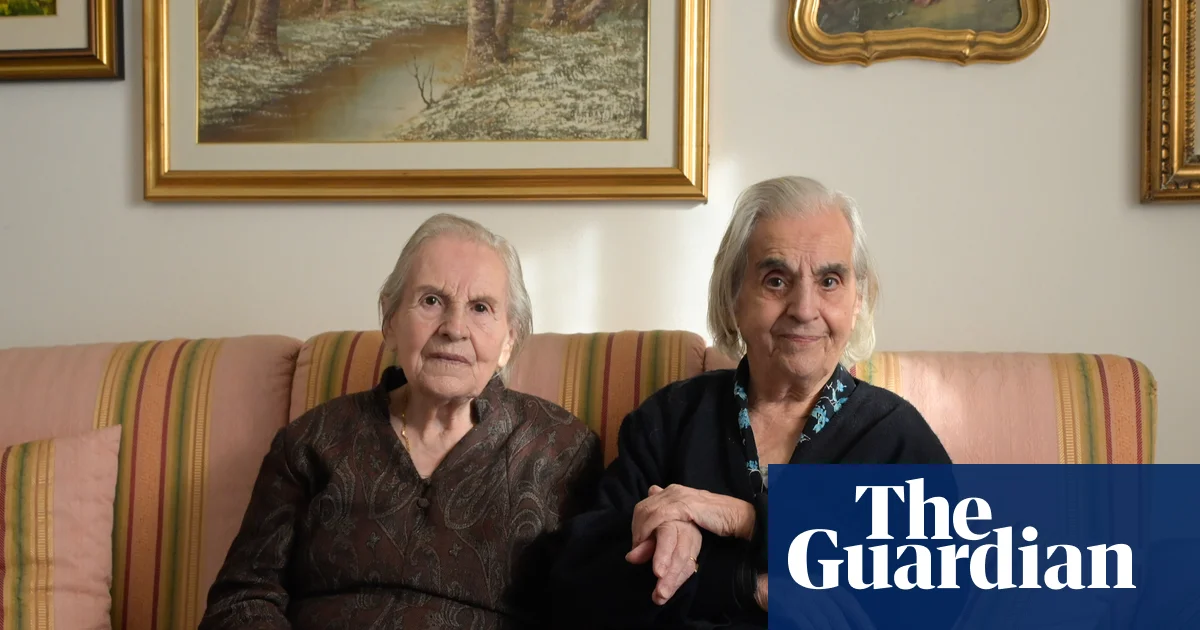
When Giovanna Marras opens the door to her home in Bolotana, a mountain village in central Sardinia, her eyes are bright with curiosity as she sizes up her visitors. Her sister, Mariangela, peeks out too, soon ushering her guests inside and handing out dishes of ice-cream. The sisters are full of life, talking animatedly. Giovanna is 101 and Mariangela is 99. This was reported by Qazaqyia.kz citing The Guardian.
The sisters' life story
Sitting in their living room, Giovanna swiftly recaps her life story: she excelled at school before moving to Cagliari, the capital of the Italian island, at 18 to train as a seamstress. The sisters went on to run a successful tailoring business in Bolotana before travelling the world after retirement. Neither married.
"Someone did come to the house and ask my parents for my hand in marriage," Giovanna said. "I told them to tell him to go away – I mean, a woman should at least know her future husband." Mariangela is equally as feisty in her response. "I didn't want to get married … I walk my own path, I don't need support."
The longevity phenomenon
The details of their lives are now being examined as part of a broader pattern of exceptional longevity in Bolotana, where women are driving a trend that could put the village, population 2,266, in the running to be the world's sixth "blue zone" – geographic areas with unusually high concentrations of centenarians. Sardinia was home to the first such zone, identified more than 25 years ago.
A study by professors at the University of Sassari and the University of Alabama at Birmingham in the US, published in the scientific journal Frontiers in Aging last week, found that 13.8% of women in Bolotana who reach the age of 70 will live to 100 – placing it second in the world for female longevity after Hong Kong.
Giovanna is the third eldest of six female centenarians in Bolotana, after Tonia Giglio and Maddalena Falchi, both 102. By the end of this year, two other women are expected to reach the milestone, and in 2027 two more, including Mariangela. The last male centenarian, Giovanni Madau, died in July, a few months short of his 102nd birthday.
Demographic data
Tore Pedde, the president of Orminas, a cultural association, played a crucial role in uncovering Bolotana as a potential longevity hotspot after painstakingly searching its demographic archives, even tracking down centenarians born in the village who had long since moved overseas.
Records of people born in Bolotana between 1900 and 1925 showed that 38 had lived beyond 100, putting their longevity rate at 57% higher than the Italian national average.
"Up until the early 1900s, Bolotana followed a trend whereby men significantly outnumbered women among the elderly," Pedde said. "From the early 20th century onwards, however, the trend shifted and women began to outnumber men. Later, the number of female centenarians started to far exceed the male ones, and this trend continues today."
Genetic and lifestyle factors
While it has already been well established that women live longer for biological reasons, scientists behind the study are tracing family trees in search of genetic clues to Bolotana's female longevity. They are also exploring the roles of diet, physical activity and social connections.
A striking characteristic of Bolotana's female centenarians is their independence. The Marras sisters still cook for themselves, eating a varied but clean diet without forsaking meat, cheese or wine. Mariangela does the shopping, which entails a walk down a hilly street and back.
The women have grit and are remarkably lucid. Filomena Scarpa, a former language teacher who turned 100 in January, began learning German in her 90s and was a voracious reader before a problem with her left eye started to hinder her. "It saddens me not to be able to read with the same level of consistency," she said. She goes to a personal trainer twice a week. "Because I can't sit around all day."
Scarpa, who has two sons, is a childhood friend of Falchi, who now lives with her daughter about an hour away in Oristana. The pair speak often. Falchi is notorious in Bolotana for smoking like a trooper. "I told her to quit because it's not good for her health," Scarpa said. "But she said: 'It hasn't got me so far, so I shall carry on.'"
Geographic location
Bolotana is situated in Sardinia's Marghine mountains, about 70 miles (110km) from the island's original blue zone – a cluster of villages nestled on the slopes of the central and eastern provinces.
"What's special here is that for the first time we've identified an area where women live to a great age, whereas the original blue zone was predominantly male," said Giovanni Mario Pes, who led the study and is a co-creator of the blue zone concept. "We therefore need to explain why longevity specifically affects women here."
Unlike the original villages, Bolotana is relatively close to cities, including Sassari and...