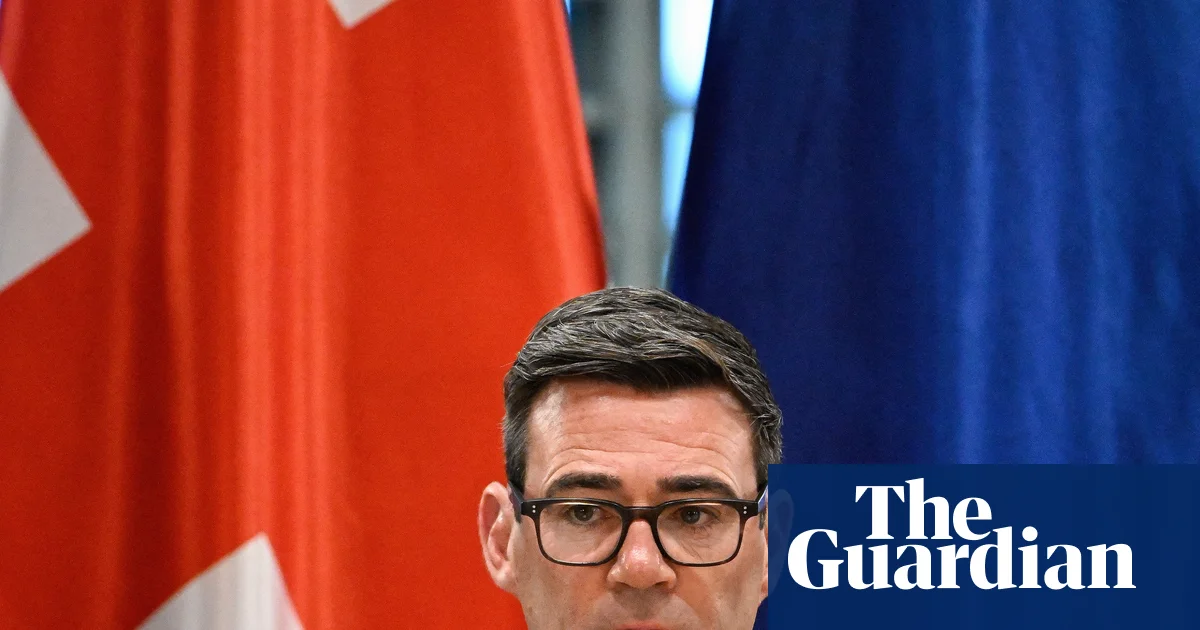
UK Prime Minister Andy Burnham has called for a closer relationship with the EU and drawn a line under a decade of "drift and division". This was reported by Qazaqyia.kz citing The Guardian.
Burnham made the statement on his first day back after party conference. On Sunday, he said it was "clear" the Kremlin had been involved with the 2016 Brexit referendum vote. Both statements mark a break, rhetorically at least, from his predecessors.
Conservative governments long insisted there was no evidence of Russian interference in the Brexit vote. Keir Starmer attempted to put the entire issue of Brexit behind him, treating it as a historic event rather than a cause of economic pain.
But for all his words about a closer relationship with the EU, Burnham has kept the details pretty vague. With the help of the Guardian's Brussels correspondent Jennifer Rankin and senior political correspondent Peter Walker, we ask what his stance might actually amount to.
Top stories
**UK** | Andy Burnham said Iran's Islamic Revolutionary Guards Corps were "almost certainly" behind threats to RAF Fairford, the firmest attribution of responsibility made so far by the UK after an incident late last month.
**UK politics** | A close adviser to Nigel Farage had an influential role at a national polling company despite not being publicly associated with the firm, the Guardian revealed.
**Ukraine** | Volodymyr Zelenskyy has vowed to respond to Russia's continuing attacks on the Ukrainian power grid as European leaders rally around Kyiv amid a feud with Donald Trump over Ukraine's strikes on oil refineries.
**Israel** | Benjamin Netanyahu has ordered the country's attorney general and the head of the Shin Bet security service to reveal the identities of soldiers and officers interviewed in the documentary NAZA and prosecute them for causing "harm to Israel's diplomatic and security interests".
**US news** | RJ Mitte, the young actor best known for playing Walter White Jr in the award-winning TV series Breaking Bad, died on Monday. He was 34.
Britain and the EU: a decade on
In the years after it voted to leave the European Union, Britain became something of a laughing stock among EU member states. "It was like a box set TV drama. People in Brussels would be staying up to watch votes in the House of Commons," Jennifer Rankin, who moved to Brussels to cover the EU for the Guardian in January 2016, tells me.
Civil servants in Brussels grew to regard the UK as one might regard a belligerent and ungrateful elderly relative. This impression reached its apotheosis when former Northern Ireland secretary Brandon Lewis admitted that the UK's Brexit arrangements for Northern Ireland would break international law.
"From 2016 to 2020, the UK was seen as a model of how not to run your country," Jennifer says. This impression softened after the passing of the Withdrawal Agreement Act in early 2020, and the Windsor framework deal, which amended the arrangements under the Northern Ireland protocol in 2023. "That was a turning point in drawing a line under the bad blood of the Brexit years," Jennifer says.
Keir Starmer's government then sought to cooperate with the EU on various issues such as security, food and fishing. But the "reset" he pledged to deliver was tightly circumscribed by his red lines: no rejoining the single market, no customs union, no freedom of movement.
Burnham's stance
After his conference speech, Burnham suggested he might be open to reconsidering this when he suggested, somewhat cryptically, that the UK could go "all the way" (presumably towards full EU membership). Yesterday he called for a "longer-term discussion" about Britain's relationship with the EU. But what might that actually mean?
Burnham has been "showing a lot of ankle" to remainers over the last few weeks, Peter Walker tells me. During his Labour conference speech, he promised to lay out "different options" for Britain's long-term relationship with Europe, and acknowledged that Brexit had caused "more harm than good".
"It's pretty clear that a decent majority of people would like to push a switch that meant Brexit had never happened," Peter says. Indeed, a YouGov poll in January 2025 found that just 11% of people thought Brexit had been more of a success than a failure. And as recently as last week, the Messina Group, a polling company, reported that half of voters say they would like to rejoin the EU.
The economic consequences of Brexit are now well known. Research has estimated that, a decade after the referendum, UK GDP per head is between 6% and 8% lower than it would have been without Brexit. Yet reversing this decision would require another referendum, which would be politically fraught, reigniting a debate that splintered the country a decade ago, and reducing a highly complex and technical issue to a binary decision.
It's hard to imagine Burnham – or any politician, for that matter – wanting to fight the next election while pledging something so divisive. Notably, even the Liberal Democrats, the most pro-EU of the major parties, favour rejoining the single market and customs union but describe UK membership of the EU as.