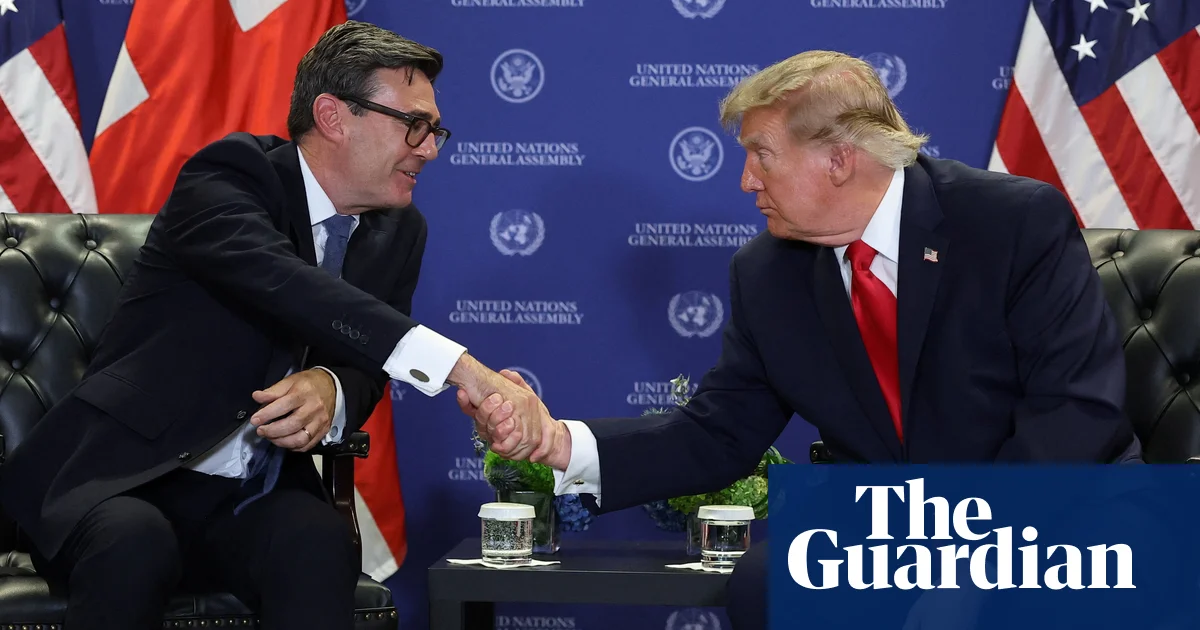
In the early hours of Tuesday a plane carrying Andy Burnham, a handful of UK ministers, an excited group of British political journalists, and Burnham's wife, Marie France, landed at a New York airport for one of Burnham's first major outings as prime minister: a face-to-face meeting with Donald Trump. This was reported by Qazaqyia.kz citing The Guardian.
Considering the president once described Burnham as the mayor of "a town," and the prime minister once said Trump wouldn't be welcome in said town (Manchester), the meeting yesterday afternoon went remarkably well.
That was the feeling among observers at the UN general assembly, an annual festival of hobnobbing and dealmaking for global leaders. Save for a few minor hiccups (Trump described Burnham as a "natural businessperson," which will be news to Burnham), their meeting was relaxed. Marie France was entertained at a "spouses lunch" with Melania, and Burnham will no doubt have ended the day with a sense of relief.
But for all the warm words in Manhattan, Burnham and his foreign secretary Ed Miliband still have tricky questions to answer about how they deal with Trump. Faced with a resurgent far right that has been emboldened by his administration, how should Burnham approach the country that was – until recently – the first ally Britain would call in a diplomatic crisis? Today's newsletter tries to answer that question with the help of our political editor, Pippa Crerar, who was on the plane. First, though, here are the headlines.
UN general assembly
Donald Trump has called on nations to unite to isolate Tehran and bring down global energy prices, as he gave a bellicose defence of his administration's foreign policy and decision to strike Iran.
The far right
Charities have condemned footage of a far-right activist using a blade to slash an inflatable dinghy in the Channel while a rescue worker was onboard, in a further escalation of organised anti-immigration protest.
UK news
Children as young as 13 in the UK have been referred to a specialist clinic for a "devastating" bladder condition linked to sustained use of ketamine.
West Bank
British banks and financial institutions are receiving warnings from MPs that they should not invest in Israel's E1 settlement project.
UK politics
Andy Burnham has opened the door to fighting the next election on the UK rejoining the EU, but said his immediate priority was continuing to rebuild bridges with European allies.
Trump's foreign policy
A non-exhaustive list of Trump's recent foreign policy achievements is a good reminder of just how swiftly he has destroyed what is rosily described as the "rules-based international order." Since taking office in 2025, he has installed loyalists in key positions, flirted with the idea of withdrawing from Nato, abolished USAID, gutted the US state department, threatened to acquire Greenland "by any means necessary," captured the president of Venezuela and recast foreign policy as a brutal means of putting "America first." His administration's national security strategy, published in December 2025, was described by one former Pentagon official as a "manifesto for the global far right." It declared that Europe faces the "stark prospect of civilizational erasure" (echoing the far-right conspiracy of a "Great Replacement") and said that America would encourage the promotion of "patriotic European parties."
Despite this, western leaders have taken a while to adjust to the second Trump presidency. "Starmer got quite a lot of criticism for being obsequious to Trump," Pippa tells me. His reverence was on full display when he placated Trump with a royal visit that included a dinner-party seat next to the Princess of Wales, and when he struck a controversial trade deal that will force the NHS to spend more on US-branded drugs (the deal, for which the US agreed not to put tariffs on British pharmaceutical exports, could cost the NHS as much as £44.7bn by 2030, my colleague Aditya Chakrabortty reported in June).
Starmer's stance gradually toughened as he realised that placating Trump was no guarantee of protection. Later in his premiership, he refused to let Trump use UK military bases in America's initial strikes on Iran. "But he was seen by some inside the government as being too flattering and fawning," says Pippa.
On the surface, not much
Within hours of arriving at the UN, Trump managed to alienate just about everyone, telling a journalist from CNN, one of the three networks he's banned from the White House, "you should not be here covering me," openly contemplating the annihilation of Iran, a UN member state, taking a shot at Cuba and attacking the UN for "imposing a radical left-wing agenda".
Burnham, meanwhile, wasn't that different in tone from Starmer. He shook Trump's hand, forgave him for once describing him as the mayor of a town, made the obligatory noises about loving the US, and appeared to nod along while Trump excoriated the Chagos Island deal (Starmer's proposal to give Mauritius sovereignty over the island on the condition that the UK can continue to operate the Diego Garcia military base there). "Our understanding is that Downing Street is sticking to the Chagos deal," Pippa tells me.
Even so, Burnham has said he wants to take a different approach to US relations, suggesting in June that he wouldn't just.