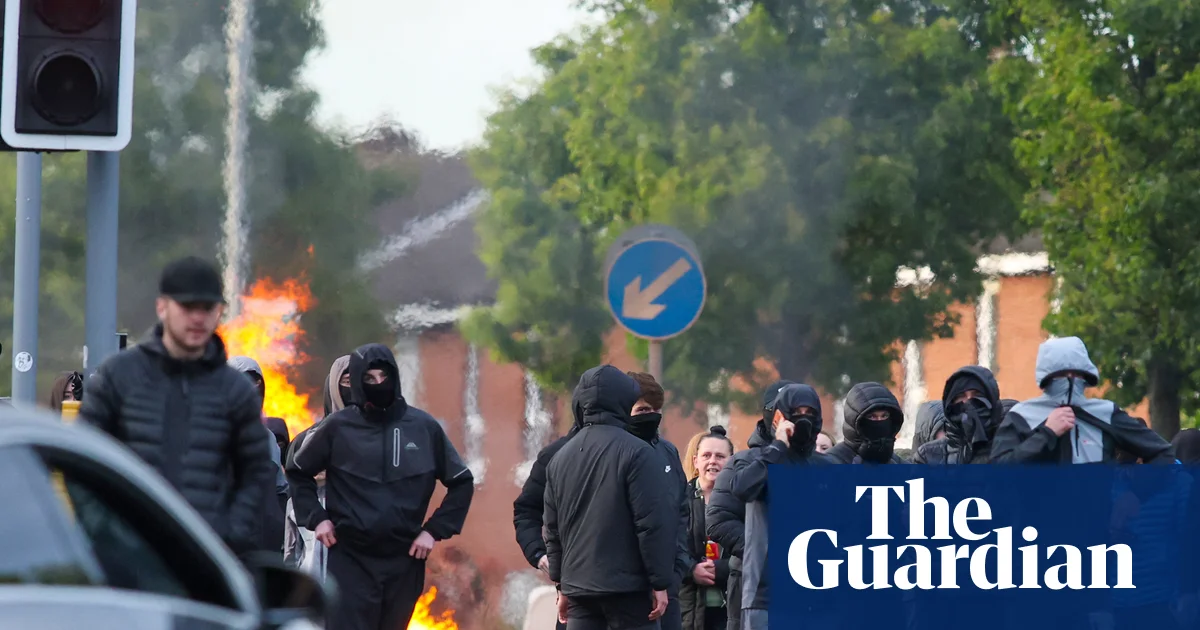
Within minutes of the footage going online – of a Black man stabbing a white man – there was a sense of inexorability to what came next in Northern Ireland. This was reported by Qazaqyia.kz citing The Guardian.
The grievances, the social media platforms, the politicians’ doublespeak and the international cheerleaders all provided a fuse. On Monday night came the spark.
Those who saw the video will not easily forget it: an assailant on a north Belfast street stabbing and slashing his victim in the face and neck, shouting in Arabic. Residents intervened and halted the assault but the victim, Stephen Ogilvie, was seriously injured, including having lost an eye.
On Wednesday, Hadi Alodid, 30, a Sudanese refugee, appeared in Belfast magistrates court charged with attempted murder. The judicial system was fast, but the gutted homes of minority ethnic families showed that a warped form of vigilante justice was even faster.
“Who was in there?” a woman asked on Tuesday night, indicating a scorched, smouldering ruin on McMaster Street, off Newtownards Road, in east Belfast. “A Romanian gypsy family in that one,” came the reply. The woman nodded, as if it made sense that a family should be expelled for a crime committed by a stranger on the other side of the city and that hundreds of youths, many with masks, should be prowling streets filled with acrid smoke and the drone of police helicopters.
Rioters burned homes and vehicles, including a Glider bus and a police car. Their social media feeds, elected representatives and far-right agitators, such as Elon Musk and Tommy Robinson, assured them it was all connected: immigrants and refugees were taking houses, imposing alien customs and committing crimes while the police did nothing, thus requiring community action.
That worldview underpinned riots in Belfast in 2024, a copycat to riots in England after the Southport attacks, and impelled the ethnic cleansing of Roma from Ballymena last year and patrols by vigilante groups who intimidate dark-skinned men.
Yet Northern Ireland’s crime rate fell last year by 3.3% from the previous 12 months and reached its lowest level since 1998, with especially steep falls in violence and injury. Racist hate crime and racist incidents, in contrast, reached their highest level since records began in 2004.
Within hours of Monday night’s attack, social media platforms crackled with rage. “Enough is enough!” many posted. By 10am on Tuesday activists where sharing lists of assembly points and times. All businesses were to close at 5.30pm – “no excuses” – and from 7pm crowds were to close roads. Some posts urged peaceful action, others advised the wearing of dark clothes and a readiness to be arrested.
At midday, leaders of five main political parties issued a joint statement condemning the stabbing attack and urging restraint. “We call for calm and for space to allow justice to take its course.”
Other statements, however, used loaded language. Gavin Robinson, the leader of the Democratic Unionist party (DUP), called the attack “medieval”. Jim Allister, the leader of the Traditional Unionist Voice party, went further. “What is going to be done to stop this importation of an alien culture that seems to now include attempted beheading?”
From thousands of miles away, Musk and Robinson, who was in Moscow, chimed in with exhortations for mass protests.
By 4pm, steel shutters were coming down over African- and Arab-owned supermarkets, barber shops and gadget stores and their owners and staff were preparing to hunker at home. The Belfast Islamic Centre cancelled evening prayers and urged the congregation to stay indoors.
Crowds gathered at designated intersections from 6.30pm. Some remained peaceful and eventually dispersed. Others swelled and splintered into breakaway groups that attacked vehicles and homes owned or occupied by people with dark skin.
“Foreigners out!” some chanted. Others spraypainted “fuck Islam”, with crosshairs, on walls. By 10pm, smoke plumed over multiple locations: Oakley Street, Crumlin Road, Lendrick Street, McMaster Street, Newtownards Road. In places there was a carnival atmosphere, with people posing for selfies and drinking beer. One man hoisted up his young son for a better view of a burning house. “Get a duke at that,” he said. “Wow,” the boy replied.
Outside Belfast, mobs torched targets in Portadown, Dundonald and Newtownabbey. The fire service received 256 calls and attended 62 incidents.
Similar scenes have played out in England, but Northern Ireland’s history echoed through the mayhem. In 1969, mobs burned Catholic families from some of the same streets, setting a precedent. “It’s the same type of behaviour – driving out people who are the other,” said Peter Shirlow, the director of the Institute of Irish Studies at the University of Liverpool.