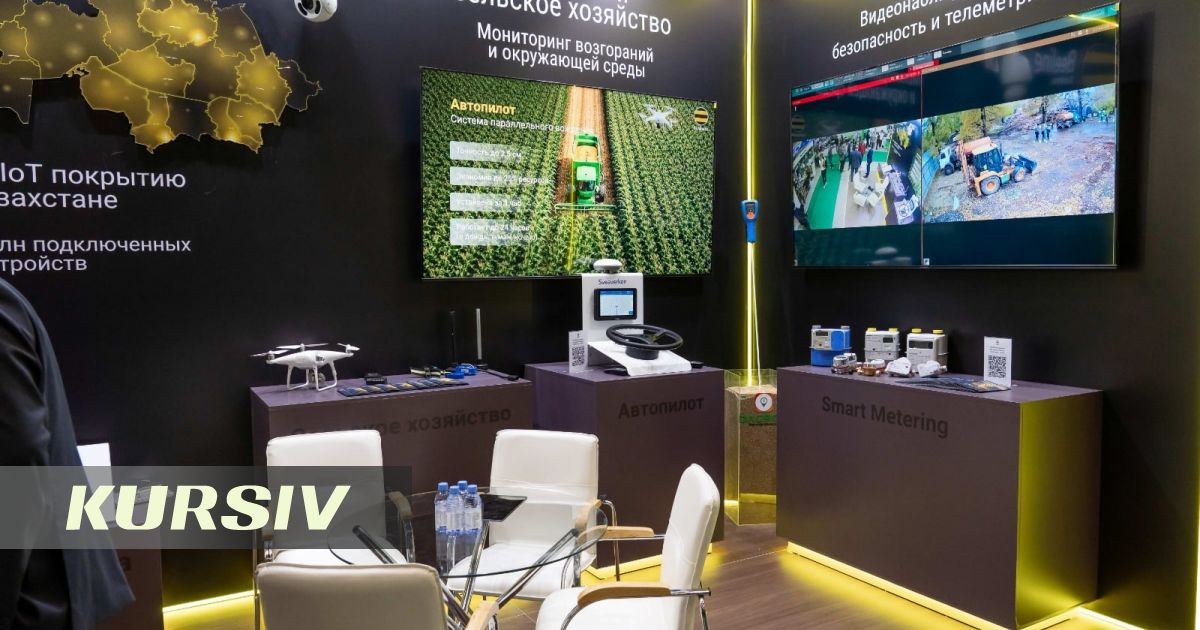
Beeline Kazakhstan is the first in Central Asia to deploy a commercial NB-IoT network across its entire coverage area. This was reported by Qazaqyia.kz citing Kursiv Media.
Why NB-IoT matters
Every day we consume resources – gas, heat, water, electricity. This process requires accounting, which in many cases is still done manually. Where humans are involved, systemic weaknesses accumulate: readings are transferred from one source to another with the risk of errors and typos, data is collected with delays, and if a meter is inaccessible at the right moment, information simply drops out of the report and becomes incomplete. As a result, utility companies incur additional costs for correcting inaccuracies and re-checking, while the average consumer risks receiving a bill that does not reflect their actual consumption.
NB-IoT (NarrowBand Internet of Things) is a cellular communication standard for smart devices. It allows sensors and meters to transmit small amounts of data through regular mobile networks with very low energy consumption.
Simply put, this technology enables metering devices to quickly and timely transmit up-to-date information, providing all stakeholders with both process automation and greater accuracy compared to manual readings by inspectors.
According to the Order of the Minister of Industry and Construction of the Republic of Kazakhstan dated March 3, 2026, NB-IoT is established as the base wireless data transmission technology for water metering devices in Kazakhstan.
Benefits for the state
For the state, NB-IoT offers the ability to scale automated accounting of utility resources to a large number of devices across the country. In the near future, NB-IoT could become part of a unified digital infrastructure for utility resource accounting – from individual homes and enterprises to large-scale urban and regional systems.
"We see NB-IoT not just as a technology for transmitting meter readings. It is infrastructure that can become the basis for large-scale digitalization of resources and urban services. The NB-IoT network is already deployed on Beeline's infrastructure across the country, so the state and businesses do not need to create separate infrastructure for each new scenario – solutions can be scaled based on the already operating network and proven technology," says Rauan Kabdrakhimov, CEO of Enterprise Co (part of Beeline Kazakhstan holding).
What businesses and utility companies get
For service providers, the effect is most obvious – the need for regular visits by inspectors to take readings is reduced, and data becomes available for continuous analysis. For example, a water utility can monitor consumption dynamics daily, compare the volume of supplied water with meter readings, and quickly identify discrepancies, leaks, and other issues.
Utility companies also have the opportunity to avoid investments in building infrastructure for their smart devices. Beeline Kazakhstan provides a ready-made "foundation" – the enterprise can build a full-fledged "structure" on it to suit its needs.
Benefits for consumers
Automatic transmission of readings allows for calculations based on actual consumption, without the need to manually take and submit readings. The number of errors related to manual reading and transmission is reduced. Access to information and notifications online is opened.
Additionally, Beeline expects that in the future, consumers will use the data obtained for more efficient use of water, gas, electricity, and heat.
"Smart technologies change the very approach to consuming utility services: a person gets the opportunity to see how much water, gas, heat, or electricity they actually consume and better manage these resources. Moreover, NB-IoT opens opportunities not only for data transmission but also for remote control of connected devices. For example, when a leak is detected, the system can be configured to automatically shut off the water. And this is just one scenario – in the future, such solutions can be used in various urban services," continues the CEO of Enterprise Co (part of Beeline Kazakhstan holding).
Among the advantages of this communication standard are:
- 01Low power consumption
- 02Long battery life
- 03Deep penetration into buildings
- 04Ability to connect a large number of devices to a single base station
Successful implementations in Kazakhstan
Work on implementing the international 3GPP standard (a consortium of organizations that creates unified technical specifications and standards for mobile communications – author's note) for mass IoT in Kazakhstan has been ongoing since 2017 – when Beeline was the first in the republic to test it on smart gas, electricity, cold and hot water meters.
Today, NB-IoT is activated on the entire LTE network of Beeline in Kazakhstan. It is actively used by a number of well-known Kazakhstani companies.
QazaqGaz Aimaq – one of Beeline's first partners – initially set the following goals: to provide a telecommunications basis for the future intelligent gas metering system. In 2018, the parties signed a memorandum on the introduction of smart gas meters, and the project was announced in Kostanay. In 2019, a pilot project was successfully implemented in the Kostanay region, and the first devices began transmitting data via NB-IoT. The network has been actively used for remote transmission of gas meter readings since 2020. As of this year, more than 106 thousand smart meters are operating in Shymkent, Taldykorgan, Taraz, Karaganda, and Astana.
The result is reduced operating costs, fewer human errors, no "forgotten" readings, a more accurate gas balance, and the emergence of a digital service for subscribers.
LLP "Water Resources-Marketing" has been cooperating with Beeline since 2022. The company has installed more than 30 thousand water meters operating via NB-IoT with various functions.