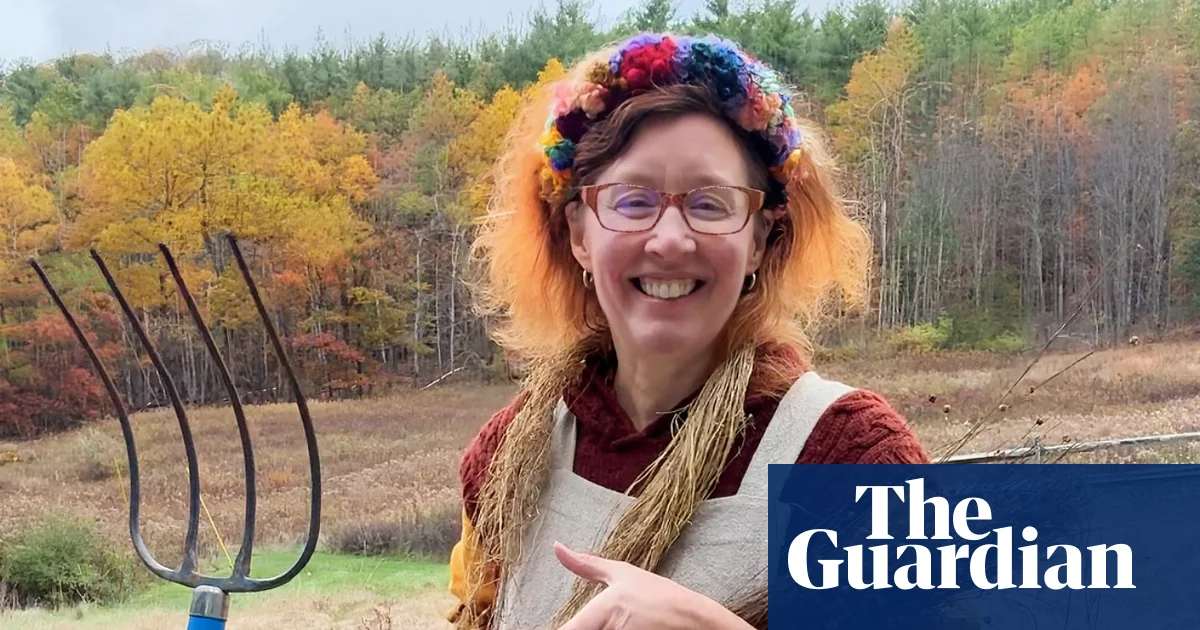
Eve Ogden Schaub of Vermont aims to create the slowest fashion imaginable by growing flax in her garden and making a dress from it. This was reported by Qazaqyia.kz citing The Guardian.
From crop tops to shorts and brightly patterned dresses, many of today’s clothes are the result of fast fashion. But one woman is taking a radical approach to challenging this trend by growing her own dress.
Eve Ogden Schaub is in the midst of a project to create a linen garment made from flax she is growing at home, documenting the process in videos shared on her Instagram account.
“I had this idea that I wanted to find the slowest fashion imaginable. And that’s when I had the idea I could grow a dress from seed in my back yard,” she says.
Schaub began the project in April 2025 when she turned a 600 sq ft vegetable garden in Vermont into a plot for growing flax. Having harvested the first crop, Schaub sowed and harvested a second. She is also learning to process the material in steps that would not sound amiss in a Grimms’ fairytale – sometimes enlisting family and friends to help.
“We retted it, which is a sort of decomposition process, and then you do breaking and scutching and hackling, and you have to spin and scour and then maybe dye your yarn,” she says, adding that she has yet to get to the latter step, but is growing indigo plants for the purpose.
Once the flax is spun into linen yarn, Schaub will weave it on a huge loom – not unlike Penelope in the Odyssey – before cutting out and sewing a dress. “So it’s an enormous undertaking, but something that not all that long ago was completely commonplace, and I found that a very attractive, interesting facet of the project,” she says.
As Schaub says, it has never been easier to get a cheap, convenient garment delivered to your door.
However “fast fashion” has become an environmental and health catastrophe, with garments ending up on huge rubbish dumps in Ghana and workers in India’s recycling factories experiencing ailments including lung disease.
In our current culture, “if you can do something cheaper and faster, it’s always the preferred option,” Schaub says. “And I want to step back and say: but is it? What might we stand to gain if we were to slow down and try to find things that are more meaningful to us, that bring us something that we can’t get from this fast-paced commercial world?”
Schaub also wants to explore the value of creativity, and question what benefits people may gain from making more things.
A self-described “fibre-person and maker”, Schaub is no stranger to lifestyle experiments, having written books on a number of projects, including her family’s attempts to give up sugar for a year, and to go 12 months without producing any rubbish.
The latter, says Schaub, dovetails with her new endeavour, noting that in avoiding waste, she learned about synthetic materials and the issues plastic poses for our environment and our bodies.
“Unfortunately, we’re all walking around wearing plastic bags most of the time, and we don’t even realise it,” she says.
Schaub hopes her project will shine a light on the implications of modern clothing – including the poor treatment and low pay of those producing such garments: “The whole system, I want to question and say, is this what we want?”
In her efforts to go from ground to garment, Schaub has picked the brains of myriad experts, adding that valuing shared knowledge is another facet of the experiment.
But she admits some steps have proved easier to get the hang of than others: in one of the many videos capturing her attempts at spinning Schaub is left grimacing at the camera.
“There’s something inherently funny in the learning process, because you screw up and you screw up, and you know you’re going to screw up,” she says.
The project, she adds, has been an eye-opener for many. “I get so many people commenting on my social media posts saying, ‘now I understand. Now I understand why clothes were so expensive, why cloth was a valuable commodity, why people only owned one or maybe two outfits, because it was so hard to get’,” she says.
Schaub says her own views about clothing have changed too, noting she no longer finds department store clothing appealing, and has a greater motivation to appreciate and mend the clothes she already has.
As for the final dress, Schaub admits her previous experience in sewing has only run as far as making Halloween costumes. But she is planning to work with an experienced friend to design the linen garment based on historical dress patterns.
“I cannot predict when this project will end, but I promise I’m going to wear something at the end of this,” she says, adding that whatever she produces, it will be deeply meaningful to her. “Because of that, I hope it will be beautiful,” she says. “I know it will be beautiful to me.”