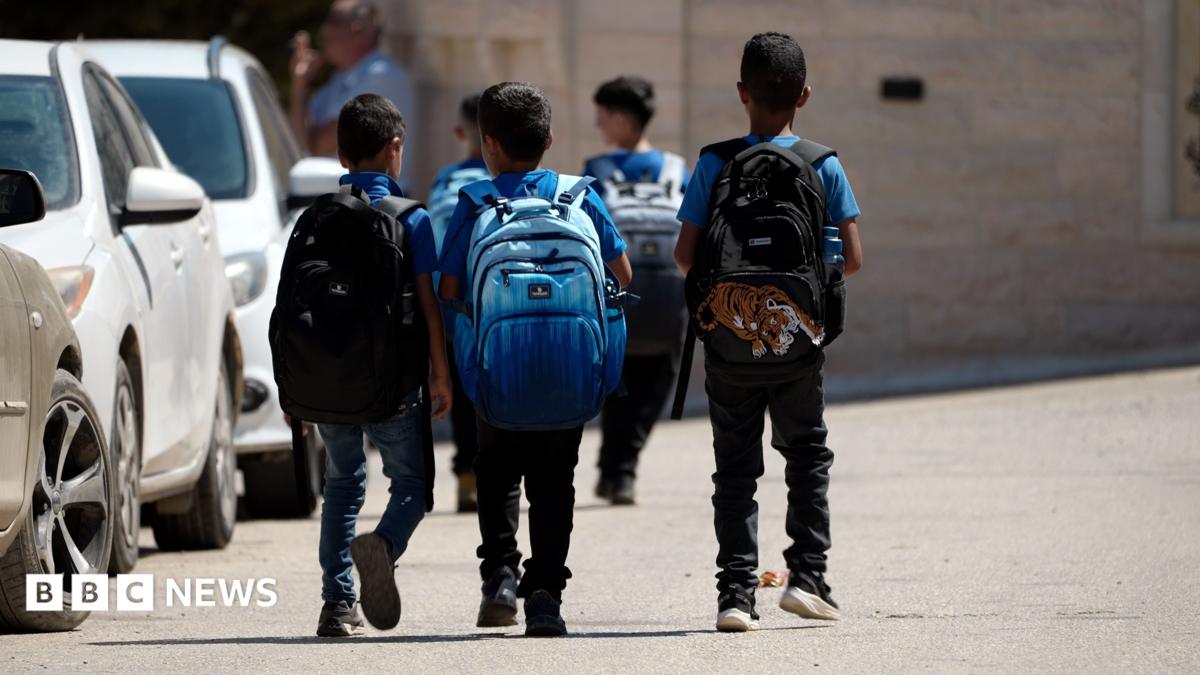
On the first day of the new Palestinian school year, the head-teacher of al-Mughayyir boys school arrived at work before dawn, walking past the freshly installed barbed wire fencing and reinforced school gates as the sun began creeping through olive trees around the village, deep inside the occupied West Bank. This was reported by Qazaqyia.kz citing BBC News.
"We are scared," Bassam al Assaf told me. "The students are afraid, and their parents are afraid."
Six people, including three pupils at the school, have been killed in al-Mughayyir this year, in a surge of settler-related violence against Palestinians. One of them, 14-year-old Aws al-Naasan, was shot dead by a settler outside the school gates in April.
"I was inside my classroom and two little students came rushing to tell me there were settlers close to the school wall," remembers English teacher Waheed Abu Naem, whose brother Jihad was also killed by an Israeli soldier in the same attack.
Waheed said he was trying to move pupils to safety inside the school gate when the settler fired towards them. Mobile phone footage shows the moment Aws was shot.
"When I turned him onto his back, I saw lots of blood coming from his nose and mouth, and the bullet in his head," said Waheed. "We lost him."
He told me that bullets continued hitting the school building, as students hid behind the walls of their classrooms, or lay on the floor.
The Israeli military said in a statement at the time that stones had been hurled at a car carrying "civilians including a reservist soldier", and that the reservist had got out of the vehicle and fired at suspects. Israeli media reported the reservist was later suspended from duty and an investigation launched.
Since that day, the casualties have grown alongside parents' fears. Over the summer, two more pupils were shot dead by Israeli forces during settler attacks and incursions in the village, along with a 19-year-old who had just left the school. In both cases, Israel's army said its forces responded to instigators of "a violent riot".
With three empty desks in the classrooms, some parents were reluctant to send their children back for the new school year. The school sits right on the edge of Al-Mughayyir, an isolated village north-east of Ramallah, increasingly surrounded by Jewish settler outposts, and regularly blocked by Israeli forces who frequently operate an ad-hoc checkpoint at the entrance.
Bassam al-Assaf has installed a long barbed-wire fence around the compound and reinforced the school gates, to try and reassure parents. Ambulance crews are now stationed on the road outside, and several parents have volunteered to wait outside the school all day as an extra layer of protection.
"I came because it makes the children feel their parents are with them, that they are safe, it gives them a kind of security," said Haroon Bishara, whose boys are in the first and second grades.
"We fear for our children more this year," he told me. "We know the situation is not safe at the school." But he said that fear was mixed with a determination not to let the threat from settler attacks force them out.
Lined up in the playground for their first assembly, pupils heard the instructions repeated by teachers again and again throughout the day: if soldiers or settlers approach the school, don't shout, don't go near them, don't react.
Just over an hour after classes began, settlers were spotted through the school windows: two men, driving sheep through Palestinian fields a couple of hundred metres from the school, as Israeli soldiers stood close by. Minutes later, another settler with a flock of sheep appeared.
"They have got closer to the village since April," said Abu Naem. They used to keep their sheep behind this [hill], but now the soldiers bring the settlers up to the village."
We asked the Israeli army for its response to all the allegations in this report, but they were unable to provide one before publication.