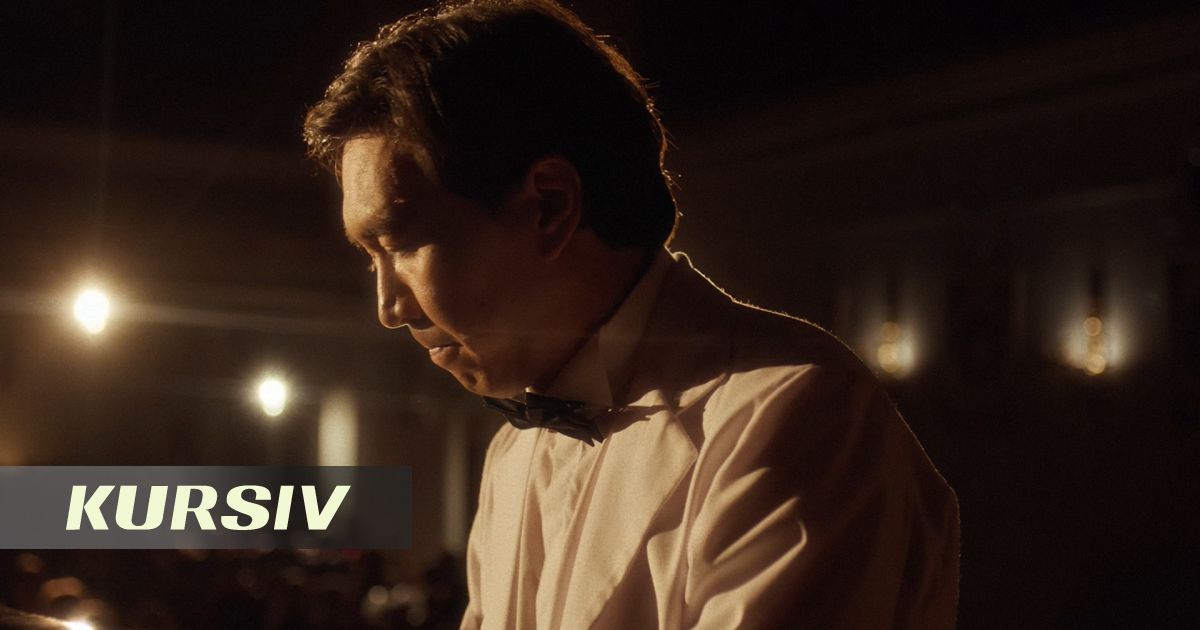
Just under three weeks after its premiere at the San Sebastián Film Festival, the film Mugalim has been released in Kazakhstani cinemas, a kind of precedent. This was reported by Qazaqyia.kz citing Kursiv Media.
Usually our festival films take months, or even years, to reach our own cinemas. If they get there at all. Mugalim has become a pleasant exception.
A very female film
Discussing the film, a colleague and I agreed that it is a very female picture. In the best sense. In recent years, our cinema has seen far more female directors, and debutante Ayana Nurdinova is one of them. Let me recall that Zhannat Alshanova (“Pobediteley vidno na starte”) and Zaka Abdrakhmanova (“Papa umer v subbotu”) have also recently made their mark with striking debuts. These films share a particular style, a moral tone and a visual aesthetic; if you like, their own lyrical mood.
Moreover, key creative positions on Mugalim were also held by women: producer Aruzhan Dosymkozha, cinematographer Aigul Nurbulatova, production designer Zhuldyz Dulatova, and the script was written by Ayana Nurdinova in collaboration with Yana Alzhanova.
Heroines in a masculine cinema
Most importantly, in our cinema — almost thoroughly masculine in terms of content — more and more heroines are appearing. Here, however, a caveat is needed: the protagonist of Mugalim is a man, yet in the film he is surrounded by many different female characters, albeit ascetically but well written. I do not recall Kazakhstani cinema ever having so many fully fledged supporting female roles — not merely episodic or formulaic ones. And Ayana Nurdinova managed to secure wonderful actresses for them.
The plot in Balkhash
Mugalim is set in Balkhash, where a young man named Zhandos teaches music at one of the local schools — though to his students, of course, he is Zhandos Akhatovich. With the help of his friend Erik, he reluctantly earns extra money at tois, where his creativity is not really needed by anyone, while he dreams of moving to a big city to perform for a truly grateful audience. Such a chance arises when Erik’s uncle comes to his native Balkhash to celebrate his anniversary. But will Zhandos be able to tear himself away from his roots, where his mother, his students, his colleague Gulnar — secretly in love with him — and his neighbour Aisulu, for whom he himself has shy and tender feelings, will remain?
Echoes of Joqtau
Last year, the film Joqtau by director Aruan Anartay was released, also featuring Aruzhan Dosymkozha and Aigul Nurbulatova, with Ayana Nurdinova as production designer on the project. Coincidence or not, the two films clearly echo each other thematically. With the difference that in Joqtau the hero was returning, while in Mugalim he is only planning to leave. There is also a similarity in terms of contemplativeness and tempo-rhythm. I cannot call Mugalim, like Joqtau, viewer-friendly films, as it has become customary to say. However, there are also many fans of unhurried pictures. For them, the cliché “festival cinema” is often used.
In the case of Mugalim, this peculiar term manifests itself in another unexpected aspect. Both Zhandos and those around him constantly say “I’ll move to the city,” “I ordered it in the city,” “I’ll come from the city,” and so on, obviously meaning Almaty or Astana. And it seemed that the absence of clarification is not so much a tribute to a certain parable-like quality, where specific geographical points do not matter, as an orientation towards a foreign audience, to whom our names would mean nothing anyway. After all, Balkhash is also a city, and not the smallest one, and in Mugalim, despite the depiction of local problems, it is filmed with great warmth and love. Sometimes it even seems that the pastel, almost lubok-like (as far as the Kazakhstani provinces allow) scenes in visuals and music — usually of Zhandos riding his bicycle around the city — are superfluous.
A film about what life could be
However, Mugalim is, rather, a film not about life, but about what it could be. Zhandos loves his work, but still feels like a black sheep here. His mother leans towards the philosophy that it is better to be first in the provinces than even not second, but two-thousandth in Rome, while her son logically retorts: can one even be first here?
A widely known feature of debuts is that their authors often strive to immediately pour out everything accumulated, touch on many themes and try to embrace the boundless. The same happens with Ayana Nurdinova. In its secondary storylines, Mugalim rushes between the global and the parochial. Ecology, the existence (there is no other word for it) of a single mother with a special-needs son, our traditional, useless-to-anyone showmanship at school assemblies, male prejudices about dancing, where something like “Billy Elliot” breaks through, and even protests against the construction of a nuclear power plant in Balkhash in an episode with a picket by activists (the only question is how many seconds that picket would have stood in real life?).
But, in fairness, behind all the thematic heap, the main line is not lost: that of a talent faced with a fateful choice, who on the one hand is tied by his mother, loving students, a romantic attachment and music that literally heals the neighbour boy, and on the other is wrapped in the dream of creating and performing in an appropriate setting.
The cast
As already mentioned, Mugalim has an excellent cast — unusually star-studded for a film debut. In the lead role is composer Olzhas Dalelkhan, who, however, is no stranger to playing a musician, recalling the 2024 audience hit “Nurikamal.” A wonderful performance, and Olzhas, not particularly experienced as an actor, is not at all overshadowed by the powerful supporting company. Rustem Zhanyamanov as Erik, Ruslan Duisembekov (dance teacher) and Bakhytzhan Alpeisov, who played that very anniversary uncle who slightly undermines Zhandos’s confidence in the correctness of his chosen path, are as good as ever.
But the highlight of Mugalim, I repeat, is the unusual abundance of very different female characters, and moreover performed by wonderful actresses: Shynar Zhanyzbekova (Zhandos’s mother), Gulnara Dusmatova (the school principal, who for some reason was named Larisa Viktorovna), Olga Landina, Anna Starchenko, Madina Yesmanova and Ulytau group violinist Asel Issayeva as the protagonist’s secret love.