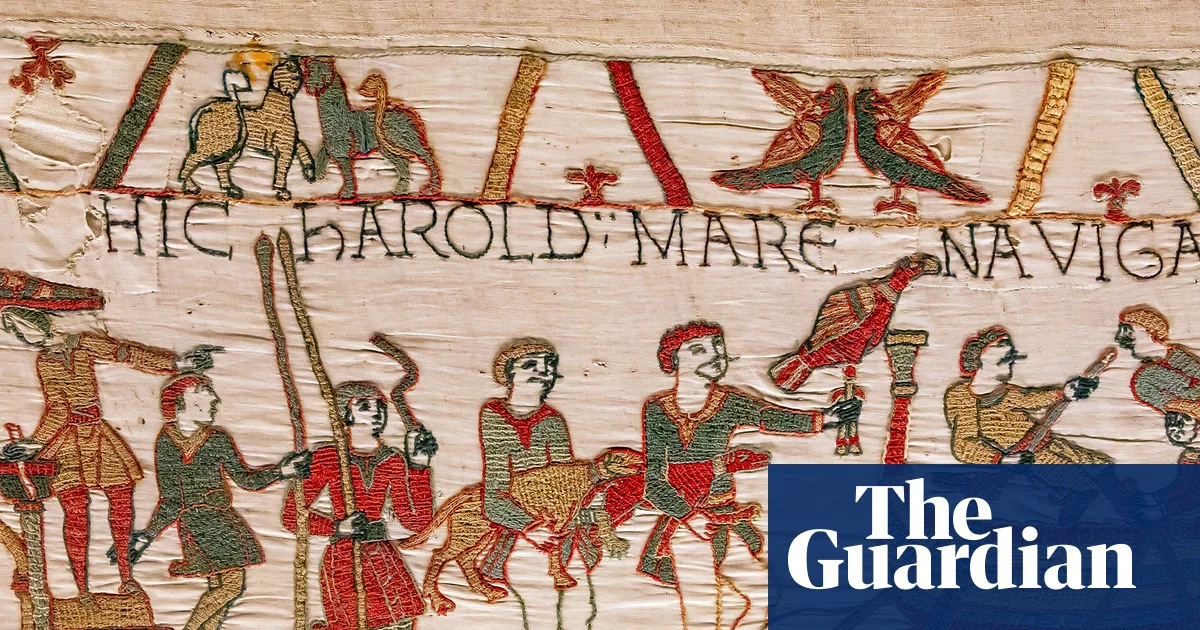
The Bayeux Tapestry exhibition opens today at the British Museum in London. The digital queue was nine hours long when tickets first went on sale in July, and the exhibition has already broken the British Museum's record for the number of tickets sold in a single day. This was reported by Qazaqyia.kz citing The Guardian.
Some lucky individuals, including King Charles and aspiring overlord Peter Thiel, have been treated to early previews of the medieval tapestry. Guests staying at One Aldwych, a hotel where rooms go for £1,000 a night, can partake in the "Bayeux experience" with a themed cocktail (mead spritzer, anyone?), a full English breakfast and preferential access to tickets.
In a break from our regular programming, this morning's newsletter brings you 68 facts about the Bayeux Tapestry for anyone who hasn't been able to see the real thing. That's one fact for each of its 68 metres (bonus fact: it's 68.3m long). If that's not your vibe, just be glad I didn't manage to find 1066 facts. First, here are the headlines.
Headlines
- 01**Reform**: The Met police will investigate allegations that Reform UK broke electoral law relating to overseas donations as part of a wider inquiry.
- 02**UK–Israel**: Prominent British rabbis have backed Ed Miliband's sanctions on Israeli settlements, warning that the time for inaction on settler violence must come to an end.
- 03**Technology**: Just a day after three Anthropic researchers warned that artificial intelligence could kill off humanity within the decade, US politicians have begun lashing out about the risks of the burgeoning technology.
- 04**UK news**: Protesters who gathered outside a Portsmouth hotel mistook Pakistan's under-19 cricket team for asylum seekers.
- 05**US news**: Donald Trump pledged to pay every adult citizen in the US $5,000 if Republicans retain the House and Senate in the midterm elections, during a marathon speech at the Republican midterm convention in Dallas.
68 facts about the Bayeux Tapestry
- 01First of all, as the exhibition's curator Michael Lewis points out in his book, the Bayeux Tapestry isn't really a tapestry. It's "more accurately described as an embroidery", Lewis writes. (Nobody actually calls it an embroidery, though, so we'll stick with tapestry.)
- 01The embroidery tapestry tells the story of the events that culminated in the Battle of Hastings in 1066, when William the Conqueror defeated King Harold.
- 01It was supposedly commissioned by Bishop Odo, William the Conqueror's half-brother, for his newly built cathedral in Bayeux in 1077. He was prone to "self-aggrandisement" (in Lewis's words), which is why he gave himself a starring role in the tapestry.
- 01But it wasn't made in Bayeux. Researchers think it was probably made in England, near Canterbury.
- 01It's embroidered on linen, with 10 colours of woollen thread likely dyed with woad, madder and indigo.
- 01Its nine panels were embroidered separately, and then stitched together to form a continuous picture.
- 01It features 623 men, 190 horses, 35 dogs, 37 buildings (including Mont-Saint-Michel) and 41 ships.
- 01It may have had a single master designer who plotted its narrative, but …
- 01The embroidery was almost certainly stitched by multiple women (William of Poitiers cited English women as skilled embroiderers).
- 01It's unclear how long it took them – one estimate reckons the stitching took between two and four years.
- 01Yet, only three women actually feature in the tapestry. None of them are having a good time: one is weeping at her husband's deathbed, another is fleeing a burning building and a third is being assaulted by a priest.
- 01This third figure is Ælfgyva (meaning elf-gift), the only named woman in the tapestry. Scholars think that she could be Emma of Normandy, who was accused of having an affair with the Bishop of Winchester.
- 01The tapestry conveniently doesn't mention Edgar Ætheling, who had a stronger hereditary claim to the English throne in 1066 than either William or Harold.
- 01The borders tell their own stories. They're filled with fantastical beasts, creating what the Guardian's art critic Jonathan Jones described as a "marginal world of monsters and myths".
- 01The upper border features one of the first depictions of Halley's Comet.
- 01The tapestry also shows a figure with the name Harold, depicting the famous (and probably apocryphal) moment he was struck in the eye by an arrow. Most scholars think Harold was actually hacked to death.
- 01It was possibly designed to be interpreted by a live storyteller in front of an audience, much like an epic poem.
- 01It's damaged at the end, and incomplete. Nobody knows what scene would have finished the tapestry (some think it could have been a depiction of William's coronation at Westminster Abbey in 1066).
- 01It survived at least three fires in Bayeux Cathedral.
- 01The first recorded reference to the tapestry was in the 1476 inventory of Bayeux Cathedral, which described a "very long and narrow hanging of linen, embroidered with figures and inscriptions representing the Conquest of England."
- 01The tapestry hasn't always been well looked after. The remaining facts are in the full version at The Guardian.