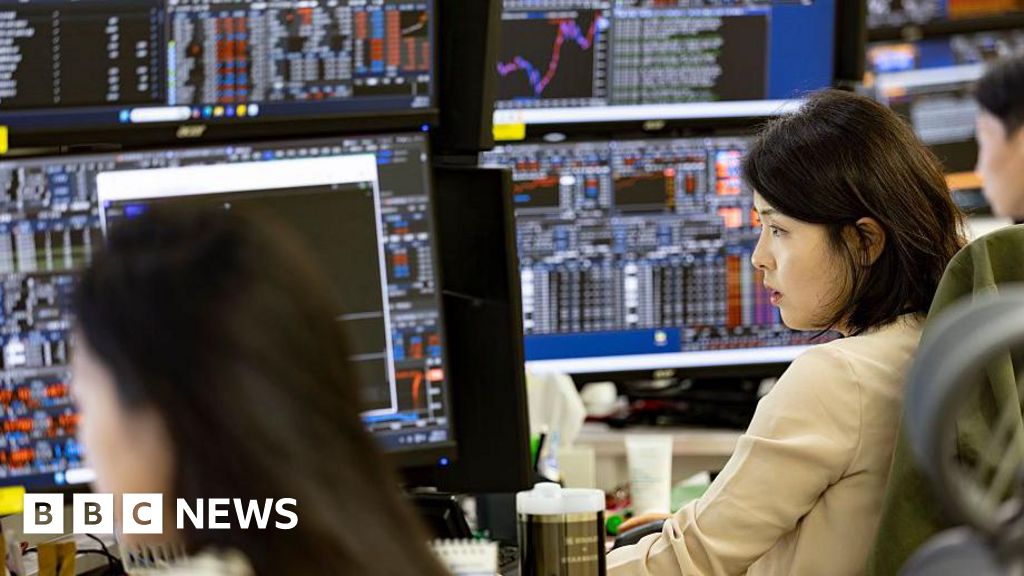
Asian stock markets hit by tech stock plunge
South Korea's stock exchange was forced to halt trading for 20 minutes after the Kospi index fell nearly 9% within minutes of opening on Monday. This is part of a circuit breaker mechanism designed to prevent panic selling, and it was activated for the third time this year. This was reported by Qazaqyia.kz citing BBC News.
Japan's Nikkei 225 index fell about 4.5% - the biggest drop in three months. Shares of major technology companies fell.
Oil price rise and Middle East tensions
Oil prices also rose on Monday, fueling inflation fears, after Iran and Israel exchanged strikes for the first time since a US-brokered truce in April.
Tehran warned that the attacks are the start of a full week of strikes and a response to the "repeated violation" of the April 17 truce. Israel later retaliated with strikes on military targets in Iran, despite calls from US President Donald Trump not to respond.
"We are very close to a final deal with Iran. It will be a good deal. I don't want it to be derailed by what is happening now," Trump told Axios.
Tech sector slump
Tech stocks had risen significantly in recent weeks, but investors are "reassessing their positions" due to fears that investments in artificial intelligence may be overvalued, said Charu Chanana, chief investment strategist at Saxo.
Markets like the Kospi and Nikkei are particularly vulnerable to such shocks because their exchanges are dominated by tech stocks.
The decline followed a sharp drop on Wall Street on Friday, where a sell-off in tech stocks sent the Nasdaq down about 4% - its biggest drop in over a year.
Part of Friday's slump was driven by fears of US interest rate hikes due to unexpectedly low unemployment in April, as well as persistently high inflation linked to the war in the Middle East.
Situation in the South Korean market
Trading in South Korea resumed after the circuit breaker was triggered, with the Kospi index down about 7.9% by early afternoon. Shares of major South Korean tech companies, including chipmakers Samsung and SK Hynix, fell sharply.
South Korean President Lee Jae-myung said on Monday that the stock market is expected to be volatile, but he believes domestic stocks are "still somewhat undervalued."
Other Asian markets
Other Asian stock exchanges, such as the Hang Seng Index and Shanghai Composite, also fell on Monday. Taiwan's Taiex index also fell sharply after shares of semiconductor giant TSMC dropped 3%. The chipmaker is a key supplier to Nvidia, whose CEO Jensen Huang said the recent tech stock decline represents a buying opportunity for investors.
Oil price rise
The benchmark Brent crude oil price rose 4.6% to $97.34 a barrel in Asia on Monday, while US-traded oil rose 4.3% to $94.40 after the exchange of strikes between Iran and Israel.
It is too early to say whether the strikes mean a full escalation of the war, but traders are again assessing risks to global oil markets, said Jiajia Yang, an associate professor at James Cook University.
Oil prices have surged since the US and Israel struck Iran on February 28, and continued to swing wildly during the subsequent truce. The war has disrupted the flow of oil and gas from the Persian Gulf, as Iran has threatened to strike vessels trying to cross the critical trade route of the Strait of Hormuz in response to US-Israeli attacks.